Introduction: From Download to Due Diligence in International Domain Prospecting
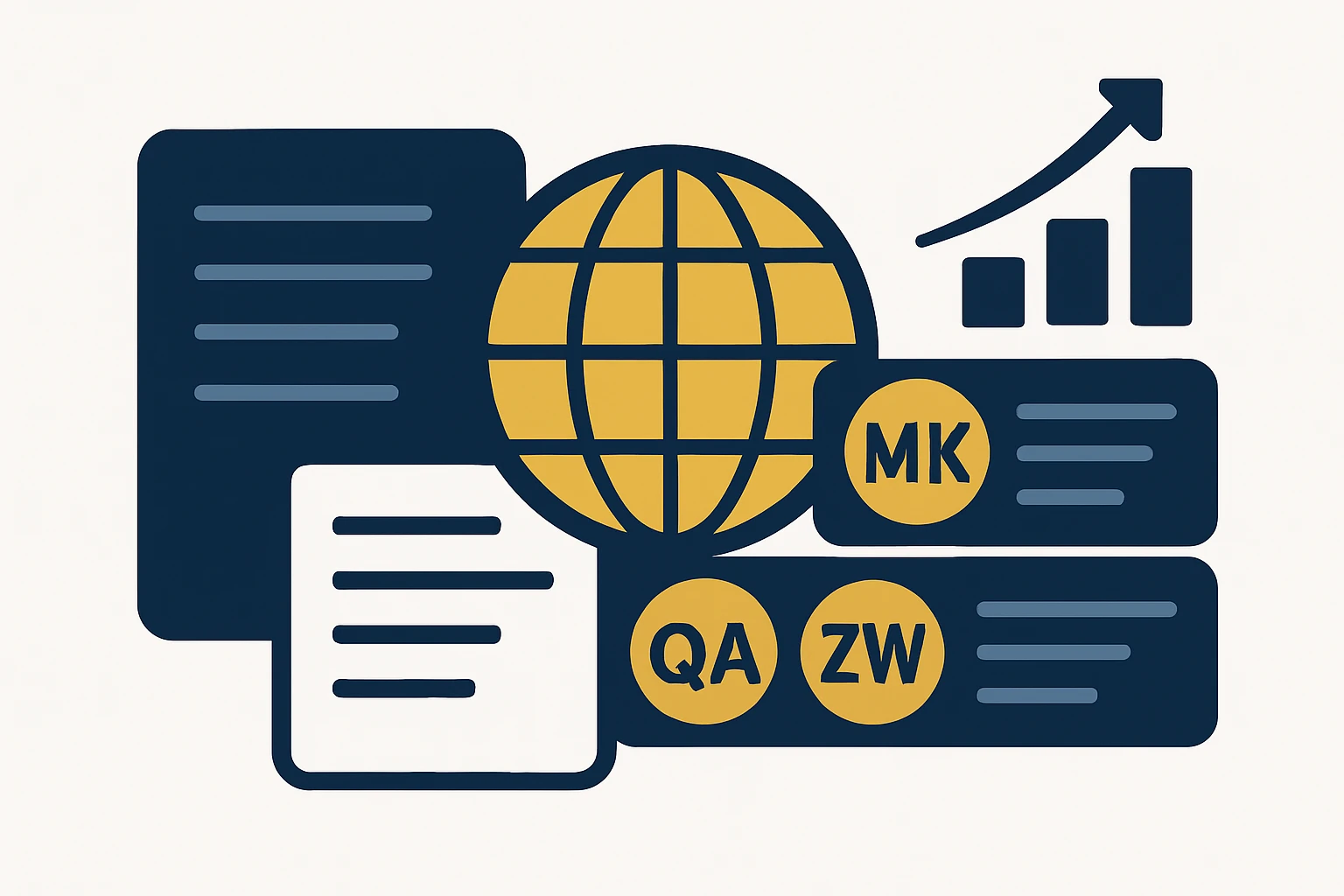
Global brands increasingly treat digital real estate as a strategic asset, not a tactical add-on. Country-code top-level domains (ccTLDs) carry local trust signals and geo-targeting advantages that can either amplify or undermine a brand’s international strategy. A raw download of country-specific website lists - such as MK (North Macedonia), QA (Qatar), and ZW (Zimbabwe) - is a sensible starting point, but it is only the first step in a rigorous, confidential domain prospecting process. Without validation, enrichment, and a disciplined evaluation, those lists risk becoming noise rather than signal.
Industry data shows that the domain namespace continues to expand, underscoring both opportunity and complexity for brand owners and premium brokers. Verisign’s Domain Name Industry Brief tracks hundreds of millions of registrations worldwide, with ccTLDs contributing a meaningful share. As of mid-2025, global domain registrations were well into the 360–370 million range, reflecting ongoing demand for both generic and country-code domains. This backdrop makes a disciplined approach to country-specific lists not just useful, but essential for brand protection and strategic acquisitions. (verisign.com)
governance of ccTLDs is handled through a global framework coordinated by ICANN, with the Country Code Names Supporting Organization (ccNSO) serving as the platform for ccTLD managers to collaborate on policy and operational issues. For brand owners, understanding this structure helps frame what an acquired ccTLD can and cannot do in terms of sovereignty, data privacy, and local governance. (icann.org)
Why Country-Specific Prospecting Matters for Brands
Country-specific domains exist at the intersection of local search, brand recognition, and digital risk management. In markets like North Macedonia, Qatar, and Zimbabwe, local domains often serve as credible storefronts, protection against cybersquatting, and targeted customer touchpoints. While global strategies remain important, a portfolio that covers key geographies can deliver incremental value through local trust, improved SEO signals, and reduced cross-border confusion for customers. Recent scholarship and industry analyses emphasize that domain value stems not only from keywords but also from branding potential, navigational integrity, and historical presence. An effective international domain strategy blends ccTLD coverage with a lighter-touch gTLD backbone to avoid overextending resources. (mdpi-res.com)
From a governance perspective, ccTLDs operate under national registries with varying policies. That nuance matters when you consider acquisitions or leases of country domains as part of a broader brand protection strategy. An informed approach considers both the opportunity set and the constraints of local regulation and governance. (icann.org)
How to Validate and Enrich Downloaded Country Lists: A Practical Playbook
Downloaded country lists are most valuable when they are cleaned, enriched, and validated. The process below helps convert a static spreadsheet into a dynamic, decision-ready prospect pool.
- Assess data freshness and scope. Country lists should be evaluated for their collection date and completeness. Outdated data can mislead investment estimates and risk misalignment with current market conditions. Cross-check against the latest public registries and local market insights where possible.
- Filter out irrelevant entries. Not every domain in a country list is a good target. Exclude obvious non-business sites (personal blogs with no commercial intent, phishing domains, or obvious non-monetizable properties) and flag high-volume parking domains that may not carry real-brand value.
- Enrich with domain fundamentals. For each candidate, pull apples-to-apples metrics: domain age, backlink profile, site authority, traffic patterns, and cross-border brand relevance. Older domains with clean backlinks can offer a foundation for quick SEO wins, however, age should be weighed against current relevance and ongoing development potential. This enrichment is foundational for disciplined evaluation. (mdpi-res.com)
- Verify ownership and transactional-readiness. Use RDAP and WHOIS data to confirm registrant identity where permissible, and assess whether the domain is held privately or by an intermediary. For confidential domain acquisition work, this step underpins risk management and transaction certainty. The client’s RDAP & WHOIS database resources provide tools to support this due diligence. (verisign.com)
- Assess governance and local considerations. ccTLD ownership often implicates local registries and regulatory constraints. In practice, evaluating governance risk helps determine whether a domain can be used as a standalone brand asset or requires a broader portfolio approach. (icann.org)
A Structured Framework: From List to Strategic Prospects
To translate downloaded lists into actionable opportunities, adopt a lightweight, repeatable framework. The four-step process below balances editorial rigor with commercial practicality - and aligns with the needs of brand owners, corporate strategists, and premium brokers.
- 1) Verify & enrich – Normalize data, confirm currency, and append domain-asset indicators (age, backlinks, traffic, brandability).
- 2) Segment by strategic value – Classify domains by potential brand impact, market relevance, and risk exposure. Create tiers (e.g., mission-critical, growth-ready, cautionary).
- 3) Plan confidential outreach – Develop a discreet, timeline-based plan for outreach, negotiation, and, if desired, acquisition, with an emphasis on privacy and compliance.
- 4) Integrate into a broader portfolio – Map acquired assets into a brand-protection and digital-asset strategy, ensuring alignment with long-term brand architecture and cross-border execution plans.
Expert insight: In practice, seasoned brokers emphasize that the most valuable deals emerge when diligence uncovers actionable signals - clear ownership, legitimate commercial intent, and a domain’s alignment with a brand’s long-term vision - rather than chasing high-volume but low-signal opportunities. A disciplined, signal-driven approach reduces operational risk and accelerates time-to-value.
Limitations, Trade-offs, and Common Mistakes
Every approach to country-domain prospecting carries trade-offs. Below are the most common missteps and how to avoid them:
- Over-reliance on raw lists. Lists can include parked domains, low-value assets, or misleading entries. Enrichment and due diligence are essential to separate signal from noise. (See the validation steps under the validation framework.)
- Ignoring local governance. ccTLDs are governed by national registries with country-specific policies. Failing to account for regulatory constraints can derail a potential acquisition later in the process. (icann.org)
- Underestimating data freshness. Data stale-mates market realities, especially in dynamic geographies. Regular refreshes are necessary to keep the prospect pool relevant. (verisign.com)
- Mispricing due to incomplete valuation. Domain value derives from more than age or keywords, branding potential, category fit, and navigational intent matter as well. A balanced valuation approach reduces overpayment risk. (mdpi-res.com)
Integrating the Client Perspective: How We Turn Lists into Brand-Ready Portfolios
For premium brokers and brand guardians, the goal is to turn data into defensible strategic choices. The client’s ecosystem - featuring country-specific domain directories and TLD inventories - offers a complementary resource to validate and operationalize the list-to-portfolio workflow. See webatla’s country and TLD directories as practical reference points for contextual understanding and data validation, including the lists of domains by Countries and by TLDs. webatla: List of domains by Countries and webatla: List of domains by TLDs. For due-diligence tooling, the RDAP & WHOIS database can further streamline ownership verification. RDAP & WHOIS Database.
In practice, we see a typical flow: (1) extract MK/QA/ZW candidates from downloadable lists, (2) enrich with age, backlinks, and traffic signals, (3) filter to a manageable handful of high-potential assets, and (4) engage in confidential negotiation and portfolio integration. This approach aligns with the broader domain strategy framework that emphasizes disciplined, signal-driven investment over indiscriminate purchasing. For brands pursuing international growth, a well-constructed ccTLD footprint can be a meaningful differentiator while maintaining careful governance and risk controls. (icann.org)
Conclusion: A Fresh, Practical Path to Strategic Domain Ownership
Country-specific domain prospecting - when grounded in validated data, rigorous enrichment, and a disciplined framework - offers a practical, high-signal path to strengthen international brand protection and unlock premium acquisition opportunities. The three-country lens (MK, QA, ZW) illustrates a repeatable blueprint: start with a downloaded list, validate ownership and relevance, enrich with domain fundamentals, and integrate assets into a coherent digital-asset strategy. As ccTLD governance and the global domain market evolve, maintaining an adaptive process - supported by credible industry data and robust due-diligence tools - will continue to yield durable brand value in a crowded, fast-moving namespace. For practitioners seeking a principled, confidential approach to premium domain brokerage, the framework outlined here provides both guardrails and actionable steps that scale across geographies and markets.