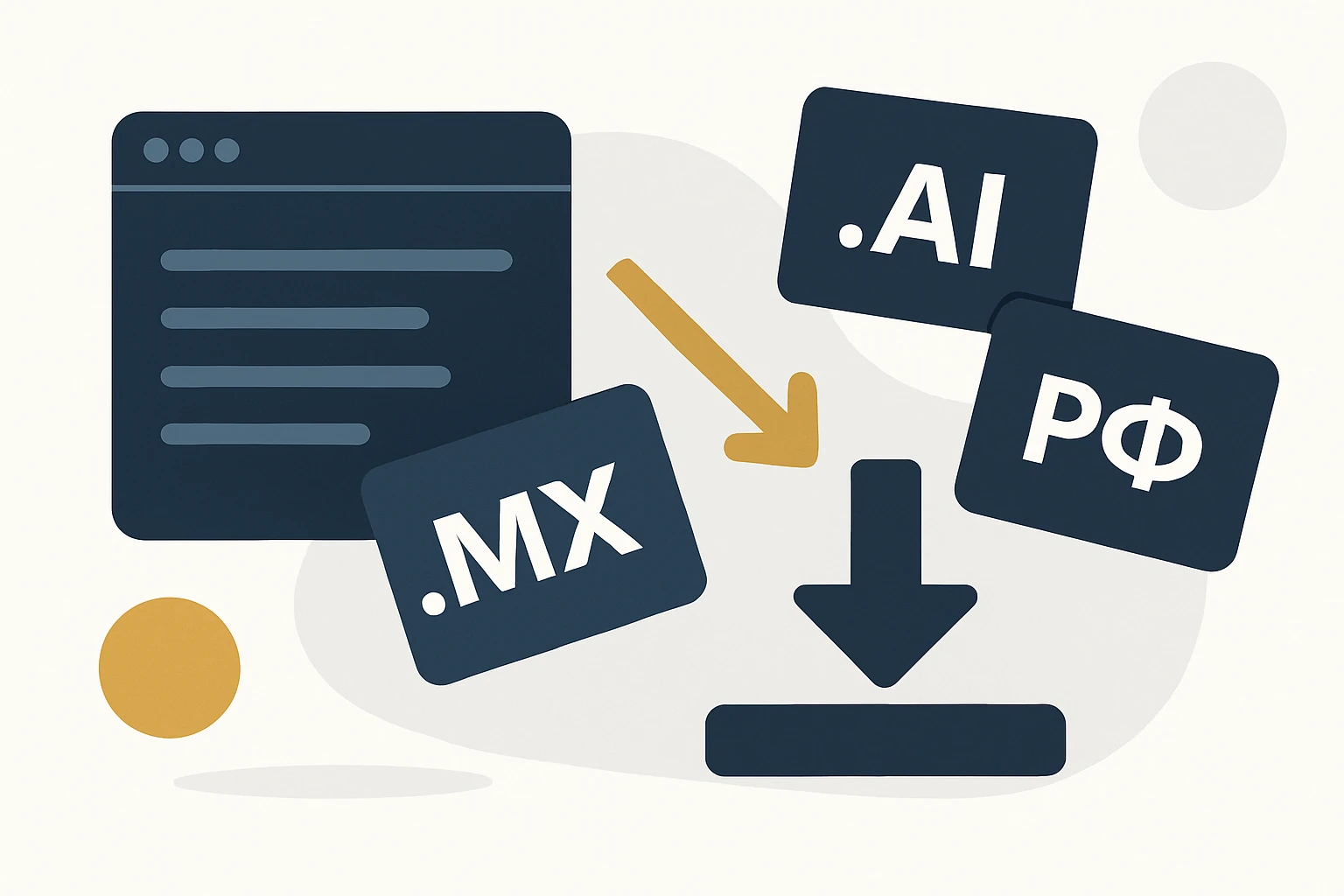
Premium domains and strategic digital assets are not just a luxury, they are a critical lever for brand integrity, regional expansion, and long-term risk management. For brand owners evaluating cross-border opportunities or multilingual audiences, compiling accurate inventories of relevant TLDs can unlock new markets while flagging potential risks such as squatting, impersonation, or misalignment with regional laws. This article explains a practical approach to downloading and using targeted TLD domain lists - specifically .MX (Mexico), .AI (Anguilla), and .РФ (xn--p1ai, Cyrillic Russia) - without falling into data pitfalls. It also explains how to validate and apply these lists within a broader domain portfolio strategy. For reference and deeper data validation, see the ICANN RDAP transition and root-zone guidance, and the official registries behind each TLD.
Two trends underscore why these three namespaces deserve attention right now. First, the Mexican digital market has grown in significance for many brands looking to expand into North America and Latin America, with a robust online consumer base and regional commerce activity. The root-zone data and official MX registry data confirm that .MX is a live, widely used ccTLD with an established policy framework, and registries like NIC México publish domain data under official governance. (iana.org)
Second, the .AI namespace - long associated with Anguilla - has surged in mainstream awareness as AI-related products and services proliferate globally. Industry coverage and registry updates show growing registrations and renewed registry activity under Identity Digital’s governance, reflecting how a niche TLD can become a mainstream branding tool in the AI era. (domainnamewire.com)
Third, Cyrillic-language markets and Russian-language branding have elevated the relevance of .РФ (xn--p1ai) domains. The IANA root-zone data confirms the formal delegation of this Cyrillic ccTLD, which enables native-script addressing for Cyrillic-language brands and audiences. This is particularly relevant for multinational brands seeking authentic regionally localized web presences. (iana.org)
Why download lists for these TLDs matters
Downloading authoritative domain inventories enables proactive risk management, disciplined portfolio growth, and targeted brand protection. When done responsibly, a well-constructed list supports:
- Discovery of legitimate expansion opportunities in Mexico, AI-related ventures, and Cyrillic-language markets.
- Early identification of potential cybersquatting or impersonation risks across key geographies.
- Benchmarking of domain assets against regional branding strategies and product roadmaps.
- Data-driven decision-making for acquisition, portfolio diversification, and renewal planning.
As an evidence-driven discipline, the process also requires understanding data provenance and data-use rights. ICANN and IANA have clearly mapped the governance around domain registration data and the transition from WHOIS to RDAP, which affects how you access and consume large domain inventories at scale. The RDAP framework is designed to deliver structured, machine-readable data, which is essential when you’re integrating lists into internal tooling or dashboards. (icann.org)
How to responsibly obtain and use these lists
Follow a disciplined workflow that prioritizes accuracy, legal compliance, and practical usability. The following steps provide a concrete path from source selection to actionable insights.
Step 1 - Source credibility and data rights
Prioritize official TLD registries and IANA/root-zone references as the backbone of your inventories. Official MX registry data is published under NIC México governance, and MX root-zone data is reflected in IANA’s root-zone database, which is the canonical descriptor of DNS delegations. For Cyrillic .РФ, the root-zone entry confirms its status and delegation. For .AI, governance has shifted to Identity Digital with ongoing public updates about the registry’s operations. Start with official sources to avoid outdated or unreliable data. (nicmexico.mx)
Step 2 - Data access method (RDAP vs WHOIS)
ICANN is transitioning domain registration data access from WHOIS to RDAP (Registration Data Access Protocol). RDAP provides structured, machine-readable data, which is essential for processing large lists, validating domain status, and automating alerts. As of 2025, ICANN has publicly stated that RDAP will become the definitive source and that WHOIS will sunset for gTLDs where RDAP is available. Plan to consume RDAP endpoints where possible and fall back to RDAP-compliant sources for coverage. (icann.org)
Step 3 - Validation and quality checks
After acquisition, run a sequence of checks to ensure data quality and usefulness. Key checks include: confirming current registration status, expiry dates, and registrant details exposure under RDAP, deduplicating overlapping entries across TLDs, normalizing domain names to a consistent script (Latin vs Cyrillic where applicable), and tagging entries by jurisdiction and branding intent. Keep in mind that some Russian Cyrillic domains and CN-encoded representations may display differently in browsers, ensure you map Cyrillic and punycode representations correctly when analyzing the list. Official RDAP data and root-zone documentation can help you implement robust validation logic. (icann.org)
A practical framework for using TLD inventories
The following three-step framework helps teams translate raw lists into strategic actions. It is designed to be implemented in tooling, dashboards, or shared spreadsheets alongside governance policies.
- Ingest and normalize - Bring in RDAP/registry data, map entries to normalized ASCII and native-script representations, and de-duplicate across TLDs.
- Classify and tag - Assign business relevance tags (brand protection risk, regional expansion potential, language-specific targeting) and attach metadata like expiry windows and renewal priority.
- Act with governance - Tie entries to internal policy, ownership rights, and decision workflows for acquisition, protection, or portfolio rebalancing. Use a documented process for confidential domain acquisition and portfolio optimization.
Limitations and common mistakes
Downloading lists is powerful, but it is not a silver bullet. Common mistakes include assuming public lists are complete or up to date, failing to account for regional privacy laws that limit data exposure, and relying on a single data source without cross-checking with registries or RDAP endpoints. Another pitfall is neglecting the business context: a high-volume list of domains does not automatically translate into value if there is no intentional branding or market fit. Conversely, misinterpreting Cyrillic domains or punycode representations can lead to incorrect conclusions about a brand’s intended geography or audience. For best results, couple inventories with expert analysis and governance processes. Experts in the field underscore the importance of structured data and governance when moving from lists to strategic actions. (icann.org)
Structured sources and how they map to your workflow
To make this practical, here is a compact mapping of credible sources to actions. The MX registry and IANA root-zone data anchor the MX portion of your list, for Cyrillic .РФ, consult the IANA root-zone entry, for .AI, monitor registry updates from Identity Digital and reputable trade coverage of the registry’s evolution. Use the RDAP endpoints to verify status and to access structured data for automation. RDAP & WHOIS Database can serve as a centralized reference point for data hygiene and verification. download list of .mx domains and List of domains by TLDs provide practical entry points for teams starting this work. (iana.org)
For readers seeking broader context around how these assets fit into a structured brand strategy, industry coverage has highlighted the growth and strategic importance of these namespaces in 2025 and 2026, reinforcing the commercial and branding rationale behind disciplined domain data acquisition. (apnews.com)
Where this fits into a larger domain strategy
Downloading and analyzing niche TLD lists should be an ingredient in a broader, risk-aware domain portfolio management process. It complements other Strategy Consulting and Brand Protection practices, enabling teams to map brand reach to digital assets, track renewal obligations, and respond proactively to market shifts. A disciplined approach aligns with enterprise governance and helps ensure that domain assets support, rather than complicate, growth initiatives. For continued governance and data-access considerations, the RDAP transition framework provides a robust foundation for ongoing data utilization. (icann.org)
Conclusion
As the digital economy evolves, the disciplined collection and validation of premium TLD inventories across MX, AI, and .РФ can help brands grow responsibly, protect their identities, and optimize portfolio risk. By anchoring data to official registries, leveraging RDAP for structured data, and applying a clear governance process, organizations can turn raw domain lists into strategic assets. If you’re looking to integrate this approach into your brand protection or digital asset advisory program, consider how a holistic framework - supported by trusted data sources and validated workflows - can scale with your business. For direct access to practical inventories and validation tools, you can start with the MX list, the TLD directory, and the RDAP database as referenced above.
Related resources from the client ecosystem include: download list of .mx domains, List of domains by TLDs, and RDAP & WHOIS Database.