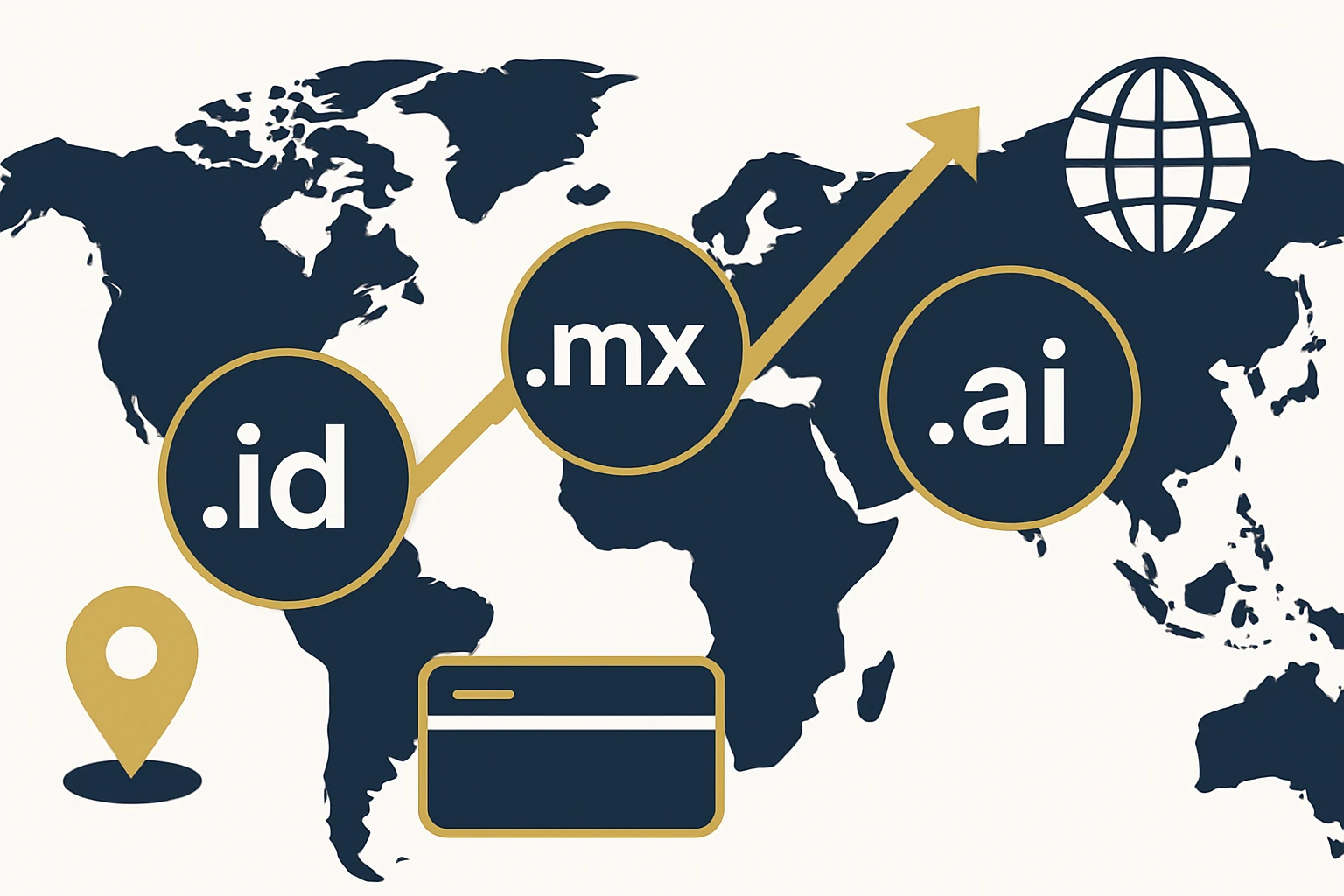
Premium domain portfolios are rarely - and shouldn’t be - built on a single namespace. For global brands, ccTLDs (country-code top-level domains) offer a powerful tool for localized trust, regional SEO signals, and protection against misappropriation. Yet ccTLDs also introduce governance, regulatory, and brand-reflection considerations that differ markedly from generic extensions. This article, grounded in the perspective of Vadiweb's editorial stance on premium domain brokerage and digital asset advisory, provides a practical framework for evaluating strategic opportunities in dynamic ccTLDs - specifically .id (Indonesia), .mx (Mexico), and .ai (Anguilla). It also shows how an integrated approach to domain portfolio management and brand protection can enhance both risk controls and growth potential.
To anchor the discussion, it’s crucial to understand who administers ccTLDs and why that matters for brands negotiating confidential acquisitions. ccTLDs are typically managed by a local registry authority or a designated operator, under policies coordinated with IANA. The policy framework and the role of national governments can influence eligibility, transfer, and ongoing stewardship - factors that directly affect the due diligence and governance you’ll require when evaluating ccTLDs for a premium portfolio. (itp.cdn.icann.org)
Why ccTLDs matter for brand strategy in 2026
ccTLDs have evolved from territorial identifiers to strategic assets in global branding. As ISO country codes map to two-letter strings used in ccTLDs, brand managers increasingly view these namespaces as authentic signals of local presence and jurisdictional legitimacy. A recent overview highlights how geo-gTLD branding relies on ISO standards and the governance environment surrounding ccTLDs, which in turn shapes the value and risk profile of investments in .id, .mx, and .ai. This dynamic is not purely marketing, it intersects with governance, policy, and regional market realities that affect where and how a brand should grow. (dn.org)
From a governance perspective, ccTLD management is often highly localized, with governments acting as significant stakeholders. ICANN’s resources for ccTLD managers explain that delegation and transfer decisions involve IANA, local governments, and other stakeholders, underscoring why a disciplined, jurisdiction-aware approach matters when you’re acquiring or holding ccTLD assets. This local nuance can be a strategic advantage - when navigated properly - by brands seeking to localize experiences, content, and search signals without compromising global governance standards. (icann.org)
Geographic branding is increasingly a strategic imperative as search engines and users increasingly expect local relevance. Geo-branding theory suggests that maps, city or region naming, and country-specific identity signals can influence user trust and engagement, particularly when the brand operates in multiple markets. This has real implications for ccTLD decisions, for example, geo-gTLD innovations have shown that branding around location-based strings often requires careful alignment with government and municipal partners to avoid regulatory friction and to establish credibility. (dn.org)
Expert insight: when brands consider ccTLDs as part of a premium portfolio, two realities emerge. First, ccTLDs can provide local authority with lower risk of trademark confusion in a region, but they demand disciplined governance - policies, renewal, and security measures must be robust to avoid complications in transfer or operational continuity. Second, the legitimacy of a ccTLD often depends on its alignment with local content, compliance standards, and stakeholder buy-in, not merely on the two-letter code itself. ICANN’s ccTLD guidance reinforces this principle by emphasizing the local nature of ccTLD management and the need for governance that serves the public interest. (itp.cdn.icann.org)
A practical framework for evaluating .id, .mx, and .ai domains
Evaluating ccTLD opportunities requires a structured approach that balances market opportunity, brand protection, and governance risk. The following framework offers a practical path from objective setting to portfolio governance, with examples anchored in .id, .mx, and .ai. The framework also accommodates a broader set of ccTLDs you may encounter in a mature premium portfolio.
-
Step 1 - Define objectives and targeting scope
- Clarify whether the ccTLD is intended for regional market localization, international brand signaling, or a combination of both.
- Align ccTLD choices with your broader premium-domain-strategy and international-brand-portfolio objectives.
-
Step 2 - Screen candidate namespaces for market fit
- Indonesia (.id): Indonesia’s internet population is among the world’s largest, with a high and rising online presence. APJII’s data show hundreds of millions online and strong year-over-year growth in 2024–2025, underscoring Indonesia’s growing digital economy. This creates local opportunity for brands seeking Indonesia-centric domains or regional branding. (apjii.or.id)
- Mexico (.mx): The .mx registry (NIC México) governs the domain, with a robust ecosystem around Mexican-market registrations and registrars. For brands targeting Mexico, .mx can offer local relevance and clear geotargeting signals. (beta.dominios.nic.mx)
- Anguilla (.ai): Although a ccTLD for Anguilla, .ai has become globally popular due to the AI boom, attracting registrations from AI-focused brands and startups. The registry and recent partnerships demonstrate how .ai has evolved from a country-specific namespace into a global branding asset, particularly for technology and AI firms. (nic.ai)
-
Step 3 - Assess governance, risk, and trademark considerations
- Understand the local governance model. ICANN’s ccTLD guidance emphasizes that delegation and management are highly local processes that require coordination among IANA, the government, and the ccTLD manager. This matters for due diligence, transfers, and ongoing governance, especially if you plan confidential acquisitions or portfolio expansion across regions. (itp.cdn.icann.org)
- Evaluate trademark and IP risk with established frameworks. WIPO and ICANN’s dispute-resolution levers (UDRP) are central to protecting a premium portfolio when acquiring or using ccTLDs. Plan for potential disputes and ensure you have a robust clearance and enforcement strategy. (wipo.int)
-
Step 4 - Pro forma value and integration plan
- Estimate local-market ROI, content localization requirements, and SEO implications. Geo-branding considerations imply you should pair ccTLDs with region-specific content, metadata, and local marketing collaborations to maximize impact. See how geo-gTLD branding is framed in practitioner literature and policy discussions. (dn.org)
- Define an integration plan that includes renewal governance, security controls (e.g., registry locks, DNSSEC), and a clear decision path for portfolio governance. ICANN and WIPO emphasize governance, risk, and dispute-resolution pathways that inform a practical lifecycle for ccTLDs. (icann.org)
Tip: For teams conducting market screening, practical screening can include downloading lists of candidate domains. The following long-tail search prompts can help with initial yield analyses: download list of .id domains, download list of .mx domains, and download list of .ai domains. These phrases reflect common research patterns when sizing a ccTLD opportunity as part of a broader, brand-centered acquisition workflow.
When you’re ready to explore concrete candidates, consider the webatla TLD catalog as a starting point to view and compare ccTLDs at scale: webatla TLD: .id and the broader webatla TLD directory. If you’re evaluating options for a confidential, multi-market domain strategy, you can also review the pricing and engagement options at webatla pricing.
A structured block: a concise ccTLD evaluation framework
The following framework distills the evaluation into a repeatable, decision-friendly snapshot you can apply across any ccTLD, including .id, .mx, and .ai. It is designed to be used by brand leaders, legal and IP teams, and premium-domain brokers working in concert with a digital asset advisory function.
- 1) Strategic fit assessment
- Does the ccTLD align with regional expansion plans or protect regional market share?
- Can it support a differentiated brand narrative in targeted markets?
- 2) Governance and risk review
- Who is the ccTLD manager and what is the local policy environment?
- What are the transfer, renewal, and dispute-resolution procedures?
- 3) IP and regulatory due diligence
- What trademark exposure could a ccTLD trigger under UDRP-like frameworks?
- Are there policy or content restrictions that could impair brand use?
- 4) Portfolio integration plan
- What is the roadmap for content localization and SEO harmonization?
- What governance, security, and renewal processes are required to protect the asset long-term?
Limitations, trade-offs, and common mistakes
Every ccTLD brings opportunity, but also constraints. A common misstep is assuming a two-letter code automatically confers global SEO value without regard to regional search behavior, content strategy, or government policy. Geo-branding is most effective when the ccTLD is accompanied by region-specific content and a governance framework that ensures stability and compliance. In contrast, a ccTLD that lacks local legitimacy or robust management can become a liability rather than a growth lever. This is precisely why governance, registry partnerships, and IP diligence are essential in any premium-domain program. WIPO’s overview of domain disputes emphasizes that brand protection requires thoughtful defensive registrations, clear legitimate use, and a readiness to engage dispute-resolution when necessary. (wipo.int)
Limitation example: while .ai has unlocked enormous branding energy around AI, the namespace is regulated by Anguilla’s registry and has evolved through partnerships with global registries. A strategy that relies solely on a trending string without aligning with long-term governance and pricing considerations may face abrupt changes in policy or pricing that affect total-cost-of-ownership and renewal planning. A recent industry update notes the governance and market dynamics around .ai in the wake of AI-market surges, including registry partnerships and regulatory considerations. (nic.ai)
Real-world considerations: a few practical notes
1) Local legitimacy can drive regional performance. In markets like Indonesia and Mexico, ccTLD adoption correlates with growth in local e-commerce and digital services. APJII and regional market analyses document the expanding online populations, which underpins the relevance of ccTLD-driven strategies for brands operating in those territories. (apjii.or.id)
2) Trademark diligence remains essential. UDRP and WIPO guidance remain a cornerstone of defensible domain ownership. Any ccTLD acquisition plan should include a robust trademark clearance, use-case clarity, and a pre-signed plan for dispute resolution if necessary. (wipo.int)
3) It’s not only about the code. The branding value of a ccTLD is also about governance, infrastructure stability, and the opportunity to collaborate with local partners. ICANN’s ccTLD governance materials emphasize that the local context - policies, government involvement, and local internet community input - can be decisive for long-term portfolio health. (icann.org)
Conclusion
For brand portfolios aiming to balance local relevance with global ambitions, ccTLDs like .id, .mx, and .ai offer a compelling set of levers. When evaluated through a disciplined framework - anchored by governance understanding, IP diligence, and a pragmatic integration plan - ccTLDs can complement global gTLD strategies rather than conflict with them. The key is to view ccTLDs as functional assets with jurisdictional realities, not as mere two-letter curiosities. By aligning ccTLD choices with explicit objectives, engaging credible registries and governance bodies, and incorporating robust due diligence and dispute planning, premium domain portfolios can realize tangible value while maintaining rigorous risk controls.
Editors and brand teams can begin by surveying the webatla TLD directory to identify ccTLD opportunities in markets of strategic interest and by coordinating with a trusted premium-domain broker who has experience in confidential acquisition and portfolio governance. This approach, grounded in credible governance frameworks and market realities, can help ensure your domain assets support sustainable growth, not surprise costs or enforcement challenges.
Further reading and related resources can be found via the following mappings: webatla: .id namespace and webatla: TLD directory. For readers evaluating costs and engagement options for a structured ccTLD program, webatla pricing offers a practical starting point.