Introduction
Many brands begin with a global ambition when expanding into new markets, but the most durable international footprints blend global reach with local credibility. Country-code top-level domains (ccTLDs) offer an underutilized but powerful path to local relevance, trust, and search visibility. This article presents a practical, non-gimmicky approach to building a geo-targeted ccTLD portfolio focused on three strategically interesting codes: Vatican City (.va), Antigua and Barbuda (.ag), and Guyana (.gy). The goal is not to chase every market at once, but to design a deliberate portfolio that complements a multinational brand while preserving flexibility for future expansion. Importantly, the topic aligns with the publisher’s focus on premium domain strategy and brand protection, and it leverages current best practices in ccTLD evaluation and portfolio governance.
The evidence base for ccTLD value is nuanced. Studies and industry analyses show that ccTLDs can influence perceived local relevance and trust, and they can serve as credible signals of geographic and cultural alignment (a factor in consumer confidence and conversions in some markets). This is not universal, but in many scenarios a well-chosen ccTLD strategy amplifies a brand’s local resonance without sacrificing its global identity. (atom.com)
Understanding VA, AG, and GY: What Each ccTLD Signals for Branding
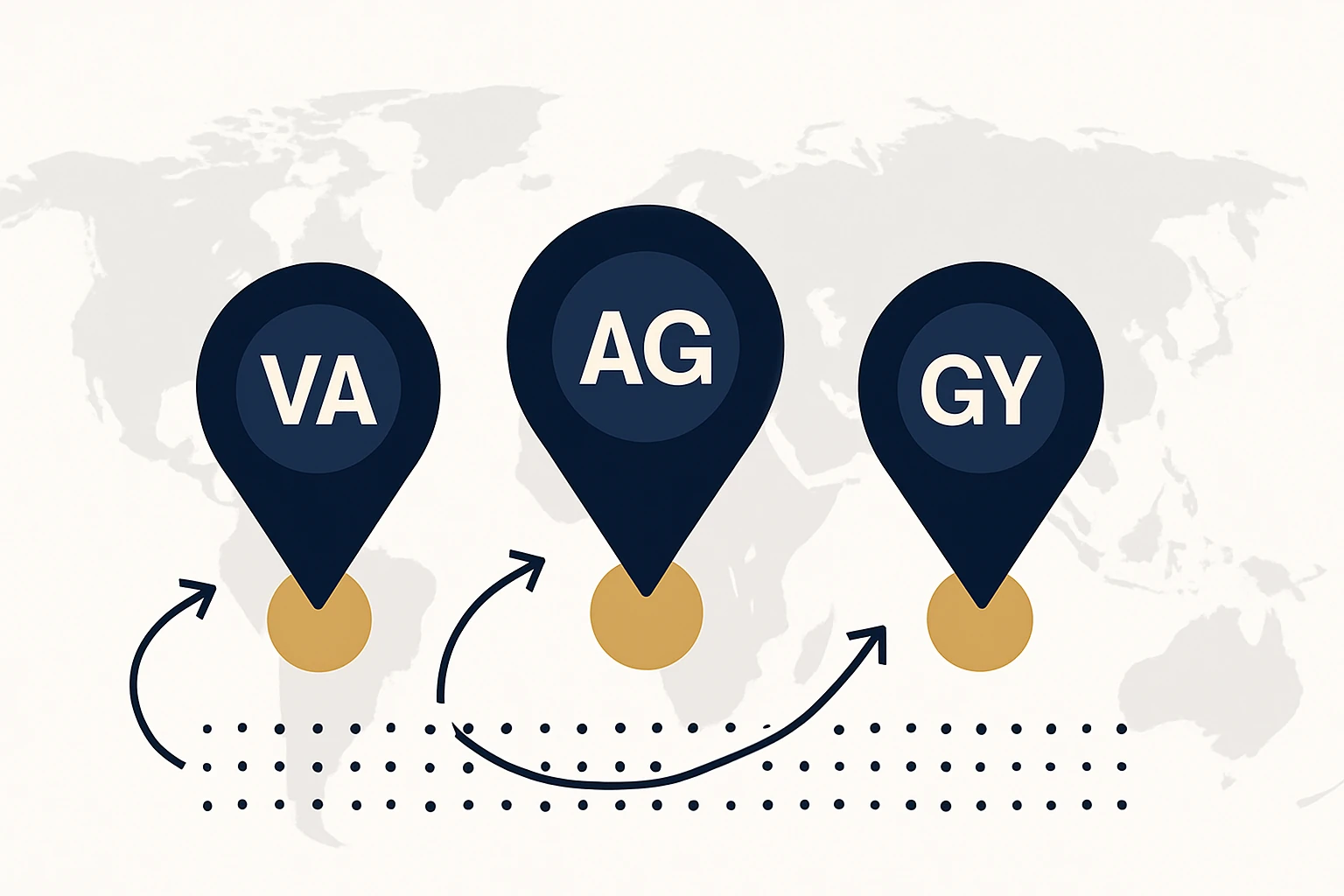
Each two-letter code maps to a specific country or territory and carries distinct branding implications. The Vatican City State uses the ccTLD .va, Antigua and Barbuda uses .ag, and Guyana uses .gy. These mappings are defined in IANA’s Root Zone Database, which maintains official delegation records for all ccTLDs. For these three codes, the registry and delegation records are active and current: .va is managed for Vatican City State, .ag for Antigua and Barbuda, and .gy for Guyana. (iana.org) (iana.org) (iana.org)
Strategically, the fit of each ccTLD depends on brand goals and regional positioning. In practice: - VA (.va) signals a footprint tied to Vatican City, which can be relevant for organizations engaging with religious institutions, diplomacy-adjacent services, or culturally attuned audiences with global attention to the Holy See. - AG (.ag) is a Caribbean code with historical resonance in the region and can serve brands seeking a tropical, hospitality, or luxury-connected identity, while also accommodating global use for certain markets. - GY (.gy) signals a South American/Caribbean nexus with growing digital infrastructure and regional appeal for technology, energy, or development-focused brands. The value comes not only from the URL itself but from how the domain complements a global strategy with localized trust.
From a governance standpoint, ccTLDs are often operated by national registries or local authorities and may have distinct renewal cycles, pricing, and regulatory considerations. Understanding who administers each code - and how disputes are handled - helps prevent later surprises when expanding or defending a portfolio. The official delegation records for .va, .ag, and .gy confirm the responsible registries and the two-letter designations that align with ISO 3166-1 alpha-2 codes. (iana.org)
A Practical Framework for Evaluating ccTLD Assets
Building a ccTLD portfolio that lasts requires a disciplined evaluation framework. The following six criteria offer a clear, decision-oriented approach you can apply to VA, AG, and GY - and to other ccTLDs as your portfolio matures.
- Market relevance and brand fit: Does the ccTLD align with a meaningful regional or audience-specific strategy? For example, .gy may pair well with initiatives in Guyana or neighboring markets, while .va could be leveraged for diplomacy or faith-oriented branding.
- Local trust and credibility signals: If a target market values local presence, a country-specific extension may bolster credibility and conversions, particularly for localized landing pages or campaigns.
- Geographic SEO and targeting: ccTLDs can influence geotargeting in search results, supporting local campaigns with signal relevance.
- Availability and acquisition cost: The practical economics of acquiring premium VA, AG, or GY domains depend on market demand and competition, budget planning should anticipate potential premium pricing for highly desirable names.
- Legal and regulatory considerations: Understand trademark, UDPRP policies, and local registry rules that could affect use, transfer, or dispute resolution.
- Portfolio governance and overlap with global domains: Plan how ccTLDs complement existing gTLDs (for example, pairing .com with .va or .gy) to maintain brand consistency while avoiding internal competition between assets.
Internally, the portfolio approach should balance ambition with discipline. A good rule of thumb is to start with one strong country code that aligns with your near-term international strategy, then expand to adjacent or high-potential markets in a staged manner. This reduces risk and provides learning that informs subsequent acquisitions. The delegation records themselves remind us that ccTLDs are not generic assets, they are country-specific technologies with governance and policy contexts that matter for how you use them. (iana.org)
Operationalizing the Strategy: Source, Assess, and Acquire VA, AG, and GY Domains
Turning a concept into a working portfolio requires practical steps. The following sequence translates the framework into actionable tasks you can apply to the Vatican City (.va), Antigua and Barbuda (.ag), and Guyana (.gy) codes.
- Define a lightweight RFM view of each code: Assess the readiness of each code against your brand, audience, and product categories. Which markets are most time-sensitive? Which extensions could best support regional campaigns or landing pages?
- Audit existing assets and gaps: Inventory current domains across gTLDs and ccTLDs. Identify gaps where a .va, .ag, or .gy could provide a strategic advantage without overlapping with other domains you own.
- Evaluate acquisition feasibility: Consider the probability of obtaining premium names based on registry policies, broker activity, and market demand. Use credible registries and data sources to gauge price ranges and negotiation dynamics.
- Craft a negotiation playbook: Develop a documented approach for outreach, offers, and counteroffers. Ensure alignment with your privacy and confidentiality requirements, especially in high-value ccTLDs where disclosure sensitivity can matter.
- Plan integration with your global strategy: Map each ccTLD to a specific region or product line and ensure consistent branding across channels. Draft a modular landing-page plan so that localized content aligns with global messaging.
- Implement governance and risk controls: Create a lightweight policy for renewal monitoring, expiry risk, and potential disputes. Leverage a centralized dashboard to track assets and performance.
For the Vatican City code, registry governance is handled in the context of Holy See operations, which adds a layer of policy nuance to any acquisition plan. For Antigua and Barbuda, the NIC AG registry manages domain registrations, with a formal process for registrars and end users. For Guyana, the Registry.GY registry governs domain registrations and has embraced DNSSEC to increase security. These governance nuances should shape your risk assessment and renewal strategy. (iana.org)
Structured decision block: a practical 4-stage framework
Below is a compact framework you can apply in real time when evaluating candidate VA, AG, and GY domains. It helps teams converge on decisions quickly while preserving strategic intent.
- Discovery: enumerate business cases, potential campaigns, and regional needs tied to each code.
- Validation: verify domain availability, price ranges, and any regulatory considerations tied to the registries.
- Acquisition planning: set budget ranges, preferred negotiation levers, and a fallback list of secondary targets.
- Activation and governance: define landing-page templates, content localization, and renewal monitoring.
When you present this framework to stakeholders, you can illustrate how each asset contributes to the broader brand strategy and risk management plan. The result should be a portfolio that is coherent, flexible, and aligned with overall enterprise governance.
Downloading lists of Vatican City (VA), Antigua and Barbuda (AG), and Guyana (GY) websites
One practical way to inform domain decisions is to compile curated lists of relevant websites within each country’s ecosystem. The keyword set you provided - Download list of Vatican City (VA) websites, Download list of Antigua and Barbuda (AG) websites, Download list of Guyana (GY) websites - points to a data-driven approach for market inspection, partner outreach, and competitive benchmarking. In practice, this means leveraging official and credible data sources to assemble country-specific website inventories that can feed domain strategy and outreach playbooks.
For Vatican City (.va), Antigua and Barbuda (.ag), and Guyana (.gy), you can start with official delegation and registry resources to confirm country-code status and governance, then broaden to credible data providers for website lists. The official ccTLD delegation records confirm the responsible registries and the two-letter codes: - Vatican City State: .va (Holy See) - Registry and delegation data available via IANA. (iana.org) - Antigua and Barbuda: .ag - Registry data and delegation information available via IANA. (iana.org) - Guyana: .gy - Registry data and delegation information available via IANA. (iana.org)
Beyond official records, reputable industry sources discuss how ccTLDs can complement a global branding strategy, including guidance on the strategic use of ccTLDs for localization and trust signals. While the landscape evolves, a disciplined approach - grounded in governance, market fit, and risk considerations - remains essential. This is where a provider with a robust data and governance capability can help. For example, data-driven analyses emphasize the role of ccTLDs in localized branding and market-specific strategies, reinforcing that a well-constructed ccTLD portfolio can be a powerful asset in a multinational brand’s toolkit.
Limitations and Common Mistakes
A candid, publication-ready strategy must also acknowledge its limits. Here are the most common missteps when adding VA, AG, or GY domains to a brand portfolio, along with practical remedies:
- Mistake: Assuming all ccTLDs provide equal value. The impact of a ccTLD is highly context-dependent. Some markets respond strongly to local presence, while others see minimal benefit. Start with a defensible hypothesis and test with localized campaigns before expanding.
- Mistake: Overlapping with existing assets. Owning both a global gTLD and a ccTLD that covers the same region can create redundancy or cannibalization. Map assets to clear regional roles and keep governance lean.
- Mistake: Underestimating regulatory or registry nuances. Each registry has its own fees, renewal terms, and dispute processes. Build a ready checklist for compliance, renewal reminders, and potential disputes.
- Mistake: Inadequate localization planning. A ccTLD is not a license to ignore content localization. Local Landing Pages and culturally appropriate messaging are critical to realizing the signal from a ccTLD.
- Mistake: Failing to monitor brand risk. Even with a strong ccTLD portfolio, you must monitor for trademark disputes and cybersquatting in the target markets. A proactive risk management approach is essential.
These cautions align with the broader reality that ccTLDs are assets requiring ongoing governance, not one-off registrations. In that sense, a mature ccTLD program benefits from a governance framework that pairs regular audits with a clear escalation path and a disciplined renewal calendar.
Integration with the Client's Tools and Data
To turn this strategy into a practical workflow, consider integrating your ccTLD program with trusted data sources and governance tooling. The client’s ecosystem includes country- and TLD-level data and a comprehensive RDAP & WHOIS database that supports portfolio management, risk assessment, and confidentiality requirements. When evaluating or pursuing VA, AG, or GY domains, use a data-backed approach that combines official registry information with a structured negotiation playbook, anchored by a confidential acquisition protocol. For organizations seeking to expand their country-focused domain footprint, these tools help ensure decisions are data-driven and compliant.
Contextual integration with the client’s data suite can also support outreach strategies - identifying potential partners, local affiliates, or regional campaigns that would benefit from a targeted VA, AG, or GY presence. The combination of formal registry data and robust data services can yield a practical pathway for confidential, strategic acquisition where the potential return justifies the investment. If you’re exploring this path, consider connecting to the client’s country directories and RDAP/WID data services that streamline discovery and due diligence.
Conclusion: A Practical Path to Local Relevance with a Disciplined ccTLD Portfolio
In an era where brands compete for consumer trust across borders, a disciplined ccTLD portfolio offers a pragmatic route to local relevance without fragmenting global identity. VA, AG, and GY each carry distinct governance and market signals, but they also offer a coherent opportunity to align regional campaigns with a broader international strategy. A methodical approach - defined by market fit, governance awareness, and a clear expansion path - transforms ccTLDs from niche curiosities into durable assets that support brand protection, local SEO, and strategic growth.
For teams seeking practical, data-informed paths to build and manage these assets, several paths exist. You can begin by validating officially delegated codes and registries (as noted above) and then explore credible data sources for market intelligence and outreach. When it comes to acquisition, a transparent framework that emphasizes confidentiality and governance tends to yield better outcomes than a scattershot approach. And remember: a ccTLD strategy should be a complement, not a replacement, for a robust global domain portfolio. If you want to explore how to operationalize this within a broader brand strategy, webatla’s country-focused directory and related data services can be a productive starting point, while the RDAP & WHOIS Database supports due diligence and risk management.
Note on data sources and accuracy: official ccTLD delegation data for VA, AG, and GY is maintained by IANA/ICANN and confirms the responsible registries for these codes. See VA: va.html, AG: ag.html, GY: gy.html.