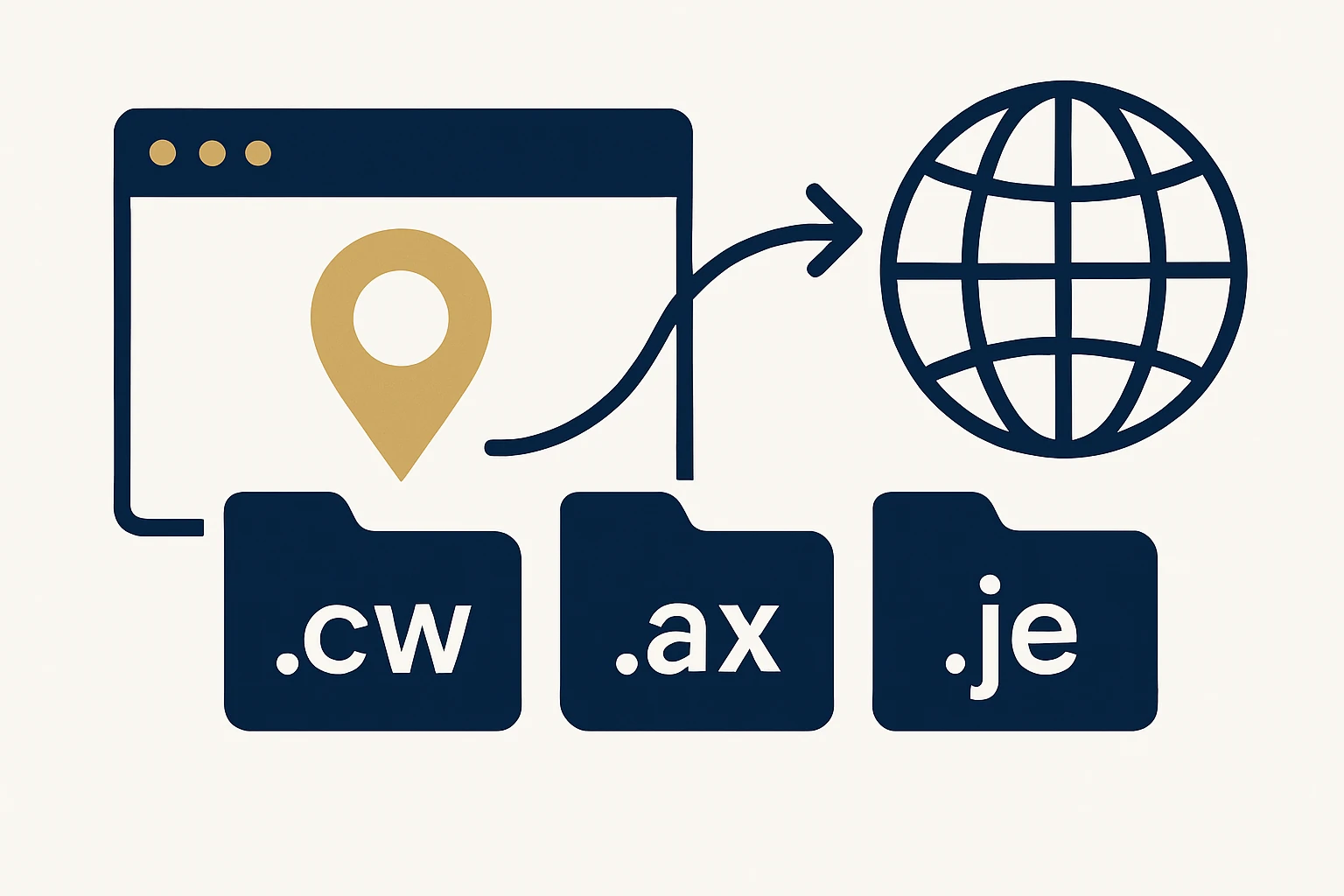
Problem at hand: global brands increasingly need a digital footprint that respects local markets without sacrificing global consistency. A deliberate, geo-aware approach to ccTLDs (country-code top-level domains) can build local trust, signal relevance to regional audiences, and strengthen brand protection across jurisdictions. But ccTLD strategy isn’t a free-for-all expansion, it requires alignment with brand objectives, regulatory realities, and governance best practices. This article outlines a practical framework for assembling a geo-targeted ccTLD portfolio, using Curaçao (.CW), Åland Islands (.AX), and Jersey (.JE) as concrete case studies, and shows how a purpose-built broker and advisory partner can help navigate the complexities.
Why ccTLDs matter today goes beyond simple geography. For many brands, a targeted set of ccTLDs can contribute to local credibility, improve navigation for regional visitors, and support differentiated regional campaigns. Research from industry analysts and governance bodies points to the value of consistent country-coded presence as part of a broader brand protection and internationalization strategy. In practice, many firms adopt a tiered approach to domain holdings, balancing primary global domains with carefully selected ccTLDs and other regional extensions. (domainnamenet.com)
Why ccTLDs matter in modern brand strategy
Local trust is a meaningful driver of user behavior. When a user lands on a country-specific domain, expectations about local relevance and language come into play, often boosting engagement and conversion relative to generic domains. This dynamic is widely discussed in brand protection and internationalization literature, which emphasizes strategic coverage of the most relevant ccTLDs alongside a defensible core portfolio. (domainnamenet.com)
Beyond trust, ccTLDs can support local SEO signals and map content to regional markets without eroding a brand’s global search footprint. A disciplined, data-driven approach - never simply “buy a bunch of domains” - helps ensure geographic relevance aligns with content, marketing intent, and technical readiness. In practice, brands often implement a tiered portfolio: core global domains, a core set of ccTLDs for priority markets, and additional domains to cover brand variants and security-conscious defenses. (domainnamenet.com)
From a governance perspective, ccTLDs are typically delegated to national or regional registries and operate under country-specific rules. This makes due diligence and ongoing monitoring essential parts of any ccTLD program. IANA maintains the root-zone data and lists for each ccTLD, which is a foundational resource for portfolio planning and compliance considerations. (iana.org)
CW, AX, and JE: case studies in regional domain strategy
Case studies help translate theory into practice. Here we summarize three ccTLDs that illustrate how local governance, regulatory requirements, and market fit shape portfolio decisions.
Curaçao (.CW)
The .CW domain represents Curaçao, and its delegation and operational governance have evolved with the island’s jurisdictional changes. The registry and registration landscape for .CW is managed locally, with Curaçao’s government-linked registry exercising administration. Notably, some registrations under .CW may involve local presence considerations, a common constraint among ccTLDs that aim to keep registrations aligned with local communities. For brand strategists, this means weighing the value of a local anchor against potential onboarding friction. The University of Curaçao registers and manages CW domain information, illustrating how local institutions participate in registry operations. (iana.org)
Practical takeaway: when considering CW as part of a portfolio, map the expected campaign geography against local eligibility rules, and plan for potential provisioning or contact verification steps. For organizations seeking to operationalize CW with a confidential, strategic lens, a partner approach that combines market insight with registry-savvy due diligence can be especially valuable.
Åland Islands (.AX)
The .AX ccTLD serves the Åland Islands, an autonomous Finnish region. Its operational status dates back to mid-2000s, and the registry is associated with regional governance (the Åland government). The IANA root-zone data confirms AX’s delegation, and ICANN announcements from the period highlight its operational transition as a dedicated country-code domain. For brands evaluating AX, these governance details help determine eligibility, renewal costs, and any locale-specific requirements. (iana.org)
Why AX matters for certain brands? It offers a local signal in Northern Europe and can complement broader Nordic or Baltic campaigns, especially where language localization and regional messaging drive engagement. As with other ccTLDs, AX decisions should be grounded in a clear local-market rationale, not mere ownership politics. (wipo.int)
Jersey (.JE)
JE is the ccTLD for Jersey, a Crown dependency with its own registry operator. Island Networks (the Jersey registry) manages JE, and IANA lists Jersey under its ccTLD delegation with the registry and registration services accessible to registrants through official channels. For brand strategy, JE can support regional presence in the Channel Islands and nearby markets, while also serving as a defensive anchor against brand impersonation in that locale. The IANA root-zone data confirms the Jersey delegation and registry operator, which helps shape due diligence and risk assessments for portfolio planning. (iana.org)
In practice, JE is often considered when a brand has a local footprint or channel strategy in the Channel Islands or adjacent markets. The decision to include JE should be guided by the same principles as other ccTLDs: alignment with brand goals, local presence considerations, and a robust governance plan to manage lifecycle and renewal. (iana.org)
A practical framework for building a geo-targeted ccTLD portfolio
Below is a pragmatic framework you can apply to decide which ccTLDs to include in a global brand portfolio, how to organize governance, and how to sequence acquisitions. It blends strategic intent with operational discipline, and it’s designed to be compatible with a confidentiality-first brokerage and advisory model.
- Define market relevance and role: Identify which markets truly require local presence signals and how ccTLDs will support regional campaigns, user trust, and conversions. Map each target market to a minimal viable ccTLD set that aligns with language, culture, and regulatory realities.
- Assess entry barriers and ongoing obligations: For CW and other ccTLDs with local-presence requirements, determine how you will satisfy eligibility, verification, or administrative needs, and plan for jurisdiction-specific renewal cycles, documentation, and privacy considerations. Use registry data and IANA root-zone delegation as anchors for feasibility. (en.wikipedia.org)
- Align with brand strategy and content localization: Ensure that any ccTLD investment is paired with localized content strategy, regional marketing goals, and clear ownership of a corresponding content pipeline. As with any multi-site strategy, the goal is to prevent dilution of global equity while maximizing regional relevance. (domainnamenet.com)
- Plan acquisition and governance: Build a procurement and governance plan that determines who can acquire, who holds legal ownership, and how changes in registries or local regulations are monitored. Consider a tiered approach - core global domains plus priority ccTLDs with defensive registrations around your core brand. (cscglobal.com)
- Institute monitoring and risk controls: Regularly review registrations for compliance, renewals, and potential impersonation risks. A disciplined monitoring program helps detect brand-risk signals across ccTLDs and new gTLDs alike. (domaindisputes.net)
To operationalize this framework, you’ll want reliable data sources and governance tools. The Internet Assigned Numbers Authority (IANA) maintains root-zone data for ccTLDs like CW, AX, and JE, which provides the official delegations and registry contexts you need for planning and due diligence. This data should be complemented by registry-specific pages and, where applicable, government or registry announcements. (iana.org)
Limitations, trade-offs, and common mistakes
Every ccTLD decision carries trade-offs. A few of the most common missteps to avoid include overextending a portfolio without a defensible local strategy, underestimating eligibility constraints, and assuming universal SEO lift from ccTLD registrations. The literature and practitioner guidance emphasize that ccTLDs should be selected to support specific markets and brand objectives, not solely for portfolio size. A measured approach - grounded in local market intelligence and governance constraints - yields the best long-term outcomes. (domainnamenet.com)
Conventional pitfalls in ccTLD strategy include neglecting local presence rules (which can impede registration or renewal) and treating ccTLDs as purely marketing tokens rather than assets requiring ongoing stewardship. For CW in particular, local-presence requirements can complicate acquisition and renewal workflows, so it is essential to model process steps and staffing needs up front. (en.wikipedia.org)
Moreover, the expectation of automatic SEO uplift from ccTLD incorporation should be tempered. Localized signals depend on a coherent ecosystem of content, hosting, and user experience. The literature and practitioner blogs consistently remind brand managers to couple ccTLD growth with local content strategies and technical readiness. (domainnamenet.com)
Data-driven research and ethical sourcing of ccTLD lists
For portfolio research, you may encounter queries like downloading lists of CW, AX, or JE websites. The most authoritative starting point is the IANA Root Zone Database, which catalogs ccTLD delegations in a standardized, official format. For CW (Curaçao), AX (Åland Islands), and JE (Jersey), the IANA root data confirms each TLD’s status and corresponding registry manager, providing a trustworthy basis for scoping and diligence. Learn more at the official IANA ccTLD delegation pages: CW, AX, and JE. (iana.org)
Beyond official root data, registries and registrars publish guidance on eligibility, pricing, and renewal. For example, CW is managed locally by Curaçao institutions with specific registry information, AX is tied to the Åland government, and JE is operated by Island Networks. When building a research workflow, consider combining IANA data with registry pages and reputable registrars to validate current rules and costs. (uoc.cw)
To support due diligence and day-to-day portfolio operations, consider modern RDAP and WHOIS resources. The client’s RDAP & WHOIS database, along with pricing and country-portfolio data pages, can complement public registry data by delivering near-term accuracy on registrations, ownership, and renewal timelines. For teams exploring confidential or semi-private acquisition options with a disciplined governance model, webatla offers practical resources such as RDAP & WHOIS Database and clear pricing structures at webatla pricing. You can also explore country-domain resources at webatla country-domain resources. (icann.org)
Conclusion: a disciplined path to geo-targeted ccTLD portfolios
Building a geo-targeted ccTLD portfolio is not about collecting more domains, it’s about aligning a defensible, locally resonant digital presence with brand strategy, governance discipline, and pragmatic risk management. CW, AX, and JE exemplify how different registries – with distinct local rules and governance models – can fit into a broader international branding plan when approached with a clear framework, diligence, and ongoing oversight. The strongest portfolios emerge when you pair decision quality with reliable data and trusted partners who can navigate registry constraints, local requirements, and privacy considerations. For brands seeking a confidential, strategic path to ccTLD deployment, partnering with an experienced advisor and broker can translate complex regulatory realities into a practical, value-driven plan.
To explore how a tailored ccTLD approach could fit your brand, consider engaging with a partner who can blend editorial rigor, market insight, and practical governance. For more information on practical options and service models, review webatla’s pricing, RDAP & WHOIS database resources, and country-domain lists as starting points.