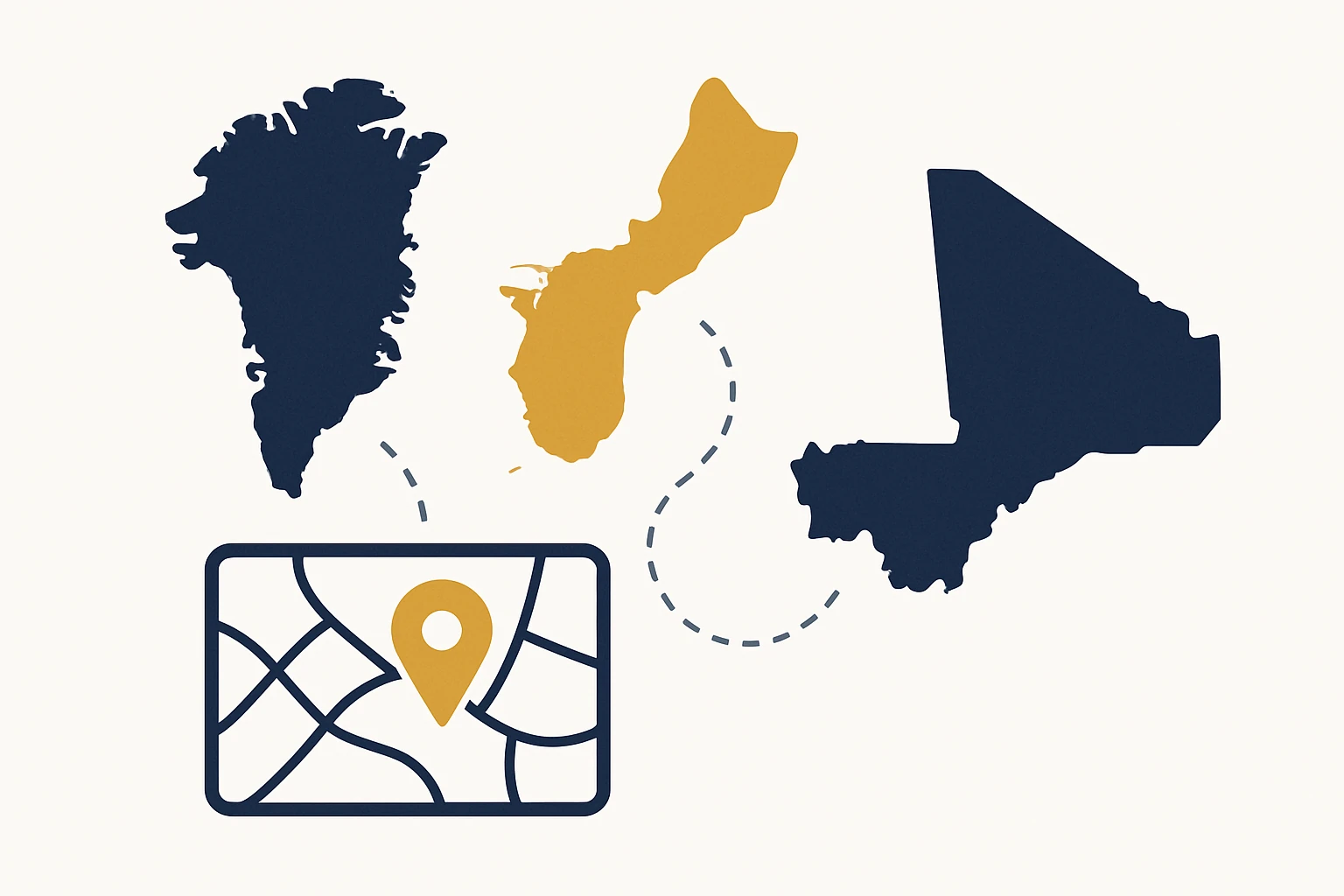
Brand teams increasingly rely on country-code top-level domains (ccTLDs) to signal local presence while enabling global brand expansion. The strategic use of ccTLDs can blur the line between geography and branding, turning extensions like .gl (Greenland), .gu (Guam), or .ml (Mali) into powerful brand signals rather than mere regional identifiers. Yet many organizations struggle to identify credible sources, validate opportunities, and manage portfolios with confidentiality. This article lays out a practical approach to building targeted domain portfolios for Greenland, Guam, and Mali that aligns with brand strategy, regulatory realities, and disciplined portfolio governance.
As a baseline, consider the broader industry view: country-code domains are increasingly perceived as branding assets that extend beyond geography, influencing perception, credibility, and liquidity in the aftermarket. A growing body of analysis argues that ccTLDs offer value not just because of local demand but also due to their semantic and cultural connotations in global branding. This shift is a core insight for any organization seeking to scale a domain portfolio with discipline. (dn.org)
Greening the portfolio begins with credible, country-specific infrastructure and governance. Greenland’s registry operates with its own practices and a registry-driven process, and registrants can verify status through official channels such as whois.nic.gl and the registry’s transfer mechanisms. Understanding these operational details helps reduce risk when evaluating opportunities in GL. For Greenland specifics, the registry information is publicly accessible and provides practical registration and transfer timelines. (nic.gl)
Why ccTLDs matter for brand strategy
ccTLDs are no longer strictly geographic markers. They can carry branding equities - perceived reliability, technical credibility, or regional affinity - that enhance a company’s narrative. The branding potential comes from three dimensions: speed of recognition, visual appeal in English- and non-English-speaking markets, and the implicit trust associated with a country’s governance and regulatory posture. In practice, this expands the addressable market for a brand name and can improve perception in digital channels, search, and paid media when used thoughtfully. (dn.org)
However, the value of a ccTLD is contingent on registry policies and practical access. Some extensions have more permissive registration rules than others, and residency or local presence requirements can affect feasibility. Prospective buyers should assess both branding potential and logistical constraints before committing to a portfolio. This is a core reason to pair branding analysis with registry due diligence. (iana.org)
A practical triple-country portfolio framework: Greenland, Guam, and Mali
Below is a concise, repeatable framework to identify, validate, acquire, and protect ccTLDs for Greenland (GL), Guam (GU), and Mali (ML). The approach balances editorial rigour with deal discipline and is designed to support confidential acquisitions when needed.
- Step 1 - Discover and validate opportunities: Begin with a structured discovery process that includes market signals, linguistics fit, and branding potential. For teams performing due diligence, it can be useful to search terms like "Download list of Greenland (GL) websites" or "Download list of Mali (ML) websites" as part of a broader market intel exercise, then validate candidates against brand strategy and domain metrics.
- Step 2 - Evaluate branding fit and liquidity: Assess each candidate for length, memorability, and compatibility with English- and non-English-speaking audiences. Consider how the extension’s perceived jurisdiction affects brand signals and long-term liquidity in the aftermarket. The literature on ccTLD branding supports treating these domains as brand assets rather than purely geographic identifiers. (dn.org)
- Step 3 - Confidential acquisition options: When pursuing premium or strategic assets, confidentiality is often essential. Work with a broker or advisory that can safeguard terms, transfers, and pricing while negotiating favorable conditions. The value proposition of confidential domain acquisitions is well established in industry practice. (dn.org)
- Step 4 - Protect and manage the portfolio: Implement registration controls, renewal alerts, and registrar governance to prevent leakage, inadvertent transfers, or mispricing. Ongoing management should include risk assessments, watchlists, and disciplined renewal cycles to preserve value over time.
Structured framework at a glance:
- Discover - market intel and keyword-driven scoping
- Validate - branding fit and liquidity assessment
- Acquire - confidential negotiation and transfer planning
- Protect - long-term governance and renewal discipline
Concrete steps to apply the framework to GL, GU, and ML
Greenland (.gl): Greenland’s registry and registration mechanics are publicly documented, and the registry maintains processes for domain status checks, renewals, and transfers. Understanding GL’s operational model helps reduce risk when evaluating GL candidates for branding and regional presence. Practically, you can verify status via the registry ecosystem and related WHOIS interfaces. (nic.gl)
Guam (.gu): The .gu domain is a recognized ccTLD and is integrated into global registration systems. While many registries publish their own guidelines, you should consult IANA/root-zone data and local registrar guidance to determine any project-specific requirements or restrictions that may affect feasibility at scale. This is a standard best-practice step in any ccTLD portfolio program. (iana.org)
Mali (.ml): Mali’s ML extension has seen renewed interest in global branding contexts. Registries and registrars in the ML space provide various registration pathways and pricing structures, and some providers describe ML as a flexible asset suitable for international branding. When evaluating ML domains, align acquisition goals with available registry tools and price models. (gandi.net)
Limitations, trade-offs, and common mistakes
Despite the allure of ccTLDs, there are notable limitations. First, not all ccTLDs offer global liquidity, some markets remain regional, and the “brand signal” value may be stronger domestically than internationally. Second, registry policies vary, and some extensions impose restrictions that complicate broad deployments. Third, the hype around short, generic-looking ccTLDs can outpace practical branding needs, longer or less conventional extensions may still offer compelling brand benefits if paired with disciplined strategy. The core takeaway is that ccTLD strategy should be grounded in a transparent framework and tested against real-world usage and transfer dynamics. (dn.org)
Common mistakes to avoid include over-reliance on a single extension as a universal solution, underestimating local regulatory and transfer complexities, and neglecting ongoing portfolio governance. The practical cure is to couple branding design with registry diligence and to implement a formal portfolio-management discipline.
Client integration: how to work with a premium domain brokerage and digital asset advisory
For organizations seeking a structured approach to confidential domain acquisition and portfolio management, working with a specialist can help translate strategy into action. In practice, a brokered engagement can provide access to curated lists, market intelligence, and a governance framework that preserves confidentiality while enabling scalable growth. To explore country-specific offerings and governance models, see webatla’s Greenland-focused page as an example of country-specific domain market intelligence and advisory services: webatla Greenland country page. For broader access to domain lists and pricing, you can review the company’s domain-portfolio resources and pricing models here: webatla pricing and to the RDAP & WHOIS database for technical due diligence: webatla RDAP & WHOIS.
In all cases, the client’s objective should be to balance editorial quality, brand protection, and market liquidity, treating the client’s assets as part of a broader digital asset advisory practice. The Greenland page above demonstrates how a dedicated country page can anchor a broader advisory framework.
Conclusion
As brands navigate an increasingly complex digital ecosystem, ccTLDs offer a disciplined path to expand branding reach while preserving control and confidentiality. Greenland, Guam, and Mali illustrate how country-specific domains can serve as strategic assets when paired with a rigorous discovery, validation, acquisition, and protection framework. By combining brand-signal insights with registry-aware diligence, organizations can build a localized yet globally resonant domain portfolio that supports long-term brand objectives, risk management, and portfolio liquidity.