
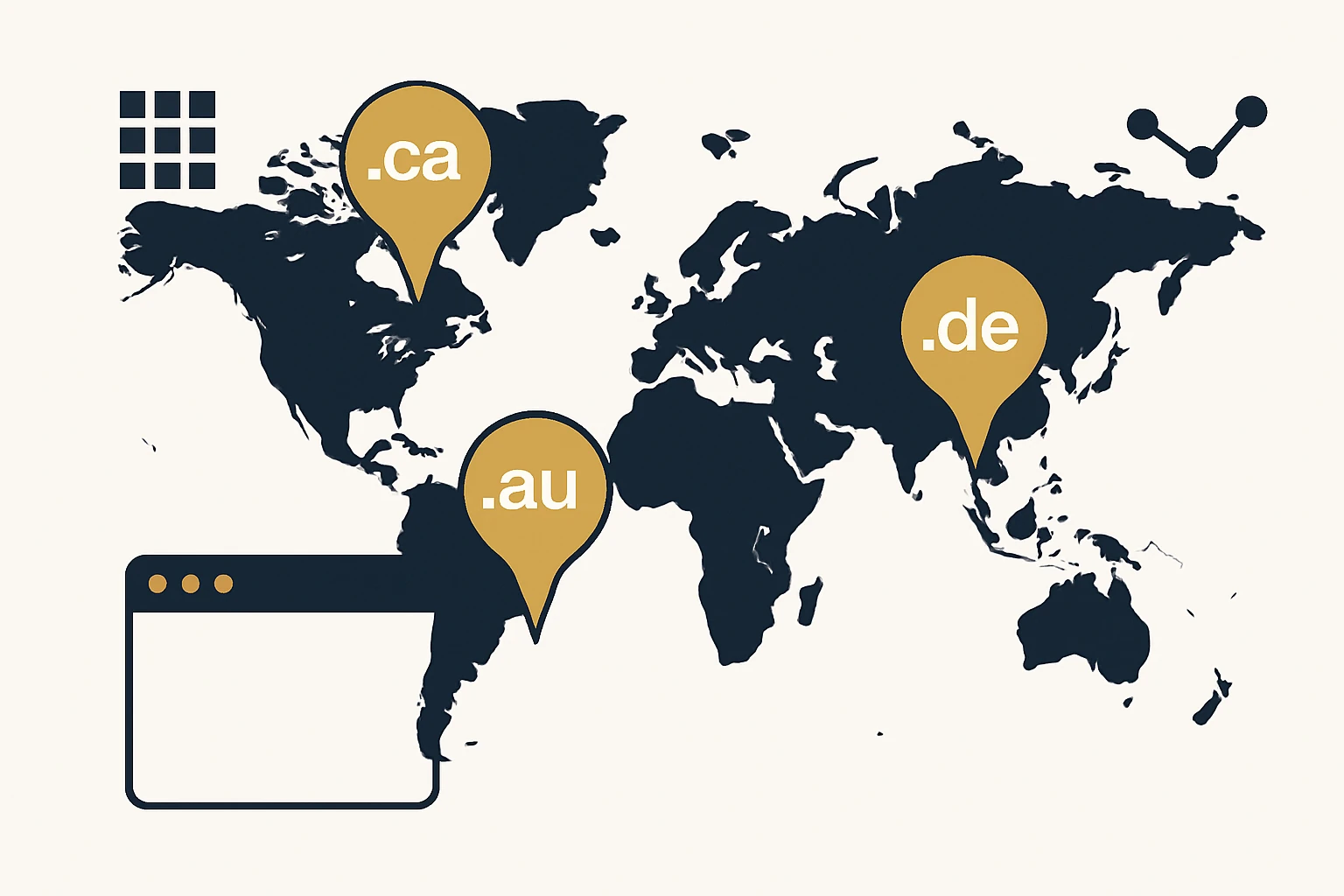
For global brands, the online address is more than a URL, it is a strategic asset that signals local relevance, protects brand equity, and enables country-specific customer journeys. Yet many firms treat domain names as an afterthought - buying a handful of generic domains and hoping for global impact. In practice, a disciplined approach to country-code top-level domains (ccTLDs) can dramatically improve local trust, search visibility, and guardrails against unauthorized use. This article outlines a practical framework for mapping websites by country, prioritizing ccTLD investments, and building a resilient, scalable portfolio that aligns with brand goals.
What ccTLDs are and why they matter for brands
Country-code top-level domains (ccTLDs) are the two-letter suffixes that represent individual countries or territories in the Domain Name System. They are typically delegated to local registries and governed under country-specific policies. The standard, and a practical starting point for any global brand, is that ccTLD strings are usually ISO 3166-1 alpha-2 codes, which provides a consistent mapping between a country and its online identity. This alignment with ISO codes is a core principle used by IANA when delegating ccTLDs. ICANN and IANA describe the delegation framework and the local governance model that underpins ccTLDs. Source .
Beyond local branding, ccTLDs can influence user perception and local SEO signals, especially when content is localized and search intent is geo-targeted. However, not all ccTLDs carry identical value for every market, some function primarily as local identity signals, while others gain brands’ traction beyond their geographic origin. The governance and operation of ccTLDs are typically handled by national registries, with registries collaborating with global bodies to maintain a stable DNS. IANA and CENTR provide deeper context on how ccTLDs are allocated and stewarded. Source .
From country code domains list to a global domain strategy
A practical ccTLD strategy begins with a country-by-country assessment that maps business intent, market opportunity, and regulatory considerations to the corresponding two-letter codes. The most basic step is to assemble a country code domains list that aligns with ISO 3166-1 alpha-2 standards, which underpins almost all ccTLD delegations. This alignment is explicitly described in IANA’s delegation guidance and ICANN’s ccTLD FAQs, which emphasize that ccTLD strings are tied to ISO codes and that delegations follow local governance policies. IANA Delegation • ICANN ccTLD FAQs. Source .
Beyond initial mapping, consider the retirement risk and governance lifecycle of ccTLDs. Some ccTLDs may be retired or redelegated as country status or policy evolves, which can affect brand strategy and asset protection plans. It is prudent to build a portfolio with ongoing governance review and a plan for renewal, transfer, or sunset where appropriate. The IANA retirement guidance outlines processes for decommissioning ccTLDs when necessary. Retirement of a ccTLD. Source .
How to leverage data on websites by country to prioritize ccTLD investments
Decisions about which ccTLDs to acquire should be grounded in two practical inputs: market opportunity and audience geography. In many cases, a country with a sizable local audience or a material revenue share warrants a local online presence through a ccTLD, particularly when content and product experiences are tailored for that market. When planning a portfolio, brands should quantify: (1) revenue concentration by country, (2) local search demand and competition, and (3) regulatory or privacy considerations that affect digital properties in that country. While global analytics provide insights into where visitors originate, ccTLD strategy should be anchored in ISO-based country codes to avoid misalignment and governance friction. For a deeper governance perspective, see IANA/IANA’s ccTLD delegation framework and ICANN’s ccTLD resources. IANA Delegation • ICANN ccTLD FAQs • CENTR. Source .
As a practical illustration, a company planning its global footprint might prioritize markets such as the United States, United Kingdom, Germany, and Japan based on revenue potential and consumer behavior. In parallel, the company could maintain a broader watchlist of nearby markets with evolving regulatory climates or growing digital ecosystems. For organizations that want to explore country-specific domain opportunities in a structured way, WebAtla provides country-focused domain inventories that can help map available options to markets of interest: WebAtla country-domain inventories. For more on general TLD exploration, see WebAtla TLD directory. For pricing and service details, pricing for domain acquisition services is available.
A practical framework for building a ccTLD portfolio
Below is a compact, actionable framework to guide a disciplined ccTLD portfolio build. Use it as a repeatable workflow across markets and product lines.
- Step 1 - Market mapping and country-code alignment: Identify target markets using revenue concentration, customer base, and strategic importance. Pair each market with its ISO alpha-2 code to determine the relevant ccTLDs.
- Step 2 - Priority scoring: Score markets on three axes: demand (search interest), competitive density, and regulatory risk. Prioritize domains for high-score markets, while noting lower-priority markets for long-tail protection.
- Step 3 - Availability and price sanity check: For high-priority markets, assess availability, renewal costs, and likelihood of future price increases. Don’t over-index on expensive, uncertain assets, balance cost against expected lifetime value.
- Step 4 - Localized strategy and content readiness: Decide whether a ccTLD will host localized content, or if it will function as a brand-protection asset and redirect to a global site. Align with local language needs and regulatory considerations as needed.
- Step 5 - Governance and risk management: Establish renewal schedules, ownership clarity, and a plan for potential redelegation or retirement. Regularly review portfolio health and align with brand protection goals. Retirement considerations should be part of ongoing risk assessment.
- Step 6 - Monitoring and optimization: Implement a continuous improvement loop: monitor changes in local search behavior, policy shifts, and brand usage threats, adjust holdings as markets evolve.
To operationalize this framework, many organizations pair it with ongoing advisory support. For those evaluating partnerships, note that ccTLD governance is typically local, with registries managing policy and delegation in coordination with global bodies. CENTR provides additional context on how regional and national registries engage with ICANN and IANA. Source .
Use cases: how real brands use websites by country and ccTLDs
Case 1 - Local trust and compliance: A multinational retailer deploys dedicated country-code sites (for example, a country like Germany with a well-developed retail ecosystem) to deliver localized content, pricing, and consumer protections. The ccTLD acts as a trust signal for local customers, complements translations, and improves local search performance when paired with localized content and structured data. This approach requires thoughtful mapping to legal and consumer protection requirements in each market.
Case 2 - Brand protection and market signaling: A tech company uses a mix of ccTLDs to prevent impersonation and to signal regional hub presence. In settings where brand protection is critical - especially for high-value product lines - maintaining guardrails on brand use and ensuring that local registries align with corporate policy helps reduce misrepresentation and trademark risk.
Case 3 - City- or region-focused branding: Some brands find value in geographic TLDs such as .nyc, .berlin, or .tokyo to emphasize a local innovation center or flagship market. These assets are often used for events, local campaigns, or regional product launches. WebAtla’s catalog of geographic TLDs and city-specific domains can be a practical starting point for teams exploring this strategy: nyc geographic TLD list • berlin geographic TLD list • tokyo geographic TLD list.
Across these scenarios, the core value of ccTLDs lies in enabling a brand to inhabit local digital spaces with clarity while controlling brand narratives across jurisdictions. For teams evaluating acquisition options or confidentially pursuing domain assets, WebAtla’s country-focused inventories offer a structured pathway to explore available assets without exposing strategy externally. See WebAtla country-domain inventories for more detail, and explore broader TLD options at WebAtla TLD directory.
Limitations, trade-offs, and common mistakes to avoid
Like any asset class, ccTLD portfolios carry trade-offs. A few common mistakes can undermine long-term value if not addressed up front:
- Over-indexing on the wrong markets: It is common to assume that all ccTLDs will deliver equal SEO or brand ROI. Without market-specific content and local signals, many ccTLDs may not yield proportional benefits.
- Neglecting regulatory and privacy considerations: Local laws affect how domains can be used, including data handling and consumer protections. Planning should include liaison with local counsel or regulatory advisories as part of portfolio governance.
- Ignoring retirement and redelegation risk: Some ccTLDs can be retired or redelegated, a plan for redelegation or sunset - documented in governance policies - reduces risk of sudden asset impairment. See IANA’s retirement guidance for details. Retirement of a ccTLD.
- Underestimating operational complexity: Managing a multi-country domain portfolio requires robust processes for renewals, transfers, and brand protection. A thoughtful framework helps avoid gaps in registrations or misalignment with local brand strategy.
Expert perspective: In practice, ccTLD stewardship benefits from understanding both the international standards and local realities. IANA’s delegation framework emphasizes ISO codes, while local registries manage day-to-day policies and disputes. This duality means a successful portfolio balances global consistency with local agility. IANA Delegation • CENTR. Source .
Conclusion: turn strategy into action with a structured, country-aware domain portfolio
Web presence without a clear country-focused domain strategy risks fragmentation, brand risk, and missed growth opportunities. A disciplined approach to mapping websites by country, prioritizing ccTLDs with strong market alignment, and maintaining governance discipline creates a durable foundation for global branding. The ccTLD ecosystem is nuanced - governance is local, but the strategic aims are global. By starting with ISO-aligned codes, building a robust priority model, and partnering with a knowledgeable adviser, brands can transform their domain assets into a powerful geographic signal for customers and a shield for brand integrity. For teams ready to begin, WebAtla's country inventories and TLD directory provide concrete starting points to assess availability and plan acquisitions with confidence: WebAtla country-domain inventories • WebAtla TLD directory.