Introduction
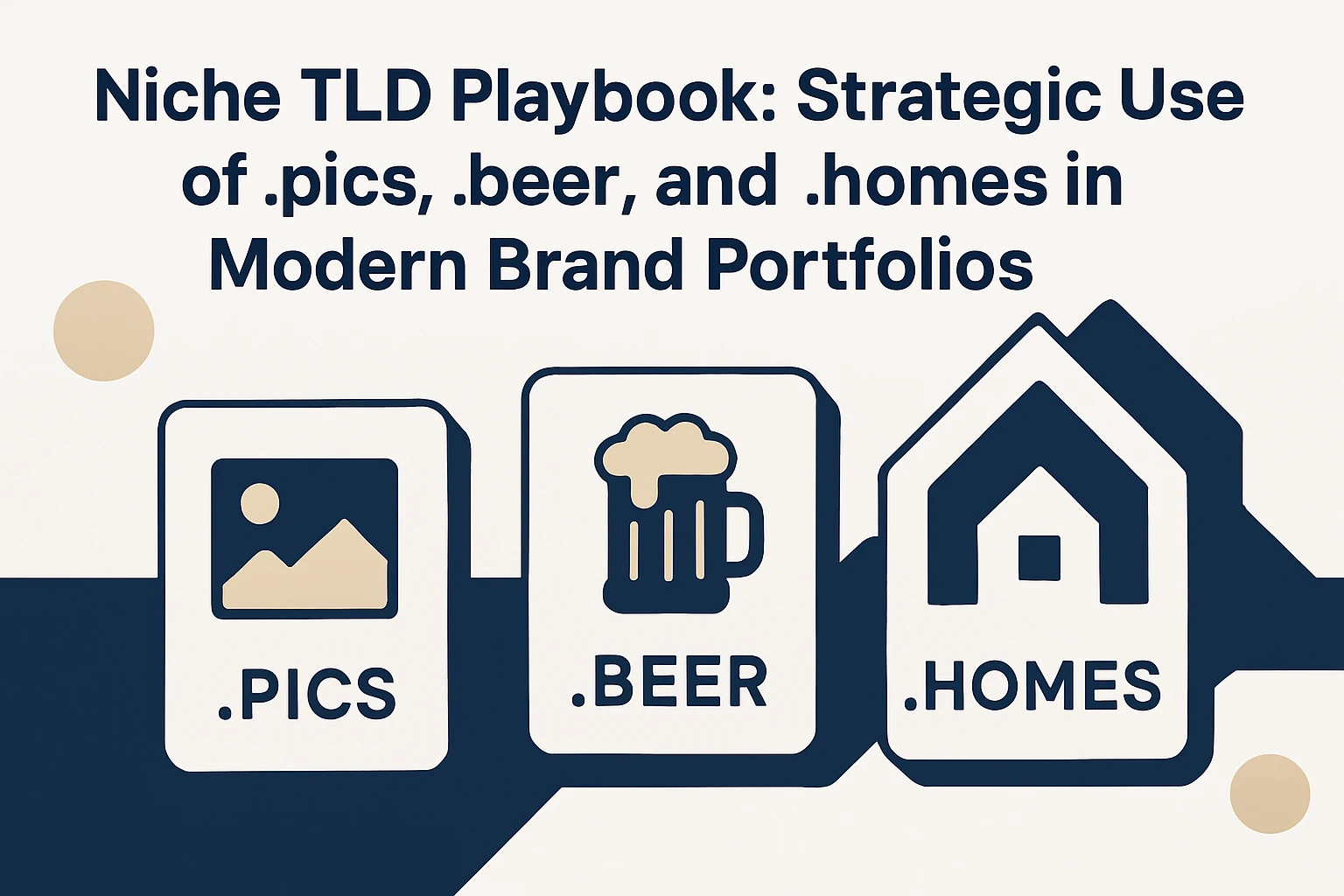
In today’s crowded digital marketplace, building a brand portfolio that’s both defensible and value-enhancing requires more than a clever name. The growth of niche top-level domains (TLDs - such as .pics, .beer, and .homes) has created new opportunities to align a brand with a specific audience, intent, or geography. But these opportunities come with new decisions: which TLDs actually fit your strategy, how to evaluate available domains, and how to pursue acquisitions without revealing your negotiating moves or inflating risk. This article offers a practical, non-generic playbook for corporate brand owners and investors who want to use niche TLDs as part of a disciplined portfolio strategy. It also shows how reputable resources, including industry analyses and governance guidelines, frame this decision landscape. ICANN Phase I Assessment provides context on how new gTLDs changed the marketplace, while the World Intellectual Property Organization (WIPO) highlights how domain names intersect with brand protection and dispute resolution. Enterprising Ideas.
1. Why niche TLDs matter in 2026
Niche TLDs give brands the ability to signal relevance, expand campaigns, and reduce search ambiguity. They can anchor a product line, a geographic initiative, or a campaign micro-site with a memorable extension that aligns to consumer intent. But they’re not magic bullets. The ICANN Phase I Assessment notes that the introduction of hundreds of new gTLDs expanded the universe of available domains and also dispersed registration shares and pricing across registries and registrars. That dispersion means buyers must approach each TLD with discipline: not every niche extension delivers value, and misalignment can erode brand equity rather than enhance it. ICANN Phase I Assessment.
2. A practical framework for evaluating thematic TLDs
To move from curiosity to a defensible investment, use a framework that translates brand objectives into measurable questions. The following five criteria help separate attractive options from vanity buys:
| Step | Action | Why it matters |
|---|---|---|
| 1. Brand alignment | Map your brand architecture to potential TLD themes (for example, product lines, campaigns, or regional footprints) and test whether the extension reinforces brand meaning rather than cluttering it. | Brand alignment reduces cognitive load for customers and increases recall. |
| 2. Demand signals | Validate demand patterns using keyword research and search intent signals, scan for related queries such as long-tail variants or intent-specific phrases. | Helps avoid investing in domains nobody searches for. |
| 3. Availability and liquidity | Assess not only the list of candidate domains but also the liquidity of the market - are the names actively traded, is renewal affordable, and is there a credible resale path? | Liquidity determines how quickly you can monetize or pivot if the strategy changes. |
| 4. Risk and policy | Evaluate IP exposure, trademark risk, and dispute resolution mechanisms, review UDRP risk and local enforcement considerations. | Global brand protection requires understanding legal frameworks across borders. |
| 5. Lifecycle governance | Set renewal governance, ownership structure, and monitoring protocols to manage risk over the long term. | Long-term value depends on consistent stewardship. |
3. What ICANN’s TLD groups teach us about niche opportunities
ICANN’s Phase I assessment documents how new gTLDs are grouped into families that often reflect consumer intent (for example, beer, home, education). The report shows that the so-called Beer family and Home-related groups were actively tracked for registration shares, indicating that brands may benefit from thematic alignment when the timing and pricing are right. This doesn’t mean you should chase every trend - rather, it highlights that readers should think about whether a niche domain supports a concrete marketing program or geographic strategy. ICANN Phase I Assessment.
4. Limitations and common mistakes
Even with a solid framework, niche TLDs carry caveats. The WIPO guidance on domain names emphasizes that IP rights are territorial and that disputes can arise across borders. A domain extension’s value depends on how well it integrates with your brand strategy and on the ability to enforce rights against cybersquatters or bad-faith registrants. A common mistake is assuming that a niche TLD will automatically drive traffic or protection without a clear cross-functional plan. Always pair domain decisions with trademark strategy, brand governance, and a disciplined acquisition process. Enterprising Ideas.
5. A practical action plan (framework in one view)
Use this concise, risk-weighted checklist to begin evaluating niche extensions for your portfolio. The steps below function as a living guide that can be customized to a brand’s risk appetite and growth goals.
| Step | Actions | Outcomes |
|---|---|---|
| 1) Mapping | Link brand architecture to TLD themes, identify which campaigns or markets would benefit from a niche extension. | Clear thematic fit and language for internal briefings. |
| 2) Validation | Run keyword research, check long-tail queries, validate search intent and volume for target phrases. | Data-driven vetting of candidates. |
| 3) Due diligence | Run RDAP/WHOIS checks, assess availability and transferability, study renewal costs. | Trusted baseline for negotiations and budgeting. |
| 4) Negotiation strategy | Plan discreet acquisition, consider anonymous or semi-anonymous approaches, confirm a fair maximum price. For example, Safenames outlines a Domain Name Acquisition service that facilitates discreet negotiations and secure transfers. | Protected negotiation posture and realistic budget. |
| 5) Governance | Document ownership, renewal calendar, and ongoing brand-monitoring processes. | Sustainable portfolio health over time. |
6. How WebAtla can support your niche-TLD strategy
For teams that want a structured process with specialist support, partnering with a domain advisory and brokerage firm can help translate the framework above into real-world results. WebAtla’s suite - including curated TLD lists, domain-by-domain evaluation, and access to RDAP/WHOIS data - supports both confidential acquisitions and disciplined portfolio management. For example, you can explore a dedicated page for .pics at WebAtla .pics, view the broader framework of domain lists by TLD at List of domains by TLDs, or access data resources at RDAP & WHOIS Database.
Conclusion
Niche TLDs offer a targeted path to reinforce brand narrative and campaign specificity - when chosen with discipline and governance. By combining a clear evaluation framework with diligent due diligence and a governance plan, brands can turn niche extensions into durable assets rather than vanity purchases. The market context the ICANN and WIPO sources provide reinforces the need for a structured, risk-aware approach to theme-based TLDs.