Introduction
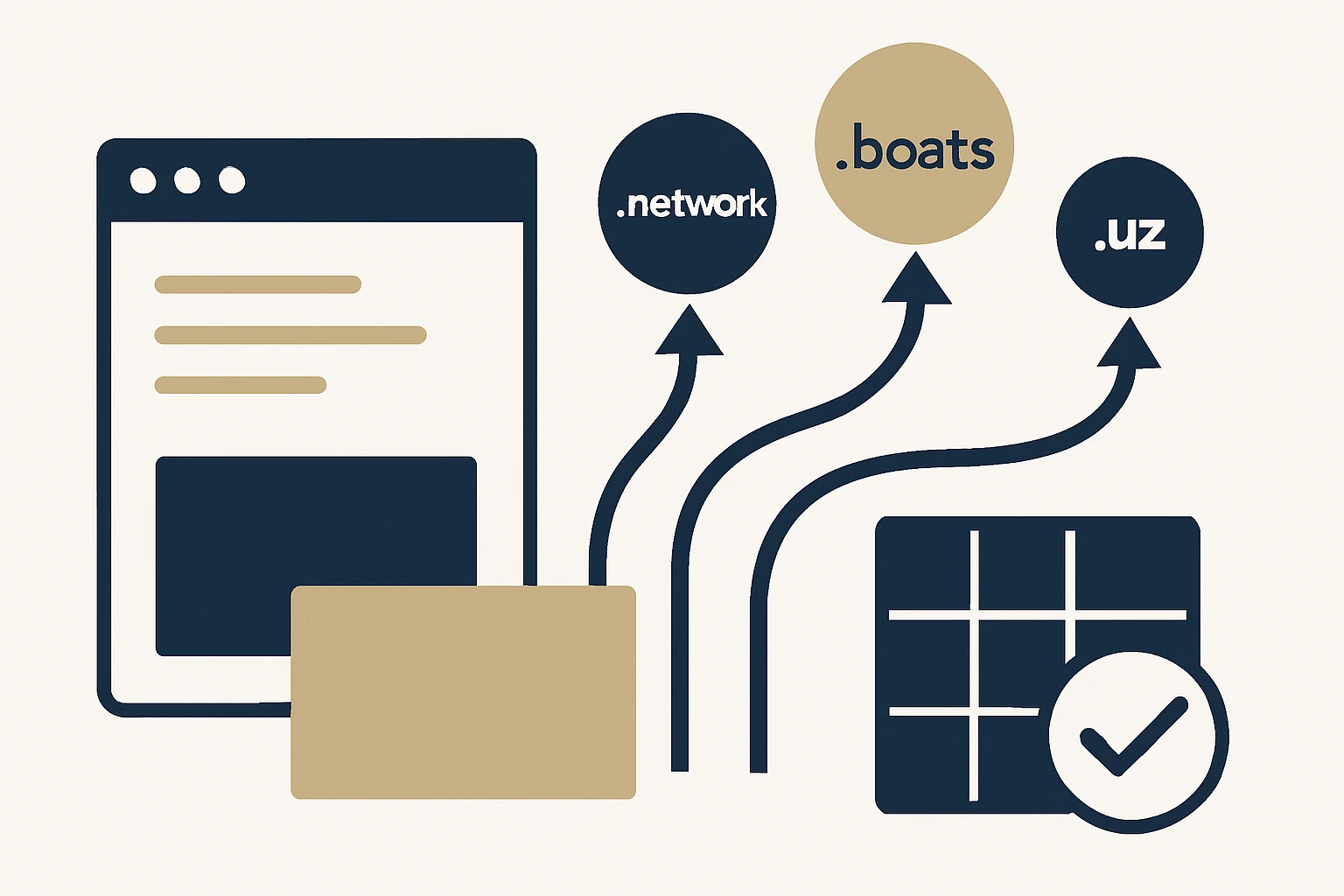
Premium domains are no longer limited to obvious choices like .com. A thoughtful portfolio today blends conventional assets with niche top‑level domains (TLDs) that storytelling, regional strategy, and product scopoft branding. Brands increasingly test new narratives by leveraging TLDs such as .network for industry authority, .boats for lifestyle and recreation positioning, or country-code domains like .uz to signal local relevance in Central Asia. The challenge is not merely finding available names but building a coherent, defensible portfolio that aligns with business goals, risk tolerance, and long‑term brand architecture. This article presents a practical framework to evaluate niche TLDs, source credible domain lists where appropriate, and integrate them into a disciplined premium domain strategy. webatla's network TLD list and webatla's TLD catalog offer real‑world examples of how niche catalogs are organized and surfaced for strategic review. For readers seeking curated catalogs and expert review, these resources illustrate how data-driven sourcing can support premium-domain portfolio decisions.
As a backdrop, the domain market remains large and dynamic. The latest quarterly data from Verisign shows continued growth across all TLD categories, with hundreds of millions of domain registrations worldwide. This broader context matters because it anchors niche‑TLD strategies within the overall scale and velocity of the market. Verisign DNIB Q4 2025 confirms that while the majority of registrations sit in established gTLDs, new and niche extensions contribute to overall demand and pricing dynamics. (Source: Verisign DNIB Q4 2025)
Why niche TLDs deserve a place in a premium portfolio
Niche TLDs are not a substitute for brand safety or core brand strategy, they are a complement that can amplify positioning, regional entry, and product lines when used thoughtfully. Three considerations drive this rationale:
- Brand storytelling and relevance: A TLD that mirrors an industry or locale can reinforce messaging and reduce cognitive load for audiences. A .network domain may signal sector authority, while a .uz domain can reflect local market intent and compliance posture in a specific geography.
- Defensive and expansion opportunities: Owning adjacent or semantically related domains can prevent rivals from capturing misdirected traffic and support regional campaign alignments as brands grow into new markets.
- Portfolio resilience: Diversification across TLD classes (gTLDs, ccTLDs, and niche TLDs) reduces overreliance on a single extension and spreads risk related to policy shifts, price changes, or search-engine behavior.
From a market‑data perspective, the broad growth in domain registrations supports a diversified approach. DNIB data show that growth is happening across TLDs, including newer extensions, which helps justify a measured expansion into niche domains as part of a long‑term strategy. Verisign DNIB Q4 2025. (Source: Verisign)
A practical framework for evaluating niche TLDs
Adopting a disciplined framework helps separate hype from value. Below is a concise, four‑step approach that can be applied when you consider adding niche TLDs such as .network, .boats, or .uz to a premium-domain portfolio. This framework is designed to be operational - not purely theoretical - so you can translate insights into actions, including file-and-forgeable checklists and a structured decision table.
- Define brand fit and audience alignment: Start with your core markets, customer personas, and product lines. Ask: Which audience segments are most sensitive to domain cues? Does a niche extension reinforce your value proposition or risk confusion with core brands?
- Assess risk and governance: Examine regulatory, privacy, and policy considerations for each TLD. For example, country-code TLDs (ccTLDs) such as .uz come with locale compliance expectations, while niche gTLDs may have marketing restrictions or registry requirements. The industry is moving toward RDAP for registration data, superseding WHOIS in many contexts, which affects risk monitoring and brand protection workflows. RDAP overview and ICANN RDAP sunset of WHOIS provide context for data access and governance. (Sources: ICANN)
- Estimate acquisition costs and ongoing value: Beyond sticker price, factor renewal costs, lander/hosting considerations, and potential SEO implications. Consider defensive registrations for variants and related terms to protect brand integrity over time.
- Plan for data and monitoring: Ensure you have access to reliable data feeds about new registrations in those TLDs and a process to monitor for brand‑risk events. This is especially important for niche extensions where volume may be lower but impact high if misused.
These steps lead to a practical decision framework you can adapt to your organization’s risk tolerance and growth goals. To illustrate, here is a concise evaluation block specific to the three niche TLDs discussed.
Structured decision block: Niche TLD evaluation table
| TLD | Brand fit | Acquisition cost | Regulatory / policy risk | Data availability / monitoring | Strategic note |
|---|---|---|---|---|---|
| .network | 4 | Medium | Low to moderate depending on registrar policies | Good visibility in niche markets, monitor for brand abuse | Strong for industry authority, pair with core brand terms |
| .boats | 3 | Medium | Moderate, sector-specific uses may attract trademark considerations | Moderate, watch cultural and lifestyle signals | Effective for lifestyle campaigns, alignment with product lines |
| .uz | 3 | Low to medium | Geopolitical and regulatory nuances, local compliance matters | Emerging, split‑test for local presence and localization | Localized expansion potential, complement ccTLD strategy |
Note: The table above is a simplified snapshot intended to stimulate structured thinking. Real‑world decisions should be grounded in a formal scoring model that includes brand risk, legal clearance, and domain‑portfolio economics. For readers exploring more extensive catalogs and ongoing advisory services, webatla’s TLD catalog can be a practical starting point to view how these extensions are organized in professional datasets. (Source: webatla catalog reference)
How to source and manage niche TLD lists responsibly
Readers often search for practical sources to download list of .network domains, download list of .uz domains, or download list of .boats domains as part of market analysis or portfolio planning. In practice, those lists are typically curated by data providers and registries under licensing terms. When you pursue such lists, keep these guardrails in place:
- Validate provenance and licensing: Only obtain lists from reputable providers that disclose data sources, update cadence, and licensing terms. Unlicensed or low‑quality data can distort strategy and create compliance risks.
- Benchmark data against registries: Cross‑check with official registry disclosures (such as Verisign’s domain base reports and other registry communications) to calibrate your assessment of market size and growth. Verisign’s quarterly DNIB remains a key reference point for overall domain growth and distribution across TLDs. (Source: Verisign)
- Incorporate data governance: Align data practices with privacy and regulatory expectations as governance around registration data evolves (RDAP replaces WHOIS in many contexts). See ICANN’s RDAP guidance for how data access is changing. (Source: ICANN)
- Integrate with brand protection workflows: Lists should feed a broader workflow that includes domain‑name security, trademark clearance, and ongoing monitoring to prevent cybersquatting or brand misdirection.
For readers who favor a curated catalog approach, webatla’s TLD catalogs offer a structured way to explore niche lists and their strategic implications within a broader domain‑portfolio framework. Network TLD catalog example and General TLD catalog illustrate how data can be organized to support disciplined decision making. (Source: webatla catalogs)
Limitations and common mistakes
Every strategic move in the domain space carries trade‑offs. When incorporating niche TLDs into a premium portfolio, beware the following limitations and missteps:
- Over‑diversification in low‑demand niches: While niche TLDs can unlock branding opportunities, excessive diversification into obscure extensions can dilute your core brand strategy and complicate portfolio management.
- Underestimating regional and legal constraints: ccTLDs and country‑specific extensions often come with local compliance requirements and market expectations. Failing to plan for localization or trademark clearance can result in costly rebranding work.
- Neglecting data governance and monitoring: As RDAP replaces WHOIS in many contexts, keeping a robust monitoring program is essential to detect brand‑risk events and respond quickly. See ICANN’s RDAP transition for context. (Source: ICANN)
- Forgetting the core brand anchor: Niche TLDs should be purpose‑built to support the primary brand strategy, not replace it. A misaligned niche extension can confuse customers or fragment SEO signals if not integrated thoughtfully into the site architecture.
Putting the framework into practice: a quick planning checklist
To translate the discussion into action, use this compact checklist as a starting point for your next portfolio review session:
- Confirm the business unit and geography that will benefit most from niche TLDs.
- Identify 2–3 niche extensions that align with product lines and audience behavior.
- Estimate acquisition and renewal costs, including defensive registrations.
- Define a monitoring plan that uses RDAP data and brand‑protection tooling.
- Draft an integration plan that ties niche domains back to premium assets and marketing campaigns.
Conclusion
Premium domain portfolios thrive when you embed niche TLDs within a disciplined, brand‑driven strategy. By evaluating brand fit, governance risk, data availability, and long‑term portfolio economics using a structured framework, you can decide when niche extensions like .network, .boats, or .uz genuinely add value and when they are better left as optional experiments. The market dynamics, as reflected in Verisign’s ongoing DNIB data, support diversification as a prudent approach, not a reckless gamble. And as data access evolves, remaining aligned with industry governance (RDAP) and best practices for brand protection will be essential to sustaining long‑term value. Source: Verisign DNIB 2025, ICANN RDAP guidance, SiteGround domain security tips. SiteGround: How to Secure a Domain Name.