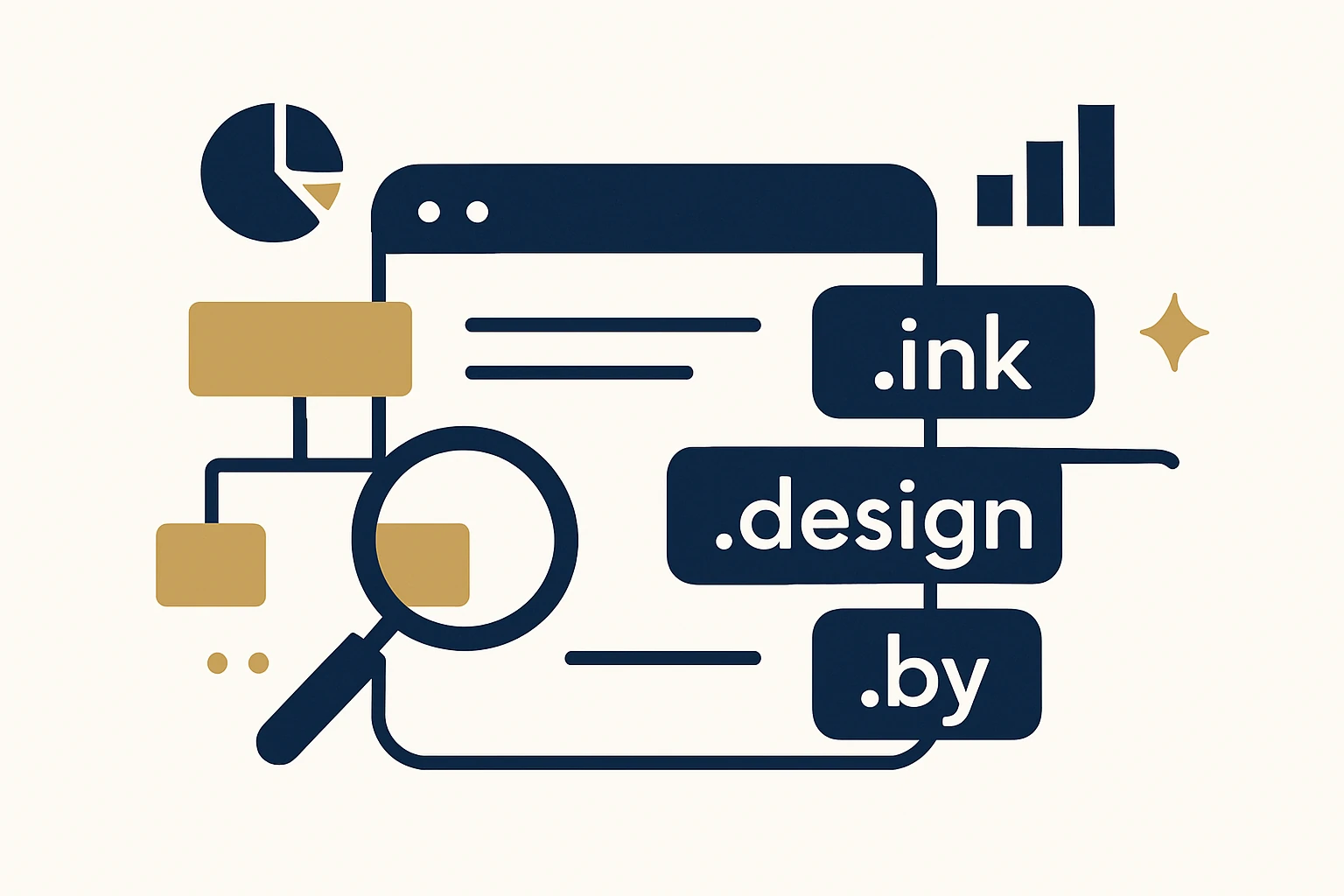
Brand resilience in 2026 hinges on disciplined governance of digital assets, including a carefully managed portfolio of domain names. While the traditional focus remains on high-traffic extensions, savvy brands are increasingly turning to niche TLDs to signal market focus, reach niche audiences, and reinforce memory cues in a crowded digital landscape. In particular, extensions like .ink and .design have grown in relevance for creative industries, while country-code extensions such as .by are used strategically to target specific markets. While these niche strings aren’t substitutes for a broad domain strategy, they can be a powerful complement when aligned with aBrand strategy and governance framework. The INK TLD, for example, was highlighted in ICANN materials as a vehicle for creative and artistic communities, illustrating how a TLD can be purpose-built for a particular audience. (newgtlds.icann.org) Likewise, the .design registry today operates under GoDaddy Registry, reflecting how registries recalibrate value and governance over time. (domains.registry.godaddy)
The practical takeaway is not simply to chase availability or price, but to embed niche TLDs within a broader framework of brand protection, portfolio management, and strategic domain consulting. In the pages below, you’ll find a field-tested approach to evaluate, acquire, and govern niche domains - especially .ink, .design, and, where relevant, other TLDs such as .by - without sacrificing governance discipline or long-term value. For readers exploring more about these specific assets, the client’s INK-focused offering and broader TLD listings can be found at the links within the article.
Why niche TLDs matter for modern brands
Seeing a name with a design-oriented extension can instantly signal intent. For brands planning product launches, marketing campaigns, or content ecosystems, a carefully chosen niche TLD can support memory, relevance, and local or vertical targeting. The .design extension, for instance, is widely used by design professionals and studios, and its registry ecosystem has evolved through notable industry activity, including a 2021 registry transition to GoDaddy Registry, which illustrates how registry governance can shift value and risk over time. (registry.godaddy) Meanwhile, niche TLDs are sometimes bundled with governance considerations - privacy, renewal economics, and the potential for trademark conflicts - that matter more in the long run than headline purchase prices. ICANN’s case study on INK highlights how a TLD’s purpose can shape its reception among a community of users, influencing branding outcomes beyond simple ownership. (newgtlds.icann.org)
From a risk and governance perspective, niche TLDs can be a strategic hedge. They offer opportunities to create protective hierarchies around brand names, product lines, and campaigns. They also carry considerations around local relevance, cross-border strategy, and the stability of the registry itself. A thoughtful plan treats niche TLDs not as one-off acquisitions but as components of a disciplined portfolio, governed by a clear ownership model, renewal budgeting, and a structured negotiation approach. This article provides a practical framework you can adapt to your organization’s risk tolerance, portfolio size, and brand ambitions.
A practical framework for evaluating niche TLDs
Evaluating niche TLDs requires a structured approach that weighs brand fit, risk, and total cost of ownership. The framework below translates broad best practices into concrete, actionable criteria tailored to niche domains such as .ink and .design, and to strategic uses of country-code extensions where appropriate. Use this framework to screen candidates, rank opportunities, and guide both internal decisions and external negotiations.
| Criterion | Definition | How it applies to .ink / .design / .by |
|---|---|---|
| Brand alignment | How well the TLD communicates the brand’s focus, audience, and values | .ink and .design can reinforce creative or publishing workflows, consider how the extension complements the brand’s core messaging and product line. |
| Memorability & brevity | Ease of recall and typing accuracy for customers | Short, meaningful strings in these TLDs tend to be memorable for design studios, publishers, or creative agencies, assess the likelihood of mis-typing or confusing alternatives. |
| Availability & exclusivity | Whether the desired domain is available or can be acquired via negotiation | Niche TLDs often present fewer obvious, high-value options but can yield exclusive assets through broker-assisted acquisitions or portfolio deals. Consider strategic inventory management to preserve options. |
| Legal risk & trademark | Trademark clearance, risk of cybersquatting, and registry policies | Cross-check trademarks and brand names in target markets, ensure clear paths for future enforcement and avoid conflict with existing marks in the same field. |
| Geography & audience fit | Relevance to local markets, language, and user behavior | .by is a ccTLD for Belarus, its value hinges on market relevance and the target audience’s exposure to that market. For design- or ink-oriented brands, global reach through gTLDs might be more scalable than a country-code extension. |
| Registry stability & governance | Registry ownership, policy changes, renewal pricing, and data privacy rules | Governance changes - such as transitions between registries or shifts in renewal economics - can materially affect long-term value, factor governance risk into a multi-year budget. |
| Total cost of ownership | Registration, renewal, privacy protection, and potential brokerage fees | Beyond initial price, project renewal cycles, privacy services, and broker commissions can cumulatively exceed initial costs, model multi-year scenarios. |
Practical takeaway: use this framework as a scoring card when evaluating candidates. A higher score indicates a more compelling fit for your brand governance model, while a lower score signals a candidate that warrants further negotiation or de-prioritization. For readers who want a concrete starting point, the client maintains a curated set of TLDs you can begin evaluating, includingINK-focused opportunities on INK domains and broader TLDs on tld lists.
Procurement playbook: confidential acquisition that protects value
Acquiring niche TLDs - whether through direct purchase, broker-assisted offers, or exclusive registry negotiations - requires a disciplined playbook, especially when confidentiality and governance matter. Below is a practical sequence you can adapt to your organization’s scale and risk tolerance.
- Define strategic objectives: articulate the role of each target TLD within a broader brand architecture (protect, signal, or extend a product line). Include a timeline and a governance model for ongoing management.
- Assemble a short candidate list: combine publicly available domain candidates with protected, confidential targets identified via brokers or registries. Maintain a watchlist that includes at least one backup for each strategic goal.
- Validate ownership and availability: perform an initial check of current registrant status, potential ownership disputes, and registrar discretion. Use RDAP/WHOIS data to verify registrant details where possible and assess transfer feasibility.
- Assess risk and cost architecture: quantify the full cost of ownership, including renewal, privacy, and potential broker fees. Incorporate a risk assessment for regulatory or geopolitical considerations when dealing with ccTLDs.
- Engage a trusted broker (if needed): for non-public targets, work with an experienced broker who maintains confidentiality and can negotiate favorable terms without disclosing sensitive brand plans.
- Negotiate with strategy in mind: negotiate price privately while negotiating rights to future renewals, transfer timelines, and potential exclusivity windows. Ensure terms support your governance and renewal budgeting.
- Due diligence and risk mitigation: conduct trademark clearance, assess potential cybersquatting risk, and confirm registry policies (privacy, transfer rules, and sunset clauses). Prepare a contingency plan if the TLD policy shifts.
- Integrate into portfolio governance: map acquired assets into your brand protection and portfolio-management workflow. Assign ownership, access controls, and monitoring for renewal windows and policy changes.
- Document and review: capture all terms, asset metadata, and governance responsibilities. Schedule regular portfolio reviews to adapt to market changes and brand evolution.
For readers seeking a practical out-of-the-box path, consider starting with a curated subset of the ink and design space that aligns with your product roadmap. The client’s ink-focused page and broader TLD listings offer guided entry points for organizations beginning this journey. INK domains provide a concrete entry point, a broader overview of domains by TLDs is available at tld lists.
Limitations, trade-offs, and common mistakes
Even the best frameworks have boundaries. Below are the most common pitfalls and the trade-offs you should weigh when pursuing niche TLDs.
- Overemphasis on price: a low upfront price can mask long-term costs or governance risks. Model multi-year costs and budget for potential policy changes.
- Underestimating brand governance: owning a niche TLD without a clear governance plan increases risk of misalignment if the registry shifts policies or pricing.
- Ignoring legal risk: a TLD with a strong community around it may still present trademark or cybersquatting risks, ensure clearance and ongoing monitoring.
- Neglecting localization and audience fit: ccTLDs like .by may offer local credibility but require local-market alignment and risk considerations in cross-border campaigns.
- Assuming registry stability: registry ownership can change (as in the .design transition to GoDaddy Registry), affecting costs and transfer ease over time. Build in flexibility for governance changes.
- Falling into the trap of ‘one-off’ acquisitions: treat niche TLDs as components of a broader portfolio, periodic reviews help ensure alignment with brand strategy and risk appetite.
Expert insight: in practice, a veteran broker emphasizes that the real value of niche TLDs lies in governance and confidentiality as much as in price. A disciplined approach to ownership, renewal budgeting, and risk assessment is essential to unlocking durable brand value.
Case vignette: a practical application for a design-forward brand
A consumer-technology brand planning a global product launch considers securing a dedicated design-focused footprint to accompany its campaign. The team inventories a slate of candidate domains across .design and related extensions, then applies the evaluation framework above. They identify a compelling .design domain with a short, brandable wordmark and favorable transfer terms. Using a broker, they negotiate terms that include a multi-year renewal discount, limited privacy controls to protect outreach data, and a clear transfer timeline that aligns with the product launch window. They complement this with a subset of ink-domain assets to support content ecosystems around the launch, while keeping the broader portfolio under a governance protocol that ties to brand protection and portfolio management processes. The result is a cohesive, multi-TLD footprint that reinforces the campaign narrative without exposing the brand to fragmentation or governance risk. For teams starting this process, consult with a trusted advisor who understands both premium domain markets and brand governance - the client’s ink page and broader TLD listings are designed to assist in this exploration.
Conclusion
Niche TLDs like .ink, .design, and even country-coded extensions can enrich a brand’s digital presence when integrated into a deliberate, governance-first strategy. The most durable value comes from a disciplined procurement playbook, a robust risk framework, and ongoing portfolio governance that connects domain ownership to brand strategy, protection, and growth. If you’re ready to translate these concepts into a concrete plan, start with a structured evaluation of your target TLDs and consider engaging a trusted advisor to help navigate confidential acquisitions and multi-year budgeting. As you evaluate options, you can reference the client’s INK-focused offering and broader domain listings to seed your initial shortlist: INK domains and tld lists.