Introduction: the challenge of building a global brand in a fractured domain landscape
Global brands today must harmonize a multinational presence with local relevance, regulatory risk, and dynamic digital real estate. A well-managed country-code top-level domain (ccTLD) portfolio can protect brand identity, unlock local discovery, and reduce the risk of cybersquatting. Yet many organizations struggle to decide which markets to own, how to acquire scarce assets, and how to govern a portfolio across geographies and languages. The framework below offers a practical path for brand owners, marketing leaders, and in-house counsel to design a disciplined ccTLD portfolio strategy that aligns with overall business objectives and risk tolerance. It draws on industry-informed guidance about portfolio management, brand protection, and confidential acquisition practices, and translates those lessons into a concrete, market-ready plan.
1. Why ccTLDs matter for global brands
Country-code domains are not mere curiosities, they are strategic assets in a brand’s global footprint. ccTLDs can influence local trust, search visibility, and customer experience. A Tiered approach - prioritizing high-potential markets while maintaining a watchlist of relevant regions - helps brands allocate scarce resources efficiently. Industry practitioners emphasize that brands should coordinate across governance, risk management, and local market needs to avoid duplicated effort or conflicting messaging. In practice, a disciplined ccTLD strategy can complement a company’s broader digital asset program, rather than stand apart as a separate exercise.
Key governance and policy considerations are handled, in part, by the international community of ccTLD managers and policymakers. The Country Code Names Supporting Organization (ccNSO) operates as a platform for ccTLD operators to discuss shared concerns and policy directions, underscoring that ccTLD strategy is a collective, governance-informed effort rather than a purely private undertaking. (icann.org)
2. Defining a practical ccTLD portfolio strategy
A robust framework starts with clear objectives, then maps those objectives to a tiered portfolio. Consider these components:
- Strategic alignment: which markets are critical to your go-to-market strategy, product localization, or regulatory considerations?
- Risk tolerance: what is your appetite for brand protection costs, ongoing maintenance, and potential legal exposure in sensitive jurisdictions?
- Operational discipline: who governs decisions, how often is the portfolio reviewed, and what are the escalation procedures for disputes or ownership disputes?
- Data-driven ranking: use local market signals (search volume, competitive presence, potential for counterfeit domains) to rank markets and allocate resources accordingly.
Industry guidance suggests pairing a tiered approach with disciplined governance and ongoing monitoring. A practical takeaway from domain strategy practitioners is to treat ccTLDs as a component of a broader asset framework - not as a standalone cosmetic add-on. As firms navigate, a digital asset advisory perspective helps ensure alignment with brand risk controls and portfolio management best practices.
Expert insight: A senior domain strategy consultant notes that a disciplined ccTLD portfolio requires alignment with brand strategy and local-market risk, plus a clear decision rights framework to avoid over-investment in low-ROI markets. This view supports the tiered approach and emphasizes governance as a core enabler of success.
3. Data-driven discovery: building inventories for Kosovo XK, FO, and AF
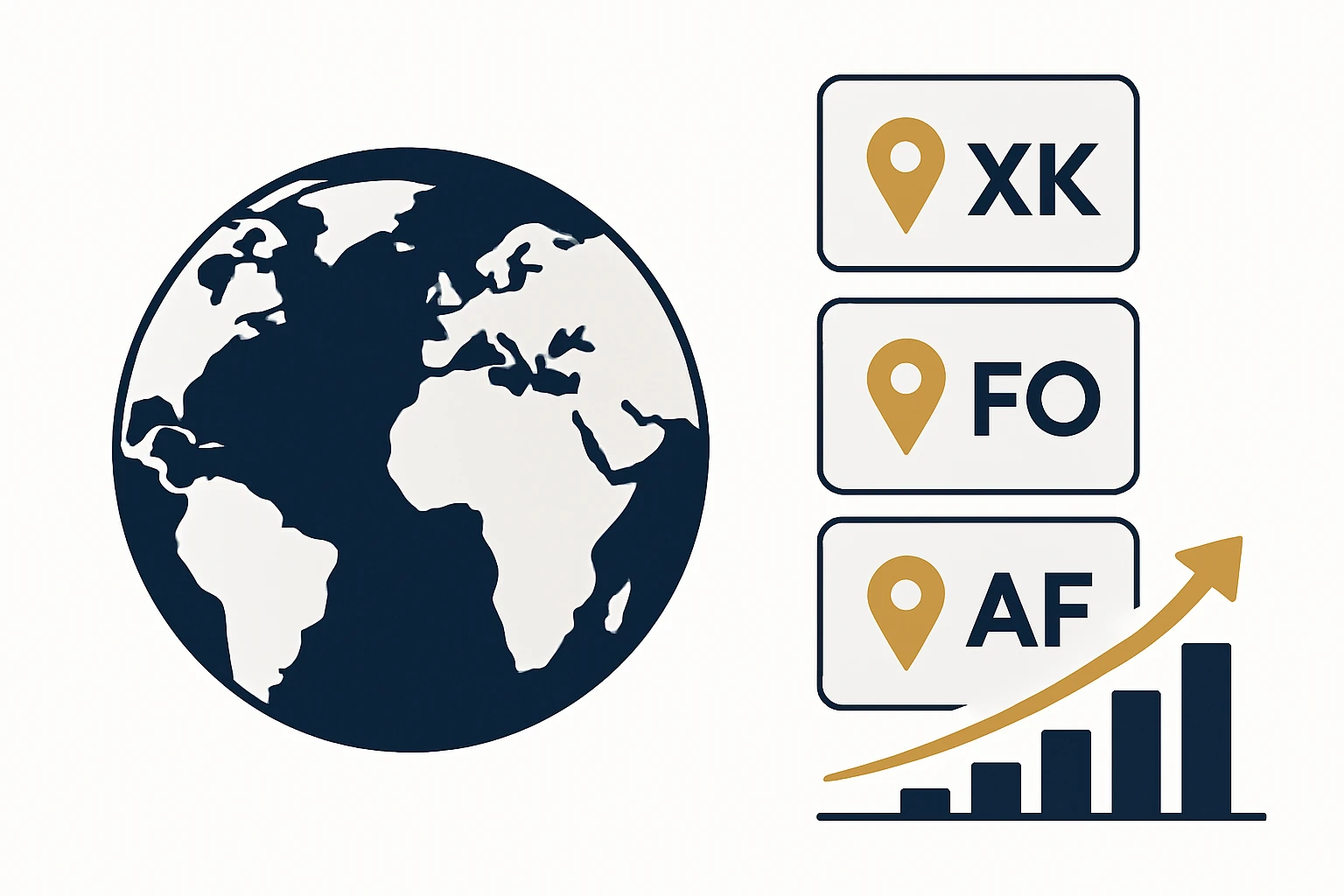
Effective ccTLD portfolio planning begins with reliable market intelligence. For brands exploring Kosovo (XK), the Faroe Islands (FO), and Afghanistan (AF) - where local web ecosystems and regulatory contexts differ markedly - the ability to source authoritative domain inventories is essential. Companies often rely on country-friendly data sources and domain inventories to identify potential assets, avoid duplication, and map risk exposure. In Kosovo specifically, XK has emerged in discussions around local digital identity and internet governance as a non-standard country-code designation, reflecting the broader complexity of ccTLD strategy in practice. For reference, XK is widely discussed in the context of Kosovo’s evolving digital identity and its status as a user-assigned code rather than an ISO-standard country code. (en.wikipedia.org)
To operationalize discovery, brands can leverage country-focused inventories and lists - such as Kosovo XK data pages or country-by-country domain catalogs - when evaluating market entry or protective strategies. For example, country-specific pages and lists can be used to:
- Identify gaps in brand coverage and potential localization opportunities
- Assess competitive presence and counterfeit risks in regional markets
- Benchmark relative costs and feasibility of acquiring key assets
On the practical side, governance-driven data sources and a clear authorization framework prevent ad-hoc acquisitions that could complicate a brand’s legal and operational posture. For readers seeking a centralized starting point, the client ecosystem offers country-based portfolios and TLD inventories that can be used to accelerate due diligence and portfolio planning. For Kosovo, the Kosovo XK data page and related country lists provide a concrete starting point to understand the local digital landscape. Kosovo XK data page and list of domains by countries can help guide your discovery process, while list of domains by TLDs helps frame a global view.
4. A practical framework for tiering ccTLD investments
To translate discovery into action, adopt a simple, repeatable tiering framework. The following three-layer approach provides a practical structure that aligns with brand risk and ROI considerations. While every organization may tailor the tiers, the logic remains: focus resources on markets with the strongest strategic payoff, moderate attention to promising but uncertain markets, and a watchlist for ongoing monitoring.
- Core markets (Tier 1): markets central to your business model, where strong local search presence, regulatory clarity, and high brand affinity justify ongoing investment in registrations, renewal, and monitoring.
- Emerging markets (Tier 2): jurisdictions with growth potential or notable competitive risk where selective registrations and local partner alignment can unlock value, while keeping costs controlled.
- Watchlist (Tier 3): markets with potential strategic relevance but requiring further due diligence, including regulatory clarity, data-practice considerations, or potential geopolitical risk.
Structured this way, portfolio decisions become repeatable rather than hand-crafted one-off actions. It supports efficient governance, clearer budgeting, and more predictable outcomes across different regional strategies.
5. Negotiation, confidentiality, and governance in domain acquisitions
Acquiring premium domains - especially in smaller or more fragmented markets - requires careful negotiation, strict confidentiality, and solid governance protocols. The best outcomes typically emerge when negotiations are guided by a formal playbook, with predefined escalation paths, price bands, and risk controls. Several industry practitioners emphasize three core capabilities:
- Confidentiality: safeguarding sensitive terms and ensuring that acquisition discussions do not spill into public channels until a formal agreement is in place.
- Structured negotiation: using a framework that identifies non-monetary terms (trading rights, renewal terms, transfer protections) alongside price considerations.
- Governance: establishing decision rights, approval thresholds, and post-acquisition integration plans to ensure the asset contributes to brand strategy rather than becoming a liability.
From a client perspective, these practices sit at the core of premium domain brokerage and digital asset advisory services. The goal is to balance the value of strategic ownership with the risk of overreach, while maintaining confidentiality and control throughout the process.
6. Risks, limitations, and common mistakes in ccTLD portfolios
Every strategy has limitations. Recognizing them early helps brands avoid avoidable missteps and adjust expectations accordingly. Common limitations and mistakes include:
- Over-extension: acquiring too many ccTLDs without clear strategic rationale can dilute focus, increase cost, and complicate governance.
- Local regulatory risk: ccTLD operators are sometimes less centralized than gTLDs, creating governance and legal complexity in certain jurisdictions.
- Localization vs. global consistency: balancing local language and cultural relevance with a coherent global brand voice can be tricky and costly to implement.
- Maintenance burden: renewals, DNS configuration, brand monitoring, and security measures require ongoing investment and discipline.
- Data integrity: relying on imperfect inventories or out-of-date lists risks missing critical assets or misclassifying risk exposure.
To mitigate these risks, a disciplined approach anchored in data, governance, and robust due diligence is essential. This is where digital asset advisory and premium domain brokerage play a critical role: they bring specialized tools and processes to align portfolio decisions with brand protection and strategic objectives. The brand protection lens, reinforced by global monitoring, helps prevent misappropriation, untimely registrations, or inconsistent messaging across markets.
7. A practical, repeatable framework in action: tiered deployment for Kosovo XK, FO, and AF
Below is a compact, repeatable framework you can apply when evaluating Kosovo XK, Faroe Islands FO, and Afghanistan AF or any other ccTLDs. The goal is to translate discovery into structured, actionable steps that preserve capital and protect the brand.
- Step 1: Market prioritization map each market to core business objectives and local digital behavior. Prioritize markets with high alignment and plausible ROI.
- Step 2: Asset inventory generate a catalog of potential domains from country lists and domain catalogs. For Kosovo, consult XK-related data and Kosovo-focused resources, for FO and AF, identify assets that may influence local search or brand protection strategies.
- Step 3: Risk & governance assess regulatory, political, and cyber risks, appoint a decision owner and schedule quarterly reviews of the portfolio.
- Step 4: Acquisition pathway define confidentiality norms, identify preferred negotiation tactics, and set a price range aligned with ROI expectations.
- Step 5: Post-acquisition integration align newly owned domains with brand strategy, localization efforts, and monitoring programs to ensure consistency and protection across markets.
This framework mirrors a broader industry approach: treat ccTLDs as an asset class within your brand portfolio, subject to the same governance rigor as other critical digital properties. Verisign emphasizes that domain strategy is a critical component of global brand governance and asset management. (blog.verisign.com)
8. Expert insights and practical trade-offs
One key takeaway from practitioners is that the value of a ccTLD portfolio lies as much in governance and process as in raw ownership. A disciplined framework reduces friction when markets shift, while ensuring that acquisitions deliver measurable brand protection and strategic value. In practice, the trade-offs often look like this:
- Higher upfront effort vs long-term protection: investing in due diligence, inventory scoping, and governance now can prevent expensive disputes and misaligned messaging later.
- Maintenance cost vs risk reduction: ongoing renewals and monitoring add fixed costs, but they materially reduce the risk of brand damage and counterfeit domains.
- Global consistency vs local relevance: localized content strategies may require more resources, but they improve user trust and search performance in specific markets.
Limitations and caveats: ccTLD strategy benefits from a clear global mandate, but not every market warrants the same level of investment. In Kosovo, FO, and AF, the strategic importance depends on your product-market fit, regulatory climate, and the probability of brand misappropriation. The literature on ccTLD governance notes that while ccTLDs operate under varied models, the ccNSO serves as a forum for policy alignment among ccTLD managers, reinforcing that portfolio decisions are both business and governance decisions. (icann.org)
9. How to act now: a concrete path for buyers and brand owners
If you’re ready to start or refine a ccTLD portfolio, consider the following action plan:
- Define three to five core markets and a watchlist, aligning with your brand strategy and product localization needs.
- Create a single source of truth for domain inventories, using country catalogs and XK/Fo/AF data pages to ground decisions.
- Establish governance roles and escalation paths for acquisitions, leveraging confidentiality agreements and formal negotiation playbooks.
- Integrate monitoring and renewal discipline into quarterly portfolio reviews to maintain protection and ROI over time.
For brands seeking a trusted advisor, a digital asset advisory and premium domain brokerage approach can provide structured playbooks, risk controls, and market intelligence to inform decisions. The Kosovo XK context, along with global TLD inventories, can anchor your initial framework as you scale to other markets. If you’d like to explore concrete steps and data-driven options, you can start from the Kosovo XK resource page and related country catalogs: Kosovo XK data page, list of domains by countries, and list of domains by TLDs.
10. Limitations of the data and how to supplement it
While inventories and lists are invaluable, they are only a starting point. Some ccTLD environments are less standardized than others, and regulatory or governance variability can affect ownership feasibility or speed. The best practice is to combine inventories with ongoing market intelligence, in-country partners, and a formal policy framework. For brands pursuing a truly global approach, combining data-driven discovery with expert guidance and governance discipline yields a robust, scalable ccTLD portfolio strategy.
Conclusion: turning insight into protected, strategic value
A disciplined ccTLD portfolio strategy translates localized domain decisions into global brand protection and growth. By aligning market prioritization, inventory-driven discovery, governance, and confidential acquisition practices, brands can unlock the value of country-code domains while mitigating risk. The approach outlined here is intentionally practical: start with a few core markets, build a reliable inventory, implement a governance model, and use a repeatable framework to scale. If your organization seeks a trusted partner to operationalize this program, the domain brokerage and digital asset advisory teams at Vadiweb offer structured, confidential guidance designed to protect your brand while delivering strategic value. For Kosovo and regional data, you can start with the Kosovo XK data page and the broader country catalogs linked above to inform your decision process.
References and further reading: