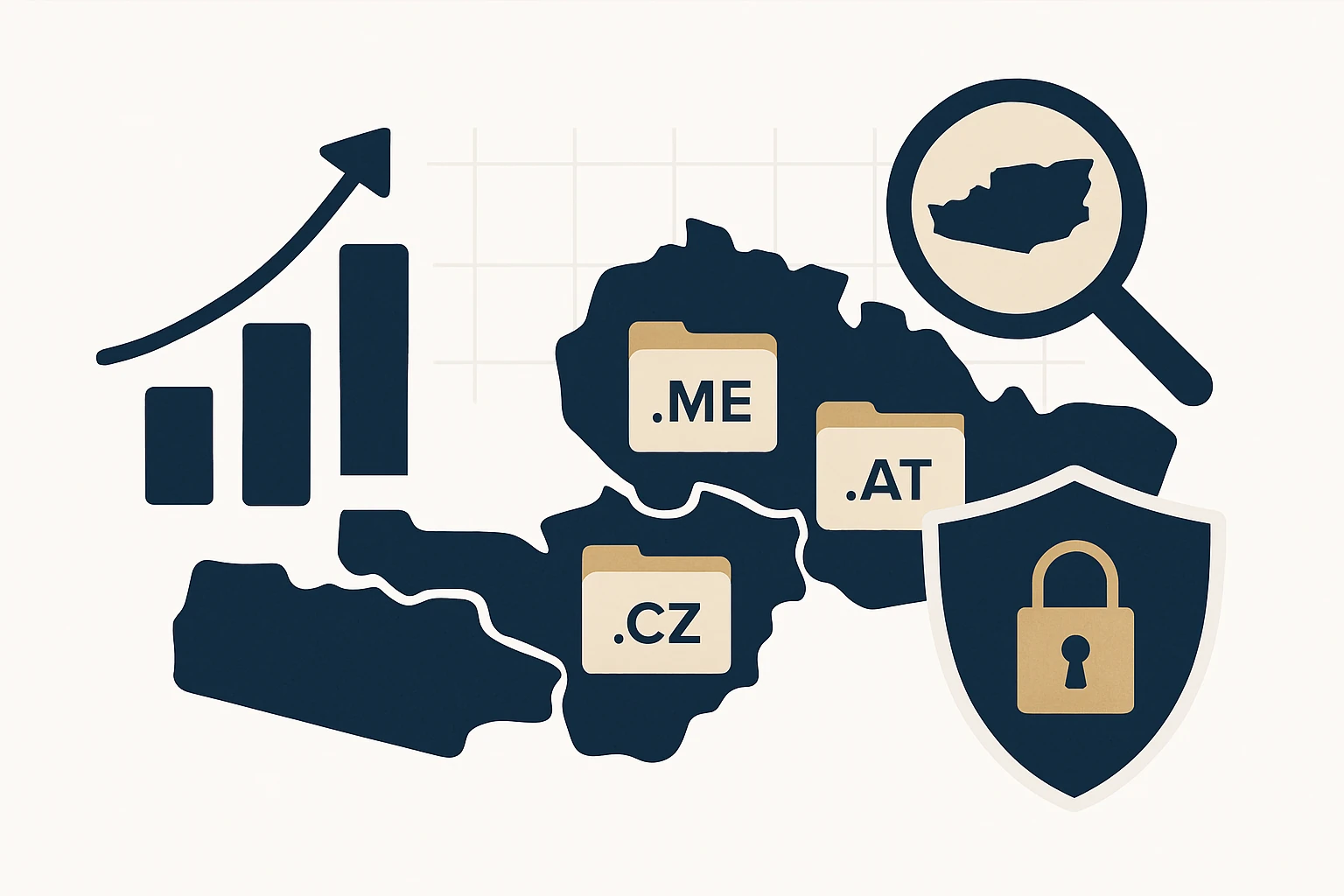
In today’s crowded digital landscape, brand owners must think beyond a single domain name. A well-constructed portfolio that includes strategic country-code extensions can protect brand identity, expand regional reach, and support localized marketing strategies. In Central Europe, three ccTLDs stand out for brands seeking authentic regional presence: .cz (Czech Republic), .me (Montenegro), and .at (Austria). Building a CZ/ME/AT portfolio is not about chasing every available domain, it’s about a disciplined approach to research, risk management, and confidential acquisition that aligns with long-term brand goals. This guide presents a practical framework for assembling and sustaining a Central Europe portfolio, with real-world considerations, trade-offs, and actionable steps. It also demonstrates how a partner with domain brokerage and advisory capabilities can help navigate complexity while keeping the process discreet. (dn.org)
Why CZ, ME, and AT matter for brand portfolios
Country-code domains offer more than geographic signaling, they can influence trust, localization, and competitive positioning. In Central Europe, the .cz and .at extensions anchor regional campaigns and customer perceptions of legitimacy, while .me has grown into a flexible branding tool for startups and regional ventures. The .at registry, nic.at, administers Austria’s ccTLD and provides the formal framework for registration, renewal, and policy alignment. For brand teams, understanding these registries’ roles helps shape risk assessments and due-diligence processes as portfolios are built. WebAtla’s AT domain directory and related resources can serve as practical inputs for initial screening. (nic.at)
On the governance side, the .cz domain is administered in the Czech Republic by CZ.NIC, a registry with established processes for domain allocation and security. This matters for due-diligence checks, as different registries expose different risk profiles (availability, disputes, privacy, and regulatory requirements). Such differences underscore the value of a structured, broker-assisted approach when expanding a regional domain portfolio. (ccnso.icann.org)
From a branding and SEO perspective, premium domains - whether regional or global - can serve as anchor assets within a portfolio. They help with brand recall, keyword relevance, and perceived authority in local markets. However, premium assets also require disciplined management, liquidity planning, and ongoing evaluation to avoid misalignment with evolving brand and SEO strategies. Industry perspectives emphasize that a balanced portfolio - combining high-potential premium domains with strategically chosen geo or niche extensions - tresents the best path to durable value. (dn.org)
A practical framework for building a CZ/ME/AT portfolio
To transform the idea of a regional portfolio into a working asset, practitioners should follow a pragmatic, repeatable workflow. The framework below focuses on three core activities: list-building and initial screening, rigorous due diligence, and confidential acquisition via brokers or direct outreach. Each step includes concrete actions you can implement today, plus caveats that arise in real-world negotiations. For reference, consider resources that catalog domain assets by TLD and country, such as WebAtla’s directory and RDAP/WHOIS databases when appropriate. WebAtla's TLD directory and RDAP & WHOIS database can support initial research and ongoing portfolio governance. (dn.org)
Step 1 - List-building and initial screening
Begin with a structured inventory of domain candidates under .cz, .me, and .at that could meaningfully support your brand portfolio. The objective is not to acquire every available domain, but to surface names with clear brand fit, competitive advantage, and defensible positioning. Practical actions include:
- Extract candidate lists from registries or catalogs (for example, the CZ, ME, and AT spaces) and filter by brand-relevant keywords, pronunciation, and memorability.
- Check basic availability and ownership signals, including public WHOIS records and RDAP data, to identify domains that are truly in limbo versus those already owned by others who may be difficult to approach.
- Assess guardrails for privacy, regulatory constraints, and potential trademark conflicts in each jurisdiction.
As you build the list, keep a running scorecard that weighs brand relevance, domain length, and potential for geographic or product-line extensions. This step aligns with the broader portfolio-management practices widely discussed in industry thought leadership. (mayerbrown.com)
Step 2 - Rigorous due diligence
Due diligence in a regional portfolio has two components: brand-safety risk assessment and market-readiness assessment. The former focuses on brand protection and legal risk, while the latter considers market fit and long-term liquidity. Credible practitioners emphasize portfolio maintenance practices that include auditing, risk assessment, and staged deployment of assets as a portfolio matures. Below are concrete actions you can deploy:
- Perform a thorough brand-intent check: Does the domain name clearly align with your current or planned regional strategy? Is there risk of confusion with existing brands in the market?
- Verify ownership, transferability, and any encumbrances using public data sources (RDAP/WHOIS) and cross-check with the registry’s policy on disputes and privacy. This helps avoid surprises during outreach or closing. (dair.nps.edu)
- Assess regulatory and trademark considerations across jurisdictions (e.g., Austria and the Czech Republic) to anticipate potential obstacles in registration, usage, or enforcement.
Structured portfolio-oversight principles - such as routine audits, risk scoring, and governance reviews - are widely discussed in the domain-management and brand-law communities as a baseline for scalable, defensible portfolios. (mayerbrown.com)
Step 3 - Confidential acquisition and integration
Confidentiality is often essential when acquiring premium or strategic domains. Working with a brokerage or advisory firm can help preserve discretion, optimize deal terms, and coordinate complex transfers across multiple registries. The most effective brokers bring a portfolio-wide lens, negotiating across assets to maximize liquidity, while safeguarding brand integrity. A practitioner-led approach to portfolio acquisition emphasizes a disciplined process, not a one-off purchase. This is consistent with how premium-domain brokers describe their service: review the entire portfolio, plan for opportunities, and manage pricing and timing to maximize outcomes. (saw.com)
How would you operationalize this approach using WebAtla’s resources? In practice, you might start with the CZ page to gauge current ownership and availability, supplement with the broader TLD directory for cross-regional context, and use the RDAP/WHOIS database to enrich due-diligence data. Such workflows illustrate how a broker-advised process translates into a concrete, publisher-friendly article like this one. For targeted CZ exploration, the WebAtla CZ catalog is a natural starting point: WebAtla CZ catalog. A broader, curated view of available domains by TLD is accessible at WebAtla TLD directory, while RDAP/WHOIS data can be reviewed at WebAtla RDAP & WHOIS. (dn.org)
A practical block: a three-step due-diligence framework
To make the framework actionable, here is compact, repeatable guidance you can reuse across CZ, ME, and AT domains. This three-step framework keeps the process tight and auditable while ensuring alignment with brand strategy and risk controls:
- Step A - Brand fit assessment: Evaluate whether a candidate domain aligns with your brand architecture, product lines, and regional messaging. Consider how it could support future campaigns or product launches in Central Europe.
- Step B - Ownership, risk, and legal checks: Confirm true ownership, assess any encumbrances, and screen for trademark exposure in each jurisdiction. Use RDAP/WHOIS data and registry- policy guidance to identify potential disputes before outreach.
- Step C - Confidential approach and terms: Engage through a broker or confidential channel, articulate a clear valuation framework, and stage negotiations to protect sensitive information until terms are favorable.
Experts emphasize that disciplined portfolio maintenance - audits, risk scoring, and governance - are central to scaling a domain program. Treat every acquisition as part of a broader strategy rather than an isolated transaction. (mayerbrown.com)
Real-world considerations: trade-offs and client-ready options
As you implement the CZ/ME/AT portfolio framework, you’ll encounter trade-offs. A classic one is the tension between liquidity and strategic value: high-value premium domains may be expensive and less liquid in the short term, but they can anchor regional branding and provide durable ROI over time. Conversely, a broader mix of regional and generic domains can offer liquidity, but may dilute a brand’s regional influence if not curated thoughtfully. Industry discussions on portfolio design and premium domains highlight this balance, and the evidence suggests a “barbell” approach - combining a handful of premium anchors with a broader set of mid- and long-tail domains - can optimize risk-adjusted returns. (dn.org)
Limitations and common mistakes to avoid
Even with a solid framework, several pitfalls can undermine a Central Europe domain program. Awareness of these issues helps you course-correct before deals close:
- Over-concentration in a single TLD or country: Relying too heavily on one extension can expose brand risk if regulatory, market, or policy changes affect that TLD. A diversified approach is a core principle of portfolio management and brand governance. (mayerbrown.com)
- Underestimating legal and trademark risk across jurisdictions: Different registries have distinct dispute resolution and enforcement environments. A proactive compliance review reduces the likelihood of costly disputes after acquisition. (mayerbrown.com)
- Ignoring the exit and liquidity plan for assets: Without a clear plan for monetization or redeployment, even valuable domains can become “sleeping assets.” The literature on premium domains and matured portfolios stresses liquidity planning as part of governance. (dn.org)
Integrating the client solution: how WebAtla supports CZ/ME/AT portfolio work
For teams actively researching and curating regional domain assets, partner resources can streamline research, due diligence, and negotiation. The client’s domain catalog and related tools provide practical touchpoints for a publisher-ready article or a brand program in development. For instance, use the CZ-focused catalog to gauge ownership dynamics and availability, use the broader TLD directory to compare cross-border opportunities, and leverage the registry-verified RDAP/WHOIS data when validating potential targets. Explore these channels here: WebAtla CZ catalog, WebAtla TLD directory, and WebAtla RDAP & WHOIS. (saw.com)
Expert insight and real-world execution
Industry practitioners often emphasize that a disciplined portfolio approach - combining expert negotiation, structured due diligence, and long-term governance - drives durable value in regional domain programs. This aligns with the broader view that premium domains can serve as strategic anchors within a scalable portfolio, provided momentum is maintained through ongoing audits, disciplined budgeting, and measured risk-taking. (dn.org)
Conclusion
Building a CZ/ME/AT domain portfolio is less about amassing a pile of names and more about aligning regional assets with a brand’s strategic ambitions. By focusing on a three-step framework - list-building and screening, rigorous due diligence, and confidential acquisition - you can assemble a portfolio that supports growth in Central Europe while protecting brand integrity. The integration of broker-assisted processes and governance practices, drawn from recognized portfolio-management perspectives, can help you navigate the complexities of cross-border domain ownership with confidence. If you’re ready to start, consider leveraging targeted CZ/ME/AT research channels and the client resources outlined above to inform your next steps.
References and further reading include premium-domain portfolio discussions, brand-management best practices, and portfolio-discipline frameworks that inform how to structure, evaluate, and optimize a regional domain program. (dn.org)