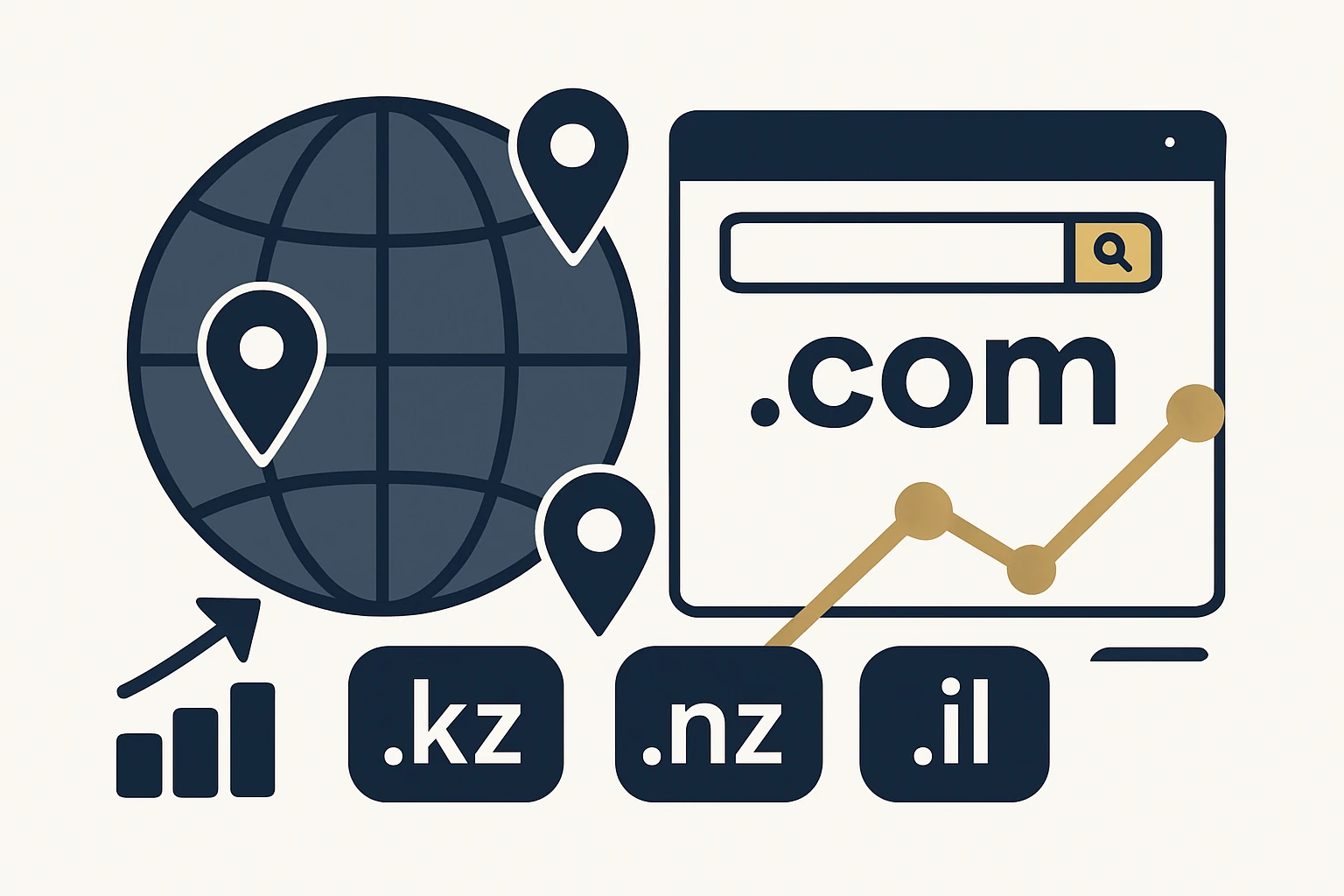
Global brands face a persistent challenge: how to secure premium digital real estate in diverse markets without exposing sensitive negotiations or tipping off competitors. For premium domain buyers and brand guardians, confidentiality combined with disciplined, country-aware strategy is not optional - it’s foundational. This article offers a practical, non-flashy playbook for building a confidential cross-border domain acquisition program, with a focus on three high-potential markets: Kazakhstan (KZ), New Zealand (NZ), and Israel (IL). It blends domain-market realism, structured decision-making, and a modest bias toward portfolio discipline, drawing on best practices from leading industry sources and the experience of a premium-domain brokerage perspective.
Why a country-aware domain strategy matters
Brand-safety and search visibility increasingly hinge on where a domain lives and how it is perceived in local markets. Country-code top-level domains (ccTLDs) carry local relevance that can boost recall, local trust, and even branding nuance. While a .com domain remains a universal anchor for many brands, country targets often warrant dedicated domains to signal geographic intent, support local marketing, and protect against opportunistic registrations. For instance, a well-chosen country domain can reinforce regional integrity, while ensuring that a brand’s broader portfolio does not become fragmented across dozens of market-specific names. For a deeper dive into how ccTLDs function, see industry overviews on country-code top-level domains.
Effective cross-border domain work also requires respecting local rules and market realities. Israel’s domain space, for example, has regulatory considerations around registrations and trademark alignment, while New Zealand’s open market typically offers broader acquisition avenues. These nuances underscore why a cross-border plan should combine market intelligence with disciplined governance. Learn more about country-code top-level domains.
A practical framework for evaluating Kazakhstan, New Zealand, and Israel domains
Developing a cross-border domain program begins with a practical, repeatable framework. We’ll use a four-part map - Market signals, Availability & valuation, Protection & governance, and Implementation plan (MAP) - to guide discovery, due diligence, and negotiation in each target market. The goal is to move from high-level ambition to concrete action while keeping confidentiality central to the process.
MAP Framework:
- Market signals: quantify local search demand, brand risk, and potential partners or competitors in each country. This helps prioritize domains that align with regional marketing and legal risk tolerance.
- Availability & valuation: assess whether the domain is legitimately available or privately held, and determine a defensible valuation based on comparable sales, renewal economics, and brand fit. If a name is highly desirable but privately held, a discreet broker relationship often yields the best path forward.
- Protection & governance: establish a governance model for the domain portfolio, including privacy controls, transfer security, and ongoing brand protection measures to prevent squatting or confusion with similar marks.
- Implementation plan: design a phased acquisition and transfer plan with clear milestones, responsible parties, and budget guardrails. This plan should accommodate country-specific escrow, regulatory, and transfer requirements.
To illustrate how this framework translates into action, consider a hypothetical cross-border program targeting Kazakhstan, NZ, and IL domains. The team would start by mapping regional search terms that matter to each market, identify candidate domains with high brand fit, and then engage a trusted broker in a confidential capacity to approach ownership discussions. The aim is to secure the optimal digital asset while maintaining a low public profile during negotiations.
As part of the market-mindset, many professionals rely on curated lists to understand the landscape. A practical step is to download lists by country or TLD as a starting point, then layer in due-diligence checks and brand-fit analytics. For cross-border teams, a structured repository of country-specific domains helps reduce duplication and risk over time.
How to conduct cross-border domain research for Kazakh (KZ), Kiwi (NZ), and Israeli (IL) markets
Country-specific research is not just about finding available names, it’s about understanding the ecosystem around each domain and how it interacts with local brands, law, and consumer behavior. Key steps include:
- Brand-fit screening: assess whether a domain name communicates the intended value proposition in the local market. Even minor spelling variants, regional pronunciations, or cultural nuances can impact recall and legitimacy.
- Trademark alignment: check for potential conflicts with local or regional marks. A domain that overlaps with a trademark can create costly litigation or redesign needs later, so early diligence is essential.
- Regulatory and privacy considerations: different jurisdictions impose varying privacy and data-transfer requirements on domain transactions and ownership. Aligning with best practices reduces risk and preserves confidentiality.
- Technical feasibility and renewal economics: ensure the domain has a sustainable renewal cost and technical readiness for hosting, redirects, and security measures.
In practice, the triad of Kazakhstan, New Zealand, and Israel offers a spectrum of opportunities and constraints. Kazakhstan’s market presents local-content considerations and regulatory scoping that can support country-aligned domains, while New Zealand generally offers broader domain accessibility for brand owners. Israel, with its mature tech ecosystem, demands careful IP due-diligence and alignment with local branding norms. The combination of market intelligence and disciplined vetting reduces the risk of overpaying for a domain that later underperforms. Industry voices emphasize that value in premium domains often comes from a combination of brand resonance, potential traffic, and the ability to preempt competitor moves - rather than a sole focus on keywords or price. Expert insight from premium-domain advisers suggests a rigorous due-diligence process, including legal checks and governance planning, before committing to purchase.
The confidential acquisition playbook: from discovery to transfer
Confidential, strategic acquisitions require a disciplined process that protects both buyer and seller, and preserves option value for post-close integration. The steps below outline a practical path, with a focus on confidentiality, risk management, and smooth transfer.
- Clarify strategic intent: document the brand intent, regional priorities, and non-negotiables (e.g., ownership privacy, governance, and renewal economics). This baseline helps guide conversations with brokers and sellers without revealing sensitive details publicly.
- Engage a discreet broker or mediator: a professional intermediary can approach owners privately, quantify seller motivation, and run a controlled negotiation. This aligns with best practices described by experienced brokers in the field. NameExperts emphasizes the initial assessment, price discovery, and security steps involved in premium-domain deals.
- Source and validate ownership discreetly: perform a private domain lookup to verify ownership history, hosting, and the absence of conflicting trademarks. This reduces post-close surprises and supports a clean transfer path.
- Negotiate with a guardrail approach: anchor discussions on market comparables and potential branding impact, while avoiding public bidding wars that can inflate prices. Industry sources highlight the value of non-public negotiation channels and transparent escrow to protect both sides.
- Escrow, IP and transfer readiness: set up a trusted escrow arrangement and a transfer plan that minimizes downtime. Escrow services are a standard safeguard in premium-domain deals, reducing counterparty risk during the transfer.
- Transfer and governance setup: upon close, configure DNS, redirect strategies, and privacy protections. Establish a governance framework for renewal management, domain portfolio integration, and ongoing brand-protection measures.
In practice, robust confidentiality is the default expectation in premium-domain acquisitions. The process often involves private outreach, controlled information sharing, and a staged transfer that minimizes public exposure until the deal completes. Industry practitioners emphasize that confidentiality should be embedded in every step - from initial approach to post-close ownership and governance. Tools and services that support secure, private transactions - such as reputable escrow and due-diligence providers - are essential components of a successful program.
Structured pathway (MAP) for cross-border growth:
| Stage | What to Do | Country Focus |
|---|---|---|
| Market intelligence | Identify region-specific branding needs, search demand, and competitive dynamics | Kazakhstan, NZ, IL |
| Access & valuation | Assess availability, verify ownership, and determine defensible pricing strategies | KZ, NZ, IL |
| Protection & governance | Set privacy controls, escrow, and portfolio governance to safeguard the asset | All |
| Execution & transfer | Coordinate a discreet acquisition, secure the transfer, and implement post-close branding | All |
Portfolio management across borders: integrating country domains
Once you secure valuable country domains, the next challenge is governance. A disciplined portfolio-management approach ensures that each asset supports the broader brand architecture while remaining cost-effective and auditable. Practical considerations include renewal budgeting, ownership transparency within the organization, and a clear policy for when a domain should be retained, re-purposed, or allowed to lapse. A well-managed cross-border portfolio reduces the risk of brand confusion, IP disputes, and missed growth opportunities. For organizations that want more structured guidance, mature players in the space treat portfolio management as a core capability - equivalent to other top-tier digital assets - rather than an afterthought.
To support ongoing governance, many teams rely on a centralized data stack linked to a country-portfolio repository, with clear decision rights and escalation paths. For teams seeking practical, ready-to-use resources, webatla offers a suite of capabilities designed to support confidential portfolio management, including country-level domain lists and RDAP/WHOIS data access, with a pricing model that reflects flexible, non-public engagement. See pricing for options and RDAP & WHOIS database utilities to inform due-diligence workflows. For broader country listings, you can also explore the country-index pages: domains by country.
Limitations, trade-offs, and common mistakes
No framework is perfect. The cross-border domain playbook benefits from discipline, but it also requires acknowledging practical constraints. Common mistakes include chasing high-priced assets without a clear business case, underestimating the complexity of cross-border transfers and regulatory compliance, and neglecting ongoing governance needs after acquisition. A disciplined approach, and a willingness to defer purchases until a strong strategic fit is shown, helps protect long-term brand value. Industry voices warn against overpaying for premium domains or pursuing acquisitions that do not align with brand strategy or regional growth plans.
An expert observation from a premium-domain adviser cautions that the most successful deals hinge on a combination of market fit, regulatory mindfulness, and a careful, confidentiality-first negotiation process. This underscores the value of working with experienced brokers who can balance speed, secrecy, and strategic fit. Entrepreneur highlights the importance of privacy shields and pre-arranged escrow to keep negotiations discreet while mitigating risk.
Limitations & common mistakes: quick recap
- Over-reliance on price without a clear business case or brand fit.
- Underestimating governance needs after close - renewals, privacy, and security must be planned.
- Public bidding or visibility that invites competitors to escalate prices and risk leakage.
Expert insight and a practical caveat
Expert insight: Industry practitioners stress that a thorough due-diligence process - legal checks, IP alignment, and governance planning - gives premium-domain deals their real, defensible value. This perspective is echoed by respected brokers who note that confidential negotiations and disciplined structuring are essential, especially when targeting market-specific domains in complex geographies.
For a deeper dive into practical acquisition tactics and the do’s and don’ts of premium-domain deals, see MediaOptions and NameExperts for concrete steps, negotiation levers, and risk controls that survive the private negotiation phase.
Conclusion: a practical, confidential path forward
Strategic cross-border domain acquisition for Kazakhstan, New Zealand, and Israel demands a disciplined framework, careful market intelligence, and governance rigor that extends beyond the close. A MAP-driven approach helps teams identify the right assets, structure discreet deals, and integrate new domains into a cohesive brand portfolio with clear risk controls. The right partner can provide the confidentiality, escrow, and governance capabilities to keep negotiations private and ensure a clean transfer. For brands seeking trusted, non-promotional guidance on confidential acquisitions and portfolio management, a professional advisory can harmonize market intelligence with governance disciplines to protect long-term brand value. If you’re evaluating next steps, exploring a confidential domain acquisition or portfolio-management engagement can be a prudent move. For more information about the client’s capabilities in this space, consider reviewing pricing, RDAP & WHOIS data, or country-domain lists to inform your approach: pricing, RDAP & WHOIS database, and domains by country.