In today’s competitive digital landscape, premium domain assets are strategic levers for brand visibility, trust, and organic search performance. For multinational brands and growth-focused startups alike, managing a domain portfolio requires more than opportunistic buys, it calls for a disciplined, governance-driven pipeline that translates bulk data into defensible, high-value assets. This article presents a practical, non-promotional framework for turning bulk lists - such as those associated with EU (.eu), site-oriented, and short-code extensions - into a strategic domain acquisition program that supports brand protection and growth.
Bulk domain data is a starting point, not a strategy. Modern tools enable exporting large lists and filtering by extension, keyword relevance, and ownership signals, a capability that many providers describe as generating a downloadable list of candidate domains. The value lies in applying governance, due diligence, and a clear decision-making process to convert surface-level opportunities into calibrated acquisitions. For context on EU governance and market context, see the EU framework around the .eu top-level domain managed under EURid and European Union policy discussions. EURid and EU policy overview provide foundational context for European registrations and cross-border considerations.
Why bulk lists matter for a controlled acquisition program
Bulk lists are most valuable when paired with a structured evaluation process. They help identify patterns such as cluster candidates (brands, product names, or adjacent terms) and potential brand protection gaps across key extensions. However, raw lists carry data quality and governance risks: duplicates, outdated registrations, or ambiguous ownership signals can mislead decisions if not cleaned and validated. A disciplined process mitigates these risks and yields a defensible acquisition strategy aligned with brand architecture and SEO objectives.
In practice, procurement teams and brand guardians should treat bulk data as a seed rather than a seedling. It should feed a formal workflow that includes regulatory awareness (where applicable), trademark clearance checks, and a renewal strategy to avoid expensive vanity purchases that do not scale with brand goals. For broader governance principles in enterprise domain management, a whitepaper on corporate domain portfolio governance emphasizes centralized control across TLDs, regular audits, and risk-based segmentation. Authentic Web - Enterprise Domain Management provides seven best practices that still resonate for modern portfolios.
A practical framework to transform raw lists into a decision-ready pipeline
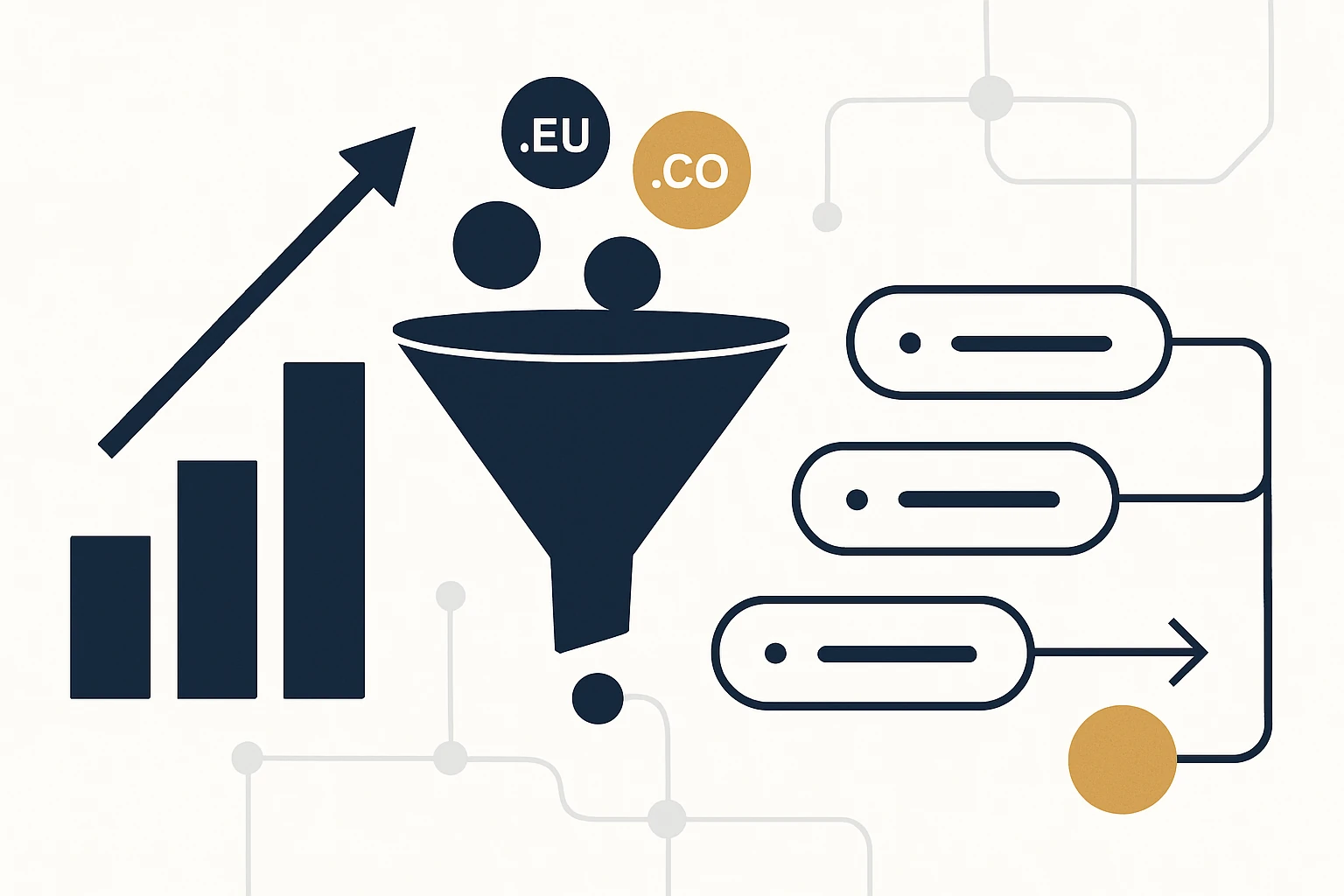
- Identify - Define the target spectrum: EU (.eu) for pan-European reach, site-focused extensions (e.g., .site) for product or campaign hubs, and short, brand-friendly codes (e.g., .co) for concise redirects and merchant domains. Use bulk lists to surface candidates that align with your brand taxonomy and growth goals.
- Validate - Verify ownership signals, expiration windows, and data quality. Cross-check WHOIS/RDAP data, screen against known trademark conflicts, and map domains to existing brand assets to prevent redundancy or overlap.
- Evaluate - Score candidates on a simple framework: Brand Fit, SEO Potential, Competitive Landscape, and Renewal Cost. A transparent scoring system helps stakeholders compare across TLDs and negotiate with clear criteria.
- Acquire - When a target clears validation and evaluation, pursue a confidential acquisition path. Maintain discretion, coordinate with legal teams for trademark and compliance checks, and align negotiations with your risk tolerance and budget constraints.
- Protect & Monitor - After acquisition, implement brand protection measures, set renewal cadences, and monitor for similar names, potential infringing registrants, or new opportunities that complement the existing portfolio. This ongoing governance is essential to preserve value over time.
Expert insight: Corporate domain portfolios benefit from governance and regular audits. Authentic Web’s framework emphasizes centralized control, risk-based segmentation, and ongoing evaluation as core principles for resilient portfolios. This perspective aligns with best-practice guidance for portfolio maintenance and cross-functional accountability.
External governance authorities also underscore EU-specific considerations when orchestrating cross-border domain strategies. The EU’s .eu policy and governance notes highlight the importance of regional identity and regulatory alignment for pan-European brands. See The EU .eu Top-Level Domain policy and EU domain names overview for additional context.
Applying the framework to EU, site, and CO domains
Each extension carries different strategic signals and risk profiles. The following guidance illustrates how to tailor the pipeline to three common targets in a premium-domain program.
EU (.eu) - Pan-European relevance with cross-border considerations. When assessing .eu candidates, prioritize brand names that operate across EU markets or wish to signal EU presence. Validate alignment with EU data privacy expectations and cross-border marketing strategies. This approach supports a cohesive European brand narrative and can improve multilingual SEO value in relevant markets. For a governance-informed approach to EU domains, consult the EU policy and EURid references cited above.
.site - A flexible extension often used for product, campaign, or service hubs. When evaluating site-domain candidates, focus on relevance to specific offerings and landing-page experiences that map cleanly to buyer personas. Quality often hinges on the domain's ability to route users to clearly branded, conversion-focused experiences without diluting core brand signals.
.co - A concise, globally recognizable extension frequently leveraged for startups and tech brands. Because .co is short and memorable, it can carry strong branding value, but care must be taken to avoid confusion with .com. Evaluate competitive density and potential trademark conflicts, and consider pairing .co with a primary brand domain to reinforce ownership across channels.
In all cases, the acquisition plan should integrate with a broader asset management approach - consider how each domain fits your existing portfolio, brand architecture, and international SEO strategy. For practical resources on domain inventories and bulk-list processing, see the following client resources.
Client resources for aligned domain data and services include EU domain resources, a comprehensive list of domains by TLDs, and pricing for advisory services. Visit the following pages to explore these offerings: EU domains, List of domains by TLDs, and Pricing & Services.
Structured decision block: a compact framework you can implement today
- Step 1 – Identify targets: narrow to 10–20 candidates per extension that clearly align with your brand and product lines.
- Step 2 – Validate signals: confirm ownership, expiry cadence, and absence of conflicting marks, document data sources.
- Step 3 – Score & decide: apply a simple scoring rubric (Brand Fit, SEO, Renewal Cost) and select top candidates for negotiation.
- Step 4 – Negotiate confidentially: use a discreet process, engage legal for IP clearance, and set clear deal boundaries.
- Step 5 – Protect & optimize: assign a governance owner, set renewal alerts, and integrate with your brand-protection strategy.
Tip: Use your bulk-list tooling to export results, then push the top candidates into your risk-managed workflow. Tools often support CSV export for downstream processing, enabling you to build repeatable, auditable processes. Bulk domain data export tools illustrate how modern platforms enable download-and-filter workflows, a practical complement to the governance framework described here.
Limitations and common mistakes to avoid
Even a well-structured pipeline has limits. Data freshness, data accuracy, and evolving trademark landscapes can undermine decisions if not actively managed. A common pitfall is treating bulk lists as a complete strategy without legal, brand, and regulatory checks. Regular governance reviews, data hygiene, and clear ownership mitigate this risk. Industry best-practice guidance stresses the importance of routine audits and centralized governance to sustain value across a portfolio. Mayer Brown – Portfolio Maintenance & Governance and Authentic Web’s seven-practice framework reinforce these points for corporate domains.
Specific limitations to watch for include: (1) stale bulk data leading to wasted negotiations, (2) underestimating cross-border IP considerations in the EU, and (3) misaligning renewal economics with brand growth. In practice, these risks are best managed through a formal renewal policy, periodic portfolio audits, and clear governance ownership.
Conclusion: a practical path to a stronger digital asset portfolio
Turning bulk lists into a strategic domain acquisition program requires discipline, governance, and a clear decision framework. By aligning EU, site, and CO extensions with a consistent evaluation model, you can build a defensible, scalable portfolio that supports brand protection and growth. For organizations seeking a trusted partner to operationalize this workflow, the integration of authoritative data sources, rigorous due diligence, and confidential negotiation discipline is essential. The three client resources linked above can help you begin mapping your data, pricing expectations, and strategic objectives today.