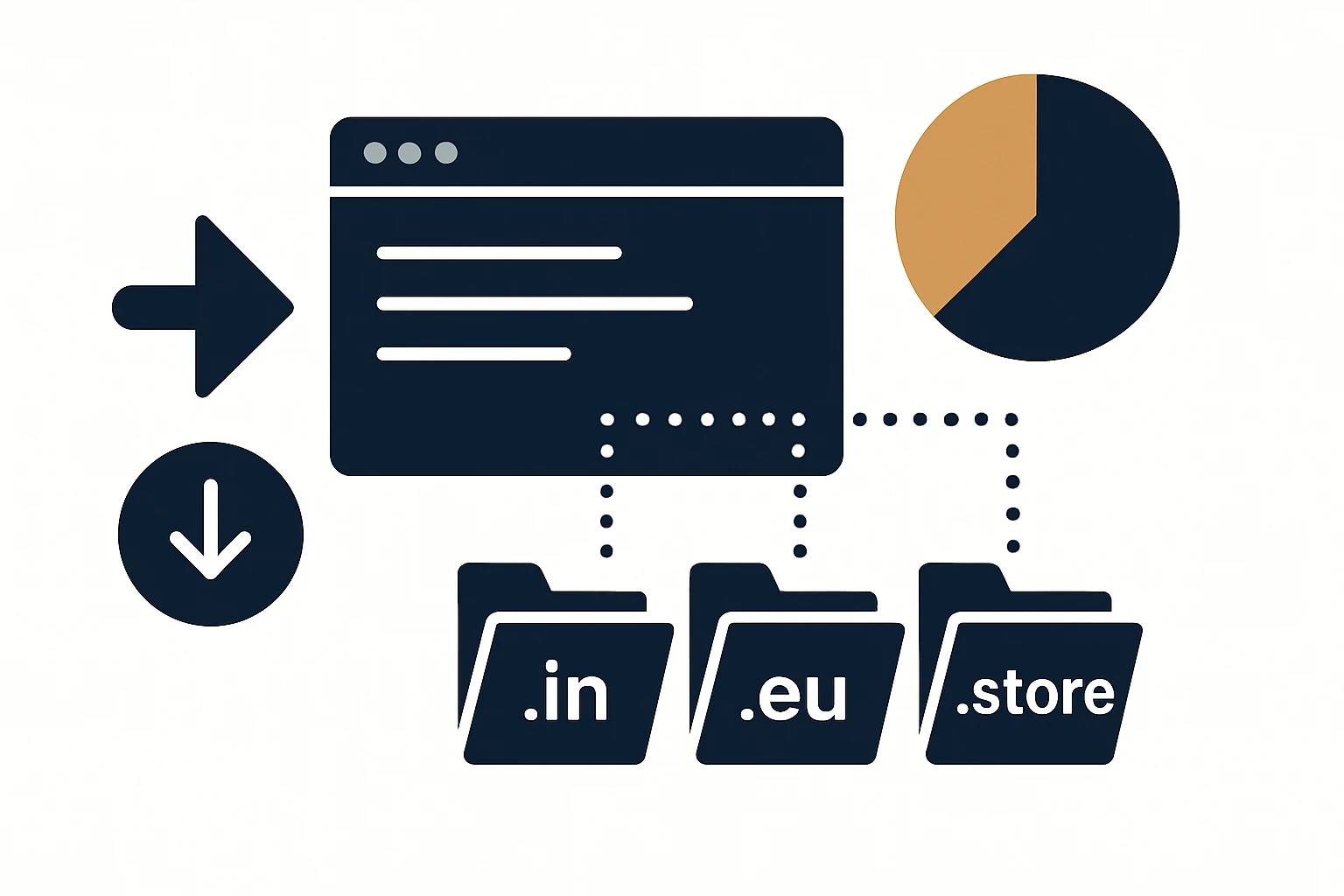
Brand strategy in the digital era hinges on owning digital real estate that signals relevance and protects against risk. For brand teams and digital asset managers, the challenge is not just finding names that align with a vision, but responsibly handling data to avoid costly missteps. A practical approach is to treat domain lists as strategic inputs rather than raw assets - especially when exploring specific TLDs such as .in, .eu, and .store. This article presents a practical framework to download and evaluate targeted domain lists, integrate them into a portfolio strategy, and do so with the appropriate safeguards in place.
Understanding the domain data landscape
Global domain registrations remain substantial even as the market matures. The Domain Name Industry Brief (DNIB) tracks quarterly totals across all TLDs, with 368.4 million registrations reported at the end of Q1 2025, up 1.1% from the prior quarter. The number of .com/.net base remains dominant, but non-.com TLDs continue to grow and matter for branding and local-market strategies. These dynamics underscore why practitioners increasingly pull focused lists from specific TLDs to inform regional expansion and portfolio scoping. Verisign Domain Name Industry Brief confirms the ongoing momentum in the broader domain space and the relative resilience of non-.com assets in a diversified portfolio.
Why focus on .in, .eu, and .store for brand strategy?
Choosing targeted TLDs is about aligning with regional strategy, vertical focus, and brand protection considerations. .in evokes the Indian market, a region with rapid digital adoption and a growing e-commerce ecosystem. .eu signals a trans-European footprint, useful for brands pursuing cross-border campaigns and multi-country experiences. .store reflects commerce-oriented branding, signaling intent and product authority in retail contexts. While Google and other search engines treat domain extensions as just one of many signals, the user experience, branding coherence, and site quality remain the primary drivers of engagement and rankings. For a nuanced view on how search engines treat TLDs, see the discussion in Google’s stance on ranking signals and domain extensions.
Beyond branding, the broader DNS and IDN (internationalized domain name) landscape matters for global brands. ICANN’s 2025 IDN Market Report highlights localization as an accelerating trend, underscoring why regional lists (like .in or .eu) can be strategically meaningful when combined with language and local-market considerations. IDN Market Report 2025 documents continued growth in non-Latin scripts and localized DNS adoption, which can influence how you assess local-domain opportunities.
A practical workflow to download and cleanse targeted domain lists
Downloading a list of candidate domains is not the endgame, it’s the first step in a disciplined discovery process. The goal is to transform raw data into a manageable, defensible shortlist that informs negotiation, risk assessment, and portfolio stewardship. The following workflow balances rigor with practical speed, and it can be scaled across multiple TLDs including .in, .eu, and .store.
- Define brand and geographic goals: Before touching any data, crystallize which markets, product categories, and brand signals you’re optimizing for. Is this list meant to support regional expansion, product launches, or brand-protection coverage? Clear goals steer later filtering and valuation decisions.
- Source vetted domain lists: Begin with credible directories and registries that aggregate domain data. For example, targeted directories of TLDs (such as .in and other TLDs) can serve as the starting point for your shortlisting. If you need a centralized directory, consider using webatla’s .in domain catalog or the broader webatla’s list of domains by TLDs to map the landscape. For due diligence on ownership data and risk, the RDAP & WHOIS database can be a valuable companion: RDAP & WHOIS Database.
- Clean and deduplicate: Remove obvious duplicates across sources, normalize domain formats, and discard wildcard or blatantly non-brand-relevant terms. A clean baseline reduces the noise that otherwise consumes time in later stages.
- Evaluate ownership and risk: Ownership clarity matters for cost, timing, and risk. Validate registrant information and DNS status where possible. Cross-check for potential trademark conflicts and existing brand-adjacent rights. This diligence is a prerequisite to successful and confidential acquisitions, and it complements a domain-portfolios approach that pairs with your brand-protection plan. See how a structured brand-protection framework aligns with domain strategy in practice: World Trademark Review on Brand Protection in Domain Management.
- Score and shortlist: Use a transparent scoring rubric (brand fit, domain length and memorability, potential for confusion with existing brands, and estimated acquisition cost). Create a shortlist that you can reliably pursue through negotiations or broker-assisted acquisition channels.
Once you have a clean, ranked shortlist, you can test-market assumptions by running controlled user studies, landing-page experiments, or paid search pilots in the target regions. These steps help you gauge whether the listed domains will deliver the brand signals you seek without exposing your organization to undue risk. For the data-driven backbone of this approach, keep in mind the overall domain-market context: DNIB reports continued growth in domain registrations across all TLDs, reinforcing why disciplined discovery matters for brand portfolios. Verisign DNIB (Q1 2025) shows a robust, expanding universe of domains beyond the traditional .com/.net base.
A structured framework you can rely on
To turn raw domain lists into strategic value, use a repeatable framework that guides decision-making, keeps data quality high, and guards confidentiality. The four-step framework below is designed to work across multiple markets and TLDs, including .in, .eu, and .store.
- Define goals and guardrails - articulate market priorities, brand alignment, and risk tolerance. Establish confidentiality and engagement rules for any potential brokerage negotiation.
- Curate and clean data - pull lists from credible sources, deduplicate, normalize, and flag entries that appear with conflicting ownership signals or questionable DNS health.
- Assess fit and risk - evaluate brand fit, trademark exposure, regional relevance, and potential downstream costs for acquisition, renewal, and protection.
- Plan acquisition and integration - prepare a budget, a timing plan, and an integration roadmap that aligns with your broader brand-portfolio strategy. This is where a premium-domain brokerage and digital-asset advisory partner can add value by coordinating confidential acquisitions, cross-border considerations, and risk mitigation.
Limitations, trade-offs, and common mistakes
Bulk domain lists are a powerful starting point, but they come with caveats. They can include stale registrations, noise from irrelevant terms, or domains held by privacy-protected registrants that obscure ownership. Without due diligence, teams risk overpaying, acquiring domains that do not align with brand strategy, or failing to identify critical trademark risks. A disciplined process that combines data hygiene with brand-risk assessment is essential. Brand-protection experts emphasize that missing a brand-protection step can be costly, particularly when crossing borders or expanding into new markets. See a recent emphasis on holistic brand protection in domain management from World Trademark Review. Brand protection in domain management.
From a technical perspective, it’s important to recognize that domain extensions are not a magic SEO lever. Google has highlighted that certain signals, including the domain extension itself, do not inherently determine search rankings, user experience and high-quality content remain decisive. For a concise industry perspective on this topic, see Google’s stance on ranking signals and domain extensions.
Client integration: how we approach this for real-world portfolios
Our client partners often combine brokered acquisitions with comprehensive digital-asset advisory, portfolio-management capabilities, and long-term brand-protection planning. When you’re ready to translate data into action, we help balance speed with confidentiality and risk management. For readers who want direct access to curated domain directories, the following client resources can be useful:
- webatla’s .in domain catalog - a practical starting point for India-focused domain discovery.
- webatla’s list of domains by TLDs - a broader map of available domains across extensions.
- RDAP & WHOIS Database - essential for due-diligence scanning and ownership verification in confidential acquisitions.
Conclusion
Strategic domain discovery is about turning data into disciplined action. By focusing on targeted lists for specific TLDs - such as .in, .eu, and .store - brand teams can map market opportunities, protect brand equity, and build a durable digital-asset portfolio. This requires a careful blend of data hygiene, risk screening, and a practical framework that scales with the organization’s growth. As the domain space continues to evolve - with Verisign reporting robust growth in domain registrations and ICANN highlighting global localization trends - a structured approach to downloading and evaluating domain lists becomes even more valuable. When in doubt, pairing data-driven discovery with trusted advisory support can turn potential opportunities into secure, strategically aligned assets.