
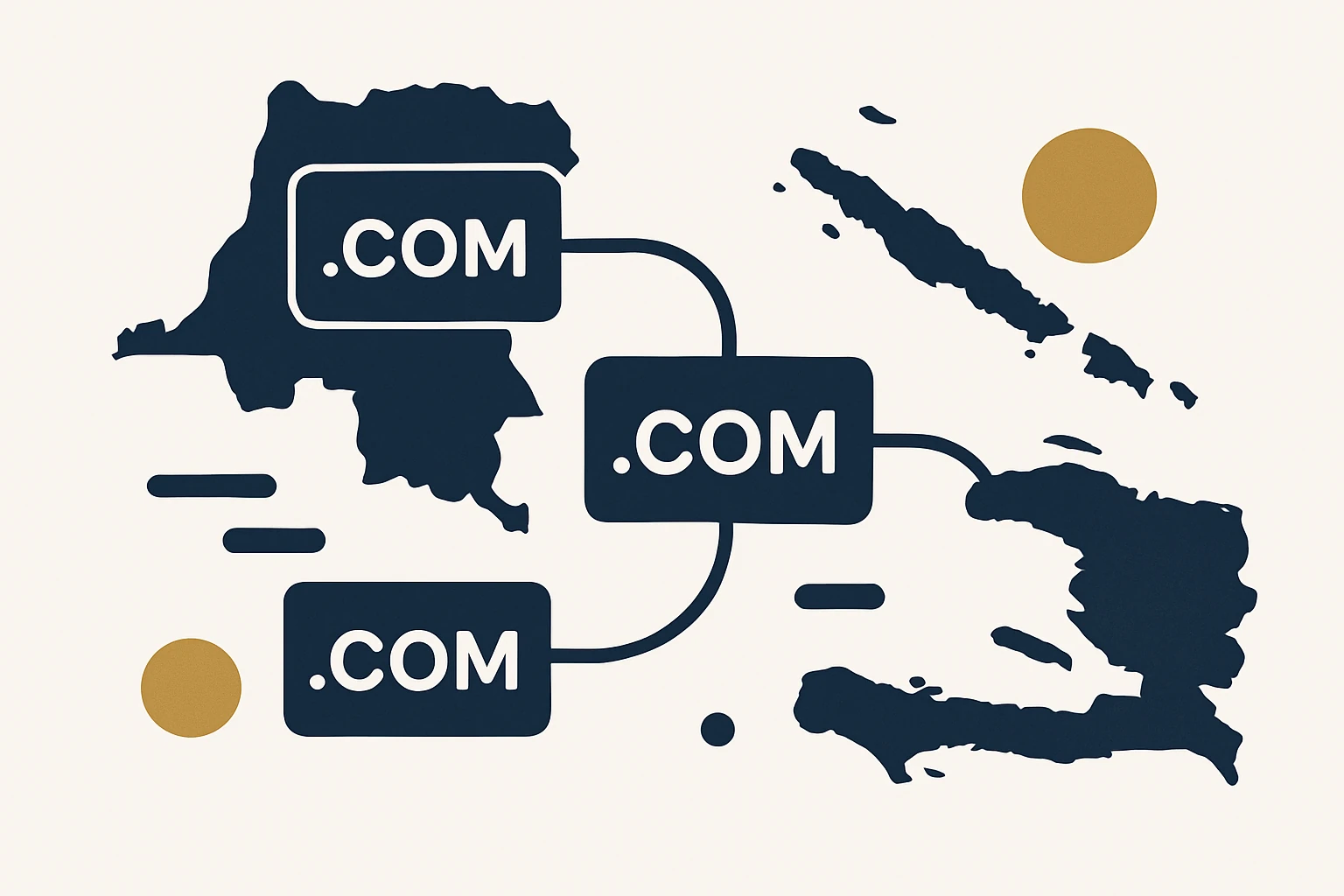
Introduction: why emerging markets demand a disciplined domain strategy
As brands expand into Africa, the Pacific, and the Caribbean, many overlook the strategic value of premium domains beyond mere naming. A disciplined approach to domain acquisition, portfolio governance, and risk management can unlock growth while safeguarding brand equity. This article outlines a practical framework tailored for emerging markets, using Congo, Solomon Islands, and Haiti as use cases to illustrate decisions, trade-offs, and common pitfalls. Recent data underscore that the domain market remains robust and dynamic: in the first quarter of 2025, total global domain registrations reached 368.4 million across all top-level domains, signaling continued demand for digital real estate across geographies. Verisign DNIB Q1 2025 (investor.verisign.com)
Section 1: framing the opportunity in Congo, Solomon Islands, and Haiti
Emerging markets present both opportunity and risk for domain portfolios. A careful alignment between digital assets and local market realities supports brand protection, local engagement, and scalable growth. For practitioners, this means moving beyond a generic registry strategy to a country-aware approach that considers local regulatory environments, language, e-commerce maturity, and regional partners. While the global domain market shows growth, the risk landscape is active: World Intellectual Property Organization (WIPO) reports thousands of domain-name disputes under the UDRP policy each year, underscoring the importance of proactive brand protection and due diligence. WIPO Domain Name Disputes (wipo.int)
In practice, this means establishing governance around a country-focused portfolio - one that integrates trademark clearance, clearance checks in local registries, and proactive monitoring for potential cybersquatting. A disciplined approach also recognizes that country-code top-level domains (ccTLDs) may carry brand equity that is culturally or economically meaningful in ways generic domains do not. For deeper policy context on dispute resolution and governance, see WIPO’s guidance on UDRP and related dispute frameworks. WIPO Guide to the Uniform Domain Name Dispute Resolution Policy (wipo.int)
Section 2: a practical framework for confidential domain acquisition and portfolio governance
The following framework distills best practices from premium domain strategy and digital asset advisory work. It is designed to be implemented with a client’s internal stakeholders and external brokers in a way that protects confidentiality while delivering tangible brand outcomes.
- Define strategic fit - Map domain opportunities to core brand narratives, product lines, and regional go-to-market plans. Prioritize assets that unlock new markets or prevent brand confusion in high-potential territories.
- Assess risk and compliance - Conduct trademark clearance, monitor potential conflicts, and plan for UDRP/URDP-style dispute scenarios where applicable. Use structured risk scoring to compare alternatives. WIPO Domain Name Disputes (wipo.int)
- Evaluate ownership and provenance - Verify registrant history, DNS stability, and potential privacy constraints. Confidential acquisition requires documented due diligence and controlled information flows.
- Estimate total cost of ownership - Include registration, renewal, privacy services, and potential renewal-price escalators on long-hold assets.
- Plan for integration and governance - Define ownership, decision rights, and monitoring cadence within the client’s governance model, align with brand-protection and risk-management teams.
- Define exit and renewal criteria - Set thresholds for when to acquire, hold, monetize, or divest a domain based on market changes, trademark developments, or strategic pivots.
For policy context on dispute resolution and practical governance, refer to the UDRP framework and jurisdiction considerations noted by WIPO. UDRP Guide (wipo.int)
Section 3: the Congo, Solomon Islands, and Haiti use-case: unique considerations
The Congo (CG), Solomon Islands (SB), and Haiti (HT) present distinct digital ecosystems. Key considerations include local language prevalence, the maturity of domestic digital commerce, and the availability of regionally relevant top-level domains that complement a global portfolio. A country-aware approach also means tailoring due-diligence processes to local registry rules, privacy norms, and enforcement mechanisms. In practice, the vendor and broker teams should assemble a country-focused mini-portfolio that can be expanded or contracted as the business expands or pivots. The broader market backdrop - driven by continued growth in global domain registrations - supports opportunistic yet disciplined acquisitions rather than broad, indiscriminate purchasing. See the VeriSign DNIB for the latest market context. Verisign DNIB Q1 2025 (investor.verisign.com)
Section 4: the role of a premium domain brokerage and digital asset advisory partner
In emerging markets, a premium domain brokerage and digital asset advisory partner can coordinate confidential acquisition, portfolio sequencing, and ongoing protection. The value lies not only in legally acquiring a coveted domain name but in aligning that asset with brand strategy, regulatory risk, and local market realities. A reputable partner helps with due diligence, negotiation leverage, and ongoing governance to ensure that domain investments deliver durable, revenue-generating outcomes. The client resources below demonstrate how a global broker can support country-specific strategies while preserving confidentiality and strategic focus.
Practical steps often include performing a risk-adjusted opportunity set, selecting a handful of high-potential domains, and implementing a portfolio-management rhythm that tracks renewal risk, performance, and brand alignment. The goal is not to own as many names as possible, but to own the right names that reduce friction for customers finding, trusting, and buying from the brand.
Section 5: limitations, trade-offs, and common mistakes
No framework is perfect, and domain strategy is no exception. Below are key limitations and common missteps to avoid when building portfolios in emerging markets.
- Overestimating immediate branding payoff - A premium domain can support trust, but it is not a standalone brand, it requires integrated marketing and user experience to realize value.
- Underestimating local enforcement challenges - Trademark protection and dispute resolution may unfold differently across jurisdictions, plan for local legal counsel and jurisdiction-specific strategies. See WIPO dispute framework for context. UDRP Guide (wipo.int)
- Neglecting ongoing portfolio governance - Portfolios require governance processes, monitoring, and renewal risk management, ad hoc ownership can erode value over time.
- Assuming confidentiality is absolute - Even with careful processes, some information may need to be disclosed in legal or commercial contexts, prepare a controlled disclosure strategy.
- Ignoring total cost of ownership over time - Renewal escalators, privacy services, and regional regulatory changes can alter TCO, model TCO across the asset’s life cycle.
Section 6: a practical framework for evaluation and decision-making
The following concise framework helps teams evaluate opportunities quickly and consistently. Use it to rank candidates, inform negotiations, and justify decisions to executive sponsors.
- Opportunity alignment - Does the domain reinforce current or planned growth initiatives in Congo, Solomon Islands, or Haiti?
- Brand protection impact - Will the asset prevent confusion or misrepresentation in key markets?
- Risk profile - Is there trademark risk, policy complexity, or enforcement friction in jurisdictional contexts?
- Acquisition feasibility - How difficult is it to acquire via confidential channels without public exposure?
- Total cost of ownership - What are the expected renewal costs, privacy costs, and potential price escalations?
- Portfolio fit - Does the asset complement existing holdings or enable a strategic expansion?
Note: The landscape for domain disputes is active, organizations should be prepared for UDRP or local dispute proceedings if needed. See WIPO's dispute overview for governance reference. WIPO Domain Name Disputes (wipo.int)
Section 7: expert insight
Industry practitioners emphasize that the strongest portfolios are built around quality and strategic fit rather than sheer volume. A disciplined approach prioritizes high-utility domains that clearly support brand clarity, regional relevance, and user trust. In practice, success hinges on rigorous due diligence, a well-defined governance model, and a clear plan for renewal risk and lifecycle management. This perspective aligns with the broader policy and dispute-resilience framework championed by WIPO and the ongoing market context illustrated by VeriSign’s quarterly updates. Verisign DNIB Q1 2025 (investor.verisign.com)
Section 8: practical resources and next steps
For brands pursuing a confidential, disciplined approach to domain acquisitions and digital asset advisory, consider integrating country-specific research with a structured portfolio governance model. Begin by prioritizing a tightly scoped set of geographies and product lines, then expand as market signals warrant. The Congo country page and our research database can help seed a country-focused initiative:
Explore practical country-focused research and governance through client resources: Congo country page and our RDAP & WHOIS Database resources. These assets illustrate how a brokered approach can balance confidentiality with rigorous due diligence, ensuring you move from data to decisions with confidence.
Conclusion: turning opportunity into durable advantage
Emerging markets offer meaningful growth potential, but only when domain strategies are embedded in broader brand, risk, and governance frameworks. By following a disciplined framework for confidential acquisitions, portfolio management, and ongoing protection - and by leveraging a partner with global reach and local sensitivity - brands can build durable digital asset strategies tied to Congo, Solomon Islands, and Haiti as legitimate growth channels, not afterthoughts. The domain market remains active and dynamic, reinforcing the case for a thoughtful, governance-first approach to premium domain portfolios.