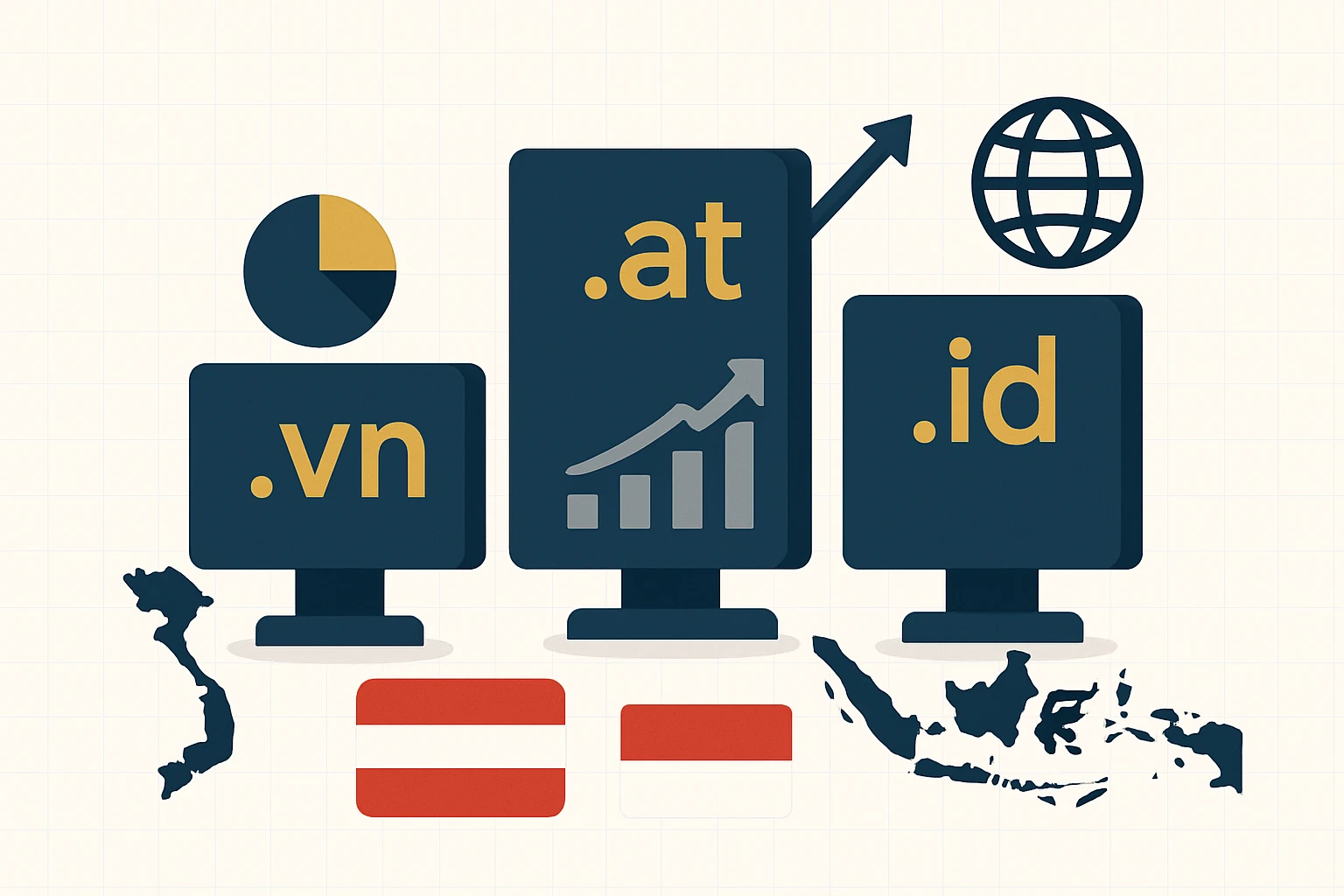
Introduction: ccTLDs as strategic assets for global brands
Country-code top-level domains (ccTLDs) are more than regional suffixes, they are strategic assets that can signal local relevance, improve trust, and influence search visibility across markets. For brands pursuing global growth, a thoughtful ccTLD strategy can complement a traditional global domain portfolio by strengthening regional signals, enabling localized branding, and reducing the risk of cybersquatting in key markets. The governing logic is simple: local domains matter when consumers in a given country expect a locally branded address, and a disciplined approach to acquisition, management, and protection can unlock long-term value. This article outlines a practical framework to evaluate VN, AT, and ID ccTLD opportunities, with real-world considerations drawn from regulatory guidance, market dynamics, and portfolio governance. ICANN itself notes that ccTLDs are country-targeted namespaces with registration rules that vary by registry, underscoring the need for thorough due diligence and governance. (icann.org)
The strategic value of country-code domains in a global portfolio
ccTLDs carry symbolic and practical weight for local audiences. In many markets, consumers associating a brand with a local suffix can boost trust, conversion rates, and perceived commitment to the market. For multinational brands, a well-structured ccTLD strategy can also function as a risk-control mechanism: it creates clear governance boundaries, reduces ambiguity about ownership, and provides a framework for local content localization and regulatory compliance. However, not all ccTLDs are equally valuable or feasible, the benefits hinge on market size, regulatory regimes, privacy considerations, and the cost of ongoing management. Industry sources emphasize that while the UDRP (Uniform Domain Name Dispute Resolution Policy) offers a widely used path to resolve disputes across many TLDs, the landscape for ccTLDs can be more variable and registry-specific. (icann.org)
Country profiles: VN, AT, and ID - what to know before you buy
Vietnam: .vn and targeted growth in a rising digital economy
Vietnam’s national domain, .vn, has grown steadily, with reports indicating more than 610,000 registrations and a push to expand digital services and e-government initiatives. Notably, the Vietnamese government has introduced policies that encourage local registrations (including two years of free registration for certain second-level domains like biz.vn and id.vn) to accelerate digital adoption and local business registration. These dynamics create both opportunity and diligence requirements for brands seeking country-specific presence. In practice, this means evaluating not just the name value but alignment with local regulatory incentives, registrar networks, and post-registration management. (en.vietnamplus.vn)
For brand custodians, Vietnam also signals the importance of local data practices and enforcement of cyberspace rules as e-commerce and digital services expand. Recent regulatory developments underscore the need to monitor domain-name governance alongside broader cyberlaw changes, including enforcement of IP rights and domain-name administration. This is where a structured due-diligence process - particularly around local registrars, WHOIS data handling, and renewal economics - becomes critical. (conventuslaw.com)
For readers exploring Vietnam from a portfolio perspective, practical signals include market maturity indicators and public policy moves that favor local-domain registrations as part of broader digital economy strategies. Practitioners often combine market intelligence with a disciplined evaluation of domain names that map to local consumer intents, brandable opportunities, and the potential for regional marketing hubs. The evolving Vietnamese landscape invites a considered approach to due diligence and governance when contemplating premium domain acquisitions in VN. (archive.opengovasia.com)
Austria: .at, GDPR, and privacy-conscious namespace governance
Austrian ccTLD .at sits within the broader European privacy and data-protection regime. The GDPR shapes how registries display and manage Whois data, with privacy considerations affecting access to registrant information. In practice, brands pursuing .at should anticipate privacy-compliant Whois practices, clear data handling policies, and a registry that operates within EU data-protection standards. Understanding these nuances is essential when designing a local presence that also preserves brand integrity across the EU. For registrants and potential acquirers, this means incorporating privacy-by-design in the domain strategy, especially where legacy Whois visibility could impact risk management and partner outreach. (nic.at)
The Austrian experience illustrates a broader point relevant to many EU markets: GDPR-driven privacy controls can influence search visibility, link-building strategies, and brand protection workflows. A disciplined approach to WHOIS privacy, data minimization, and registry policy compliance can help sustain a resilient domain portfolio in Europe. (nic.at)
Indonesia: .id and the Southeast Asian expansion play
Indonesia’s ccTLD landscape - centered around .id and co.id - reflects a large, digitally active market with a strong registry ecosystem. Registries like PANDI coordinate domain policy, RDAP privacy, and registrar partnerships, shaping how brands should approach Indonesian domains. For buyers, this translates into practical considerations around local licensing, registrar selection, and potential tiered registrations (for individuals vs. organizations) to optimize cost and control. The presence of registries with documented RDAP and registrar networks supports a careful, rules-based approach to Indonesian domain acquisitions. (en.wikipedia.org)
From a strategy standpoint, co.id and other Indonesian second-level registrations offer a meaningful pathway for regional brand localization, customer trust, and search signals in Southeast Asia. As with VN and AT, a robust Indonesian-domain plan should couple numeric indicators (market size, growth trajectories) with governance considerations (privacy, data retention, and dispute-resolution readiness). (en.wikipedia.org)
A practical evaluation framework for ccTLD opportunities in VN, AT, and ID
To help brands translate market signals into a defensible ccTLD portfolio, use a structured framework that links market potential to governance and cost. The following framework distills key decision levers and maps them to VN, AT, and ID dynamics. The framework is designed to be concrete, so you can operationalize it in portfolio reviews, regulatory risk assessments, and vendor negotiations.
- 1) Market alignment and brand intent: Assess whether a local ccTLD supports core brand objectives in each market (trust signals, local search visibility, and regional marketing efficiency). In VN, the local market size and regulatory incentives can amplify impact if you intend to run market-specific campaigns, in AT, aligning with EU consumer expectations and data rules matters, in ID, consider regional expansion Roadmaps to Southeast Asia. (Use market data to justify portfolio choices.)
- 2) Legal and IP risk management: Evaluate potential conflicts with existing trademarks, UDRP risk exposure, and local dispute mechanisms. The UDRP is a widely used mechanism in gTLDs and many ccTLDs, but governance varies by registry. Build a risk map that includes anticipated dispute costs and escalation paths. (icann.org)
- 3) Privacy, data handling, and compliance: Anticipate how GDPR in Austria affects Whois visibility and data processing, and how Indonesia’s RDAP and local privacy practices shape access to registrant data. Plan for privacy-by-design in registration workflows and partner communications. (domainnamewire.com)
- 4) Technical readiness and regional hosting: Ensure DNS reliability, regional performance, SSL availability, and registrar compatibility. Local registries often publish technical and policy details that affect implementation timelines and renewal costs. (icann.org)
- 5) Portfolio economics and renewal risk: Model the full cost of ownership (initial registration, renewal, potential premium pricing, and renewal risk across multiple years) against anticipated ROI from local brand signals and conversions. Consider the total cost of ownership in each market, including potential incentives or regulatory changes. (icann.org)
Structured framework for evaluating ccTLD opportunities
The following structured block provides a concise framework you can print out or export for governance reviews. Use it as a checklist during due diligence, negotiations, and ongoing portfolio management.
- A. Market fit assessment - market size, growth trajectory, and alignment with brand goals in VN, AT, ID.
- B. Legal risk and dispute readiness - trademark checks, UDRP/RDRP considerations, and registry dispute policies.
- C. Privacy and data governance - GDPR implications (EU markets) and local privacy rules (ID, VN) that affect Whois data handling and contact information.
- D. Technical and operational readiness - DNS stability, registrar network, and hosting options for localized content.
- E. Economic model - registration costs, renewal fees, potential premium pricing, and projected ROI.
Guided application: applying the playbook to VN, AT, and ID
How should a brand approach each market with this framework? Here is a practical lens to apply when considering premium domain acquisitions in VN, AT, and ID, and how to weave these domains into a cohesive global portfolio.
Vietnam (VN): local presence with government support signals - Focus on core brand terms that map to Vietnamese consumer intent and complementary second-level domains. Given the government’s twin priorities of digital economy expansion and simplified domain registration, a disciplined approach to value creation includes assessing sNDS (secure, localized, and scalable) hosting, content localization, and a clear ownership and renewal strategy to capture market share while mitigating the risk of price volatility. For due diligence, examine registrar networks, local policy updates, and renewal economics, monitor policy shifts that could alter domain availability or costs. The government has shown a willingness to incentivize local registrations, which can amplify ROI for well-timed acquisitions. (en.vietnamplus.vn)
Austria (AT): EU privacy considerations and brand trust - In EU markets, Whois privacy and GDPR-driven regulations shape how registries present registrant data and how brands can contact and partner with local owners. If your strategy includes Austrian presence as a hub for German-speaking markets, plan for privacy-centric workflows and robust domain governance to support audits and partner outreach. Align your registry interactions with EU privacy expectations to avoid friction in legal and marketing activities. (nic.at)
Indonesia (ID): regional scale with registrar ecosystems - Indonesia presents an expansive growth opportunity in Southeast Asia. The registry ecosystem, RDAP policies, and registrar partnerships influence how you structure registrations, renewals, and brand protection in the region. Consider tiered registrations (co.id, id.id, and others) based on target segments, and ensure your approach accounts for local dispute resolution and enforcement norms. (en.wikipedia.org)
Practical considerations: data sources, diligence, and risk controls
When evaluating ccTLD opportunities, practitioners frequently supplement market insights with domain-specific diligence. A pragmatic tactic is to compile a map of local online assets to gauge potential brand clashes, search behavior, and competitive presence. For example, in VN, mapping Vietnam-based properties and competitive domains can help determine whether acquiring VN-based brandable domains creates a defensible moat or distracts from core branding goals. Industry reports highlight how digital economy momentum in VN supports the value of local domains, while also underscoring the need for governance that aligns with local regulatory developments. Vietnam’s domain-name market dynamics and related regulatory updates provide a practical backdrop for due diligence. (en.vietnamplus.vn)
In addition, credible guidance from international bodies helps frame risk management. The Uniform Domain Name Dispute Resolution Policy (UDRP) serves as a common framework for disputes across many gTLDs and is used in ccTLDs where registries adopt it or a registry-specific equivalent. Understanding UDRP mechanics and typical cost structures can improve decision-making during negotiations and post-acquisition enforcement. (icann.org)
Limitations and common mistakes
- Overestimating ccTLD value without market validation: Local affinity and regulatory incentives matter, but the marginal ROI depends on a sound localization plan and continuous governance. (ICANN’s ccTLD overview and market discussions highlight the variability across registries.)
- Underinvesting in governance and privacy: GDPR and regional privacy regimes can complicate Whois access, brand outreach, and partner integrations if not planned for in the acquisition and ongoing management. (domainnamewire.com)
- Ignoring dispute-resolution costs and timelines: While UDRP is a standard mechanism for many domains, ccTLDs may have registry-specific processes with different timelines and costs. It pays to map these early in negotiation. (icann.org)
- Failing to localize content and hosting: A local suffix can signal presence, but without region-appropriate content, it may not translate into meaningful competitive advantage. Technical readiness is essential for a credible local brand experience. (icann.org)
- Acquiring too many low-value domains: A portfolio built around aspirational, non-strategic domains can dilute governance and erode ROI. A disciplined framework helps avoid vanity acquisitions. (icann.org)
Case study lens: how a disciplined ccTLD playbook comes to life
Consider a multinational brand evaluating a triad of ccTLDs to support cross-border marketing and regional e-commerce. The playbook translates into concrete steps: build a regional intent map (VN for local brand presence, AT for EU trust and privacy compliance, ID for Southeast Asia expansion), run a formal due-diligence process that covers legal risk, data privacy, and renewal economics, and design a portfolio framework that ties each domain to a specific regional objective (site localization, regional landing pages, or regional SEO signals). In parallel, engage a knowledgeable broker or advisory partner who can navigate registry policies, registration cost structures, and renewal calendars while aligning with your overall brand strategy. For readers who want a practical example of this approach, webatla provides Vietnam-focused advisory capabilities that illustrate how to map country portfolios and negotiate premium domain names in VN markets. webatla Vietnam page and RDAP & WHOIS Database offer a glimpse into how an advisor can support disciplined ccTLD acquisitions that align with broader brand goals.
Conclusion: turning ccTLD potential into a portfolio discipline
ccTLDs present a meaningful opportunity for brand-building, risk management, and regional market acceleration - provided they are governed by a disciplined framework that connects market intent, legal risk, data privacy, technical readiness, and economics. Vietnam, Austria, and Indonesia illustrate how diverse regulatory and market contexts shape the value and feasibility of ccTLD investments. When integrated with a robust due-diligence process and a clear governance structure, a country-code portfolio can complement traditional global domains, reducing risk while enhancing regional resonance. As you consider next steps, align your ccTLD decisions with your brand’s regional roadmaps, validate claims with credible market and regulatory sources, and partner with experienced professionals who can translate strategy into disciplined execution. For brands exploring this path, a practical, framework-driven approach - one that can be tailored to VN, AT, and ID contexts - offers the best chance of sustainable value creation over time.
Additional reading and resources
For broader context on ccTLD governance, dispute resolution, and privacy considerations across markets, see: ICANN UDRP overview and WIPO’s Uniform Domain Name Dispute Resolution Policy guide. For VN market context, see Vietnam’s domain-name market dynamics.
Note: webatla’s Vietnam-focused services illustrate how to map country portfolios and negotiate premium domain names in VN markets. See webatla Vietnam page for more. If you need a broader view of domain data, consider the public RDAP/WIPO resources linked above to anchor your due-diligence work.