Introduction: turning data into deal flow
For brands aiming to expand or protect their online presence, a disciplined, data-driven approach to acquiring premium ccTLDs can be a competitive advantage. The challenge is twofold: first, how to access authentic, up-to-date domain lists for specific ccTLDs like .au, .ca, and .in, second, how to translate those lists into a workable funnel for confidential acquisitions without overstepping privacy or regulatory boundaries. This article offers a practical framework - grounded in data access realities, governance considerations, and a disciplined due-diligence mindset - that helps you move from a raw list to a curated pipeline for premium domain deals.
Understanding the data landscape: zone files, RDAP, and WHOIS
Domain data exists in several complementary forms, each with its own strengths and limitations. A DNS zone file for a ccTLD or gTLD is effectively a snapshot of the namespace at a given moment - essentially a list of delegated domains and their name servers. Zone files are valuable for discovery and inventory purposes, but they do not reveal registrant identities or contact details. In many cases, registrant data is protected or differs across jurisdictions due to privacy regimes, making zone files just the starting point for a broader due‑diligence process. CZDS (Central Zone Data Service) provides centralized access to zone files for many TLDs, but access is governed and often requires registration or licensing. This means you should treat zone files as the data-layer that feeds discovery, not as the sole source of ownership or negotiation signals.
Beyond zone files, Registration Data Access Protocol (RDAP) and WHOIS offer registrant and technical data that can illuminate ownership or management realities. RDAP has become the modern standard for machine-readable registration data, offering a more structured alternative to traditional WHOIS, especially where privacy protections apply. However, RDAP/WHOIS data quality, availability, and privacy controls vary by registry, which is why a layered approach - zone data plus RDAP/WHOIS checks - tends to yield the most robust due-diligence signal. For context on these data access modalities and their governance, see ICANN’s guidance on zone file access and RDAP transition concepts. (zfa.icann.org)
The target ccTLDs: .au, .ca, and .in - what data access looks like in practice
Different ccTLDs operate under different data-access models. In practice, many organizations use a combination of zone-file access (via CZDS where available) and RDAP/WHOIS lookups to build a domain-view that supports strategy, risk management, and negotiation planning. The policy landscape around bulk access to zone files is governed in part by ICANN, with zone-file access rules and the CZDS enabling various registries to provide bulk data under defined terms. That framework is what makes it reasonable to consider a workflow that starts with a zone-file-based candidate list and then supplements it with ownership verification and contact checks. For a global perspective on the governance and access framework, ICANN’s Zone File Access materials are a useful reference. (zfa.icann.org)
- .au (Australia): The .au namespace is managed by auDA, which governs policy and access to the registry data. While zone files exist for discovery and portfolio purposes, access policies vary and practitioners often rely on licensed data providers or CZDS-enabled access where available. This nuance underscores a core lesson: always verify the current access terms with the registry or your data partner before attempting bulk downloads. See ICANN’s broader zone-file-access framework for how such access is typically structured. (icann.org)
- .ca (Canada): The Canadian ccTLD is managed by CIRA, which operates within a framework that includes zone-file usage in various portals and services. As with other ccTLDs, the practical workflow for attackers and brand owners alike is to blend zone-file-based discovery with RDAP/WHOIS checks to identify the most relevant targets and confirm ownership or control signals. For governance context, ICANN’s zone-file guidance remains a useful touchstone. (cira.ca)
- .in (India): .in is governed by India’s registry framework, with data access subject to local policy and privacy constraints. The general principle remains: use zone data for discovery, then validate ownership through RDAP/WHOIS where permissible and practical. The broader ICANN framework again provides a reliable lens for understanding how bulk data access is handled across registries. (itp.cdn.icann.org)
A practical framework: turning downloaded lists into a strategic acquisition pipeline
- Define objectives and risk tolerance. Start with clear brand objectives (e.g., protect a brand name, capture regional variants, or acquire complementary assets) and set guardrails for confidentiality and data usage. This ensures you don’t misunderstand the data or overreach in outreach. A well-scoped objective also helps you decide which data sources to rely on first - zone files for discovery, RDAP/WHOIS for ownership verification, or both.
- Choose your data source strategy. Use zone files to create an expansive candidate list and RDAP/WHOIS to verify ownership signals where privacy and access policies permit. The zone-file framework is widely supported across registries under controlled terms, and RDAP offers a structured path to ownership signals when accessible. For governance context, see ICANN’s Zone File Access materials and CZDS guidance.
- Quality control and normalization. Zone-file data can be noisy (duplicates, expired domains, or TEMP domains). Normalize on a common schema: domain name, registry, last update, status (active/expired), and a flag for ownership verification status. This normalization is essential before you run any prioritization or outreach workflow. ICANN’s documents emphasize the need for reliable access and data handling when working with zone files.
- Prioritization framework for outreach. Build a scoring rubric to rank domains by brand fit, regional relevance, and potential for domain-as-a-product (ownership vs. transfer). A simple, repeatable framework reduces bias in selection and supports consistent negotiation sequencing. Use the framework to determine which names warrant direct contact vs. continued monitoring.
- Ownership verification and risk checks. For high-priority targets, verify ownership signals via RDAP/WHOIS where permissible. Cross-check registrant status (e.g., is the domain actively managed, parked, or in a holding pattern?) and assess risk factors (trademark conflicts, past disputes, or active litigation). This step protects you from costly misreads and downstream disputes.
Structured data access is not a one-and-done activity. It’s a disciplined, ongoing program that blends discovery with due diligence, then moves into negotiation readiness and portfolio management. The 5-step framework above is designed to be repeatable across multiple ccTLDs and adaptable to changing registry policies. Zone File Access guidance and the CZDS program offer a credible backbone for this workflow. (icann.org)
A structured, real-world workflow block
Below is a concise, repeatable workflow you can apply to systematically convert downloaded ccTLD lists into a defensible acquisition pipeline. This block is designed to be dropped into a project plan or a data operations playbook.
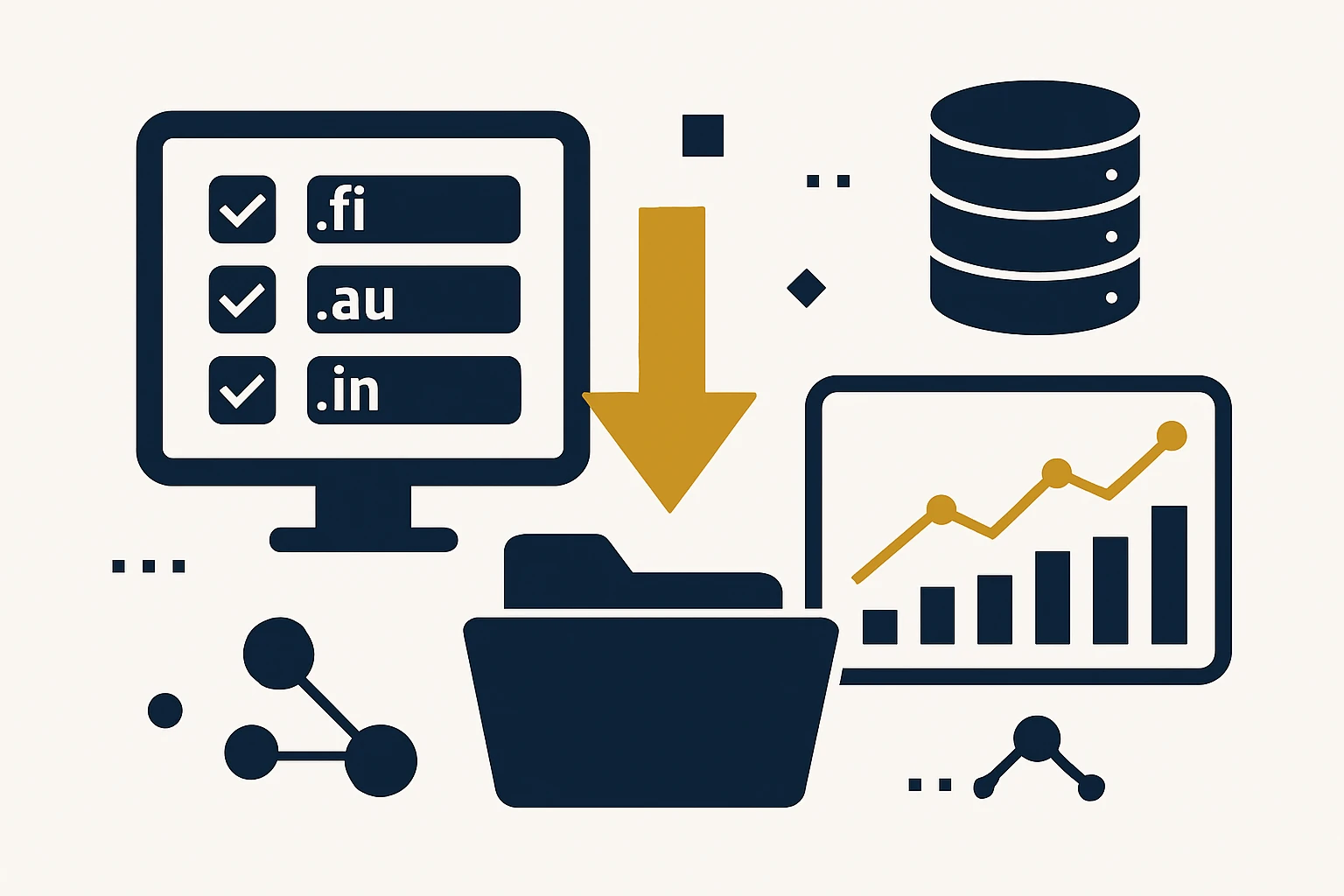
- Discovery - Generate an initial universe from zone files for .au, .ca, and .in (and any other priority ccTLDs) and de-duplicate.
- Evaluation - Apply brand-fit filters (name similarity, regional relevance, potential trademark risk) to prune the universe to high-potential targets.
- Verification - Use RDAP/WHOIS for ownership signals and registrar information where allowed. Cross-check any red flags (abuse reports, disputes, or potential privacy blocks).
- Prioritization - Score each target on strategic value, probability of successful acquisition, and time-to-close. Create a shortlist for outreach and a longer-term watchlist.
- Outreach - Craft confidential, non-promotional outreach tailored to each target, with a clear rationale and value proposition. Maintain a privacy-first approach to protect both parties.
- Negotiation readiness - Prepare a negotiation playbook, including baseline price ranges, potential deal structures (auction vs. private sale), and contingencies for due-diligence gaps.
Practical application: case‑in‑point pipeline
Consider a brand that wants to consolidate regional presence and protect a core brand name across three markets. The team starts by pulling zone-file-based candidate lists for .au, .ca, and .in and feeds the results into a data-hygiene workflow. The next step is ownership verification for the top 150-200 candidates that plausibly align with the brand’s identity and regional strategy. For the strongest opportunities, the team uses RDAP data to confirm current registrants and status before initiating private, confidential outreach. The result is a curated pipeline that blends breadth (discovery) with depth (ownership verification) and is ready for negotiation if the signals align. The approach doesn’t rely on a single data source, instead it leverages the strengths of each data form in a controlled, compliant manner.
At webatla, our approach to this workflow is reinforced by a layered data toolkit. Our RDAP & WHOIS database can be used to verify ownership, ownership history, and contact signals where permissible, providing an essential counterpoint to a raw zone-file list. See how we support this workflow in practice on RDAP & WHOIS Database and by exploring domain lists by TLD at Domain lists by TLD.
Limitations, trade-offs, and common mistakes
- Zone files are not ownership records. A domain appearing in a zone file confirms it exists in the namespace, but it does not guarantee current ownership or active management. Always verify with RDAP/WHOIS where possible.
- Data freshness varies by registry. Some registries update zone data frequently, others may have longer update cycles or restricted access, which can lead to stale signals if not monitored continuously.
- Privacy and regulation constraints. Privacy regimes (and evolving RDAP/WHOIS policies) can limit the availability of registrant data and direct contact details. Plan your due-diligence steps accordingly and respect legal boundaries.
- Cost and licensing considerations. Bulk data access and ongoing monitoring often require licensing or subscription with data providers or registry access programs. Ensure your data-use rights align with licensing terms.
- Quality varies across data sources. Zone files, RDAP, and commercial data feeds each have gaps. A systematic validation process helps reduce false positives and misreads.
Expert insight: Zone-file data is a starting point, not the final word. Real ownership signals come from corroborating data (RDAP/WHOIS) and contextual checks (registrar status, park status, or branding conflicts). Treat zone data as your discovery engine, then layer in verification for a reliable acquisition pipeline.
How to operationalize this in practice
For teams pursuing scale, the practical implementation path looks like this: set up a quarterly cadence to refresh zone-file-based candidate lists for priority ccTLDs, run ownership verification on the top slices, and maintain a confidential outreach program focused on value alignment and brand protection. This is exactly the kind of workflow that a premium domain brokerage and digital asset advisory partner can support by coordinating data access, verification, and negotiation strategy while preserving confidentiality.
To bring this into a scalable, defensible program, consider integrating data access with a portfolio-management mindset. The ideas above map naturally to a branded framework for domain acquisition, negotiation, and protection, aligning with the core services of a premium brokerage while remaining practical and non-promotional in tone.
Conclusion: a disciplined path from data to defensible deals
Downloading ccTLD domain lists (.au, .ca, .in) is a powerful discovery step, but the true value lies in how you use that data. A disciplined workflow that combines zone-file discovery with ownership verification, careful data hygiene, and a structured negotiation plan is essential for building a robust, confidential domain acquisition program. As registries evolve and data access policies shift, a multi-source approach - backed by a trusted data partner - offers the resilience brands need to protect and grow their digital assets. For teams seeking to operationalize this approach at scale, webatla provides the RDAP & WHOIS data layer that complements zone-file discoveries, helping you move from raw lists to actionable opportunities.
Explore webatla’s offerings and see how RDAP/WHOIS data can enhance your domain strategy: RDAP & WHOIS Database and Domain lists by TLD.