Introduction
For brands seeking defensible, high-value digital assets, premium domain portfolios are not just defensive tools, they are strategic levers for growth, trust, and market relevance. The challenge is to source domains that align with regional growth plans, language nuances, and brand architecture while protecting confidentiality and minimizing risk. Country-specific website lists - such as Croatia (HR), Moldova (MD), and Bangladesh (BD) - offer a practical, scalable way to identify candidate assets at scale. When used judiciously, these lists enable a structured, hypothesis-driven approach to acquisition that complements traditional broker-led negotiations. This article outlines how to download list of Croatia (HR) websites, download list of Moldova (MD) websites, and download list of Bangladesh (BD) websites in a way that supports a premium portfolio strategy, not a scattershot bid for attention.
Throughout, we anchor the discussion in the brokered, confidential framework that clients expect from a premium service. The aim is to combine rigorous due diligence, defensible valuation, and careful stakeholder alignment so that every acquisition decision strengthens brand protection and long-term equity in a portfolio. For readers exploring these Country lists, note that the process is increasingly governed by privacy-first data access standards (RDAP) in place of legacy WHOIS, a shift you’ll want to anticipate in any negotiation or data-sourcing plan. ICANN’s RDAP transition to replace WHOIS is a useful backdrop for understanding data access today.
Why country-specific website lists matter for domain sourcing
Country-specific lists translate local-market signals into actionable domain opportunities. They help you identify domains that reflect local language cues, regional consumer behavior, and market niche needs that global lists often overlook. When you download list of Croatia (HR) websites, you gain insight into local content ecosystems, potential branding alignments, and the digital presence of regional businesses that may be attractive to acquire or to benchmark against. Likewise, download list of Moldova (MD) websites and download list of Bangladesh (BD) websites reveal unique branding opportunities in Eastern Europe and South Asia, respectively, where language scripts, transliteration patterns, and cultural context can distinguish premium domains from ordinary ones.
From a strategic standpoint, country lists support three core objectives for a premium domain portfolio:
- Portfolio breadth with local relevance: Build a diversified set of domains that reinforce a country or region-specific strategy without losing global consistency.
- Opportunity discovery at scale: Surface candidate domains that may be under the radar of large, category-focused auctions.
- Confidential, brand-aligned growth: Enable discreet expansion plans that respect company privacy while advancing competitive positioning.
To operationalize these advantages, it helps to frame country-list exploration as a structured sourcing problem rather than a hobbyist scavenger hunt. The client side of this work - led by a trusted broker or advisory partner - must balance speed, accuracy, and confidentiality. The result is a curated pipeline of domains that are not only available but also strategically congruent with brand taxonomy and long-term portfolio objectives.
How to validate and filter country lists: a practical checklist
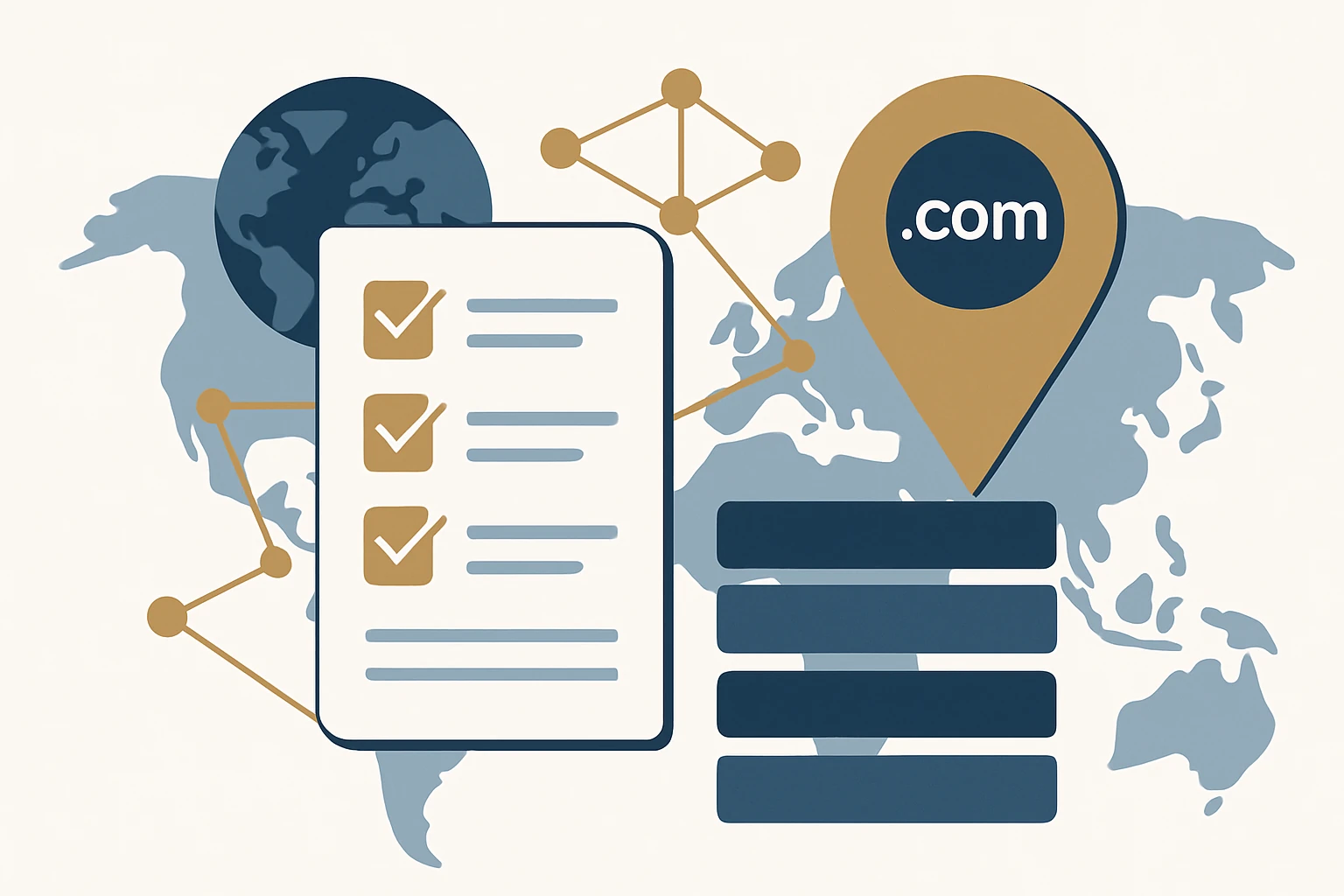
Lists are only as valuable as the quality controls applied to them. Here is a practical, repeatable checklist to turn raw lists into an actionable signal set for premium acquisitions.
- Ownership verification: Confirm current ownership and transfer feasibility. RDAP/WHOIS data is critical here, especially since many registries are moving to RDAP for privacy and access controls. As RDAP becomes the standard, ensure you can verify ownership without exposing sensitive information in a way that violates privacy policies. See ICANN’s RDAP transition for context.
- Domain history and quality: Look beyond the current registration. Check DNS health, uptime history, backlink profile, and any history of abuse that could impede transfer or monetization.
- Brand fit and risk assessment: Map each candidate to your brand architecture, avoid terms with ambiguous or conflicting meanings in target markets, and assess potential trademark or cultural conflicts.
- Availability vs. value: Distinguish between genuinely valuable, brand-safe assets and domains that happen to be available because they’re unattractive or problematic to own. This is where valuation methods and risk-adjusted pricing matter most.
- Transfer readiness and cost: Plan for escrow, registrar changes, DNS propagation, and potential broker fees. A transparent cost model reduces negotiation friction later.
- Privacy and compliance: Respect data-privacy norms and, where relevant, NDA requirements. The transition from WHOIS to RDAP is more than a tech change, it affects how you document due diligence and share details with internal stakeholders.
In practice, the validation step is iterative. You will likely discover new constraints as you verify ownership or test domain transfer paths. A disciplined process avoids overcommitting to assets that look promising on paper but fail operationally when you try to monetize or secure them.
For readers who are curious about data access standards, the shift from WHOIS to RDAP is not merely technical - it changes how due diligence is conducted at scale. ICANN’s update on RDAP and the sunsetting of WHOIS provides a clear policy backdrop for practitioners who source domains through public lists. ICANN: Launching RDAP, Sunsetting WHOIS.
A practical framework for using country lists in premium domain sourcing
The following four-phase framework is designed for teams operating in a privacy-conscious, risk-aware environment. It can be applied to Croatia HR, Moldova MD, Bangladesh BD lists, or any country-specific dataset you decide to leverage.
- Phase 1 - Identify strategic fit
- Define regional priorities (market entry, localization, brand protection, or demand shaping).
- Filter list segments by semantic relevance (local language terms, city names, or industry verticals that map to your portfolio strategy).
- Score opportunities against your portfolio thesis (brand coherence, potential for resale, or new domain-brand pairings).
- Phase 2 - Verify ownership & availability
- Use RDAP/WHOIS data to confirm registrant details and transfer feasibility, mindful of privacy policies.
- Assess DNS health, including name server responsiveness and vulnerability to DNS hijacking.
- Check for existing trademark disputes or conflicting brands in the target market.
- Phase 3 - Evaluate value and transferability
- Establish a valuation framework that accounts for regional currency considerations, potential revenue models, and transfer complexity.
- Prepare a defensible bid strategy, including escalation paths and confidential negotiation protocols.
- Engage a trusted broker or advisor to manage confidentiality and offer structure, especially for cross-border deals.
- Phase 4 - Negotiate, finalize, and protect
- Negotiate with a clear confidentiality agreement and escrow mechanism to safeguard both sides.
- Plan for a clean transfer workflow: registrar changes, DNS propagation, and post-transfer monitoring.
- Integrate acquired assets into your brand-portfolio governance with ongoing monitoring for brand protection and renewals.
In this framework, the country-list approach is not a universal solution, it’s a powerful complement to a broader acquisition program. It helps you discover assets that align with regional strategies while preserving a disciplined, risk-managed posture. A key takeaway: treat country-specific lists as a discovery layer, not a finished inventory. Each candidate requires the same rigorous due diligence as any other premium asset.
Expert insight, trade-offs, and common mistakes
Expert insight: An industry insider emphasizes that the real value of country-specific lists lies in strategic alignment, not raw volume. When a list highlights domains that reflect local language usage, cultural cues, and region-specific business names, it becomes a natural starting point for building a defensible, long-lived domain portfolio. The interpretation step - how you map those signals to your brand architecture - often determines whether an opportunity becomes a lever for growth or a sunk cost.
Trade-offs to consider include the following: country lists can surface high-volume opportunities that require substantial post-acquisition work (redirects, branding, and compliance). They also carry privacy and transfer complexities that scale with cross-border deals. The most successful practitioners view these trade-offs through the lens of risk-adjusted value - focusing on domains with clear brand intent, durable ownership paths, and predictable monetization potential.
Limitations and common mistakes to avoid:
- Over-reliance on lists: Lists can identify candidates, but ownership and transfer feasibility are the ultimate gatekeepers.
- Ignoring local branding nuances: A domain that reads well in one market may misalign in another, creating branding friction or regulatory risk.
- Underestimating transfer costs: Escrow, inter-registrar changes, and localization work add up quickly in cross-border deals.
- Privacy and NDA gaps: Handling data responsibly is essential, violations can derail negotiations and damage reputation.
- Inadequate due diligence on DNS health: A live domain is not a risk-free asset if it’s prone to downtime or security vulnerabilities.
These cautions underscore the value of engaging experienced professionals who can balance editorial rigor with negotiation discipline. In many cases, a premium domain brokerage or digital asset advisory like webatla’s Croatia profile can help structure a disciplined, confidential approach to country-list sourcing that aligns with portfolio-wide governance.
Structured client integration: how we operationalize country lists
For clients seeking to responsibly expand a premium domain portfolio, the country-list approach offers a predictable, scalable pathway. By combining discovery (country lists) with rigorous due diligence, valuation, and confidential negotiation, you can assemble a targeted pipeline that supports strategic goals without overreaching. The process benefits from the following practices:
- Define entry criteria for each country (language, vertical focus, and brand alignment) before pulling lists.
- Coordinate with a trusted broker for ownership verification and transfer planning to ensure confidentiality and smooth execution.
- Document a clear governance framework for assets acquired through country lists, including renewal monitoring and brand protection measures.
Where to start? If you’re interested in exploring country-specific opportunities, you can view a country-oriented hub that aggregates country profiles and lists, such as List of domains by Countries and the Croatia page cited above. For organizations evaluating broader scope (TLDs, regional markets, or technology stacks), webatla’s suite of country and domain analytics can help structure a disciplined acquisition program and portfolio management workflow. See also the broader country-and-technology frames at List of domains by TLDs and related assets.
Limitations, trade-offs, and common mistakes (summary)
This section recaps critical limits and avoidable missteps when using country lists for premium domain sourcing:
- Country lists provide discovery signals, not guaranteed ownership or easy transfer paths.
- Local branding nuances require careful interpretation to avoid misalignment with market expectations.
- Cross-border transfers incur additional costs and regulatory considerations, plan budgets accordingly.
- RDAP privacy standards affect how you document due diligence and share information in internal channels.
- Without governance, a growing list can turn into overexposure, implement portfolio controls and renewal monitoring.
Conclusion: a disciplined path to a country-aware premium domain portfolio
Country-specific website lists are a powerful augmentation to a premium domain strategy when used with discipline. They enable scalable discovery, regional relevance, and confidential growth. The key is to treat the lists as a starting point - an input to a rigorous, governance-driven process that emphasizes ownership verification, value-driven screening, and prudent negotiation. By aligning country-list sourcing with a thoughtful portfolio framework, brands can expand their premium-domain estates with lower risk and clearer pathways to monetization and protection.
Further reading and authoritative sources
- ICANN: RDAP transition and privacy considerations
- This Is a Local Domain: On Amassing Country-Code Top-Level Domains from Public Data
- What Is Domain Privacy: RDAP, privacy controls, and compliance
Disclaimer: The examples and figures cited are meant to illustrate a practical approach to using country-specific lists for premium domain sourcing and are not a substitute for professional due diligence or legal advice. For confidential domain acquisitions and portfolio strategy, consider engaging a specialized advisory team with experience in country-specific branding and cross-border transfers. To learn more about how we can support such efforts, visit the Croatia page linked above or the broader country- and TLD-based resources on webatla’s site.