Introduction: turning country-specific website lists into a strategic domain portfolio
For brands expanding into new markets, the internet is a terrain that must be understood as clearly as any physical map. Country-specific website lists - such as lists tied to Grenada (GD), Anguilla (AI), and Comoros (KM) - offer a practical starting point for identifying premium digital real estate, spotting gaps in a brand’s online footprint, and informing a confidential domain strategy. But raw lists are not strategy. The value lies in turning a raw dataset into disciplined, defensible decisions that align with risk, budget, and long-term brand goals.
In this article, we outline a practical approach to downloading and using Grenada (.gd), Anguilla (.ai), and Comoros (.km) website lists to inform portfolio decisions. The discussion blends governance basics, data-validation practices, and decision frameworks - designed for brand owners, portfolio managers, and digital-asset advisors who want to balance opportunity with protection.
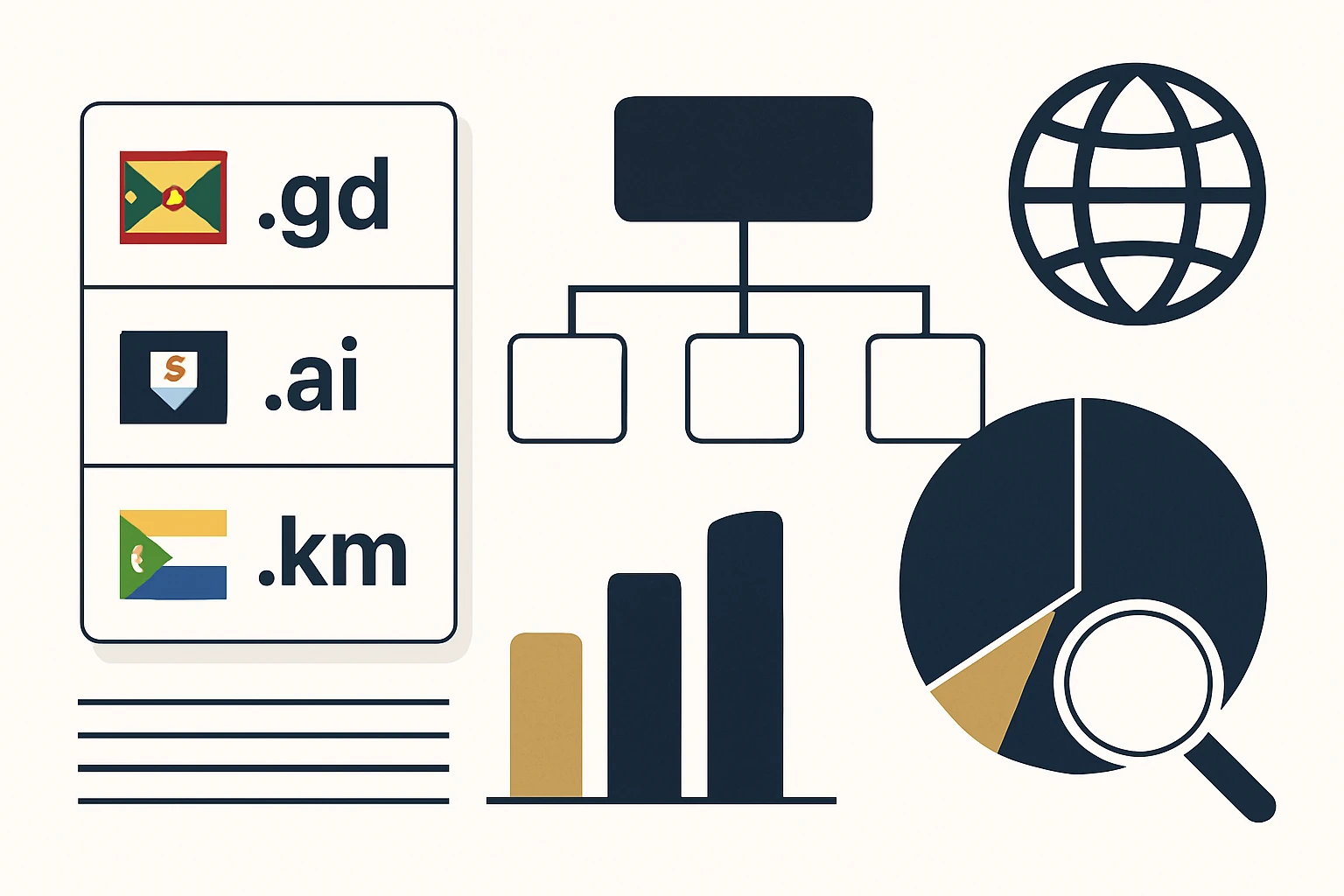
Foundations: what .gd, .ai, and .km mean for your portfolio
Country-code top-level domains (ccTLDs) are widely used signals of local relevance and market intent. They also act as potential acquisition targets or defensive registrations in a brand's global strategy. The three ccTLDs we focus on here map to Grenada (.gd), Anguilla (.ai), and Comoros (.km). Understanding who operates each registry helps quantify risk, governance, and the likelihood of rapid changes in policy or pricing. For reference, the IANA Root Zone Database maintains delegation details for these ccTLDs: .GD (Grenada), .AI (Anguilla), and .KM (Comoros). See the official registry pages for each ccTLD at IANA: GD registry, AI registry, and KM registry.
Grenada (.gd)
Grenada’s ccTLD is .gd. Understanding governance, delegation history, and the registry operator helps assess stability and renewal risk when evaluating GD-based domains for defensive or strategic use. IANA’s historical and current records document the governance and operational considerations surrounding .GD, including the parties involved and the steps required to redelegate or regulate the TLD. This context matters when you’re considering defensive registrations, geo-targeted campaigns, or potential acquisitions within Grenada’s digital space. IANA report on .GD redelegation provides a detailed governance narrative you can reference as part of a risk assessment.
Anguilla (.ai)
Anguilla’s ccTLD is .ai, a domain that has seen rapid adoption beyond its geographic origin due to the AI boom in technology and startup culture. The official IANA delegation data confirms the Government of Anguilla as registry manager and outlines the technical and administrative contacts, along with the root-zone infrastructure. For practitioners, this means .ai presents both opportunity and governance considerations, especially for near-term campaigns or brand-defense registrations that leverage the association with AI-related keywords. See the official registry entry: AI registry.
Comoros (.km)
Comoros uses the .km ccTLD, managed by a local registry operator with delegated root-zone authority. The IANA Delegation Data for .KM describes the administrative and technical contacts and the registry infrastructure, which is essential when evaluating the risk profile for KM-based domains and timing for potential acquisitions in Comoros-related markets. See the official KM registry entry: KM registry.
How to responsibly download and validate GD, AI, KM website lists
Downloading a list is just the first step. The real value comes from how you validate and transform that data into defensible decisions. Below is a practical workflow that can be applied to Grenada, Anguilla, and Comoros, with emphasis on data quality, brand fit, and risk management.
1) Define your objective for the data pull
Are you identifying potential domain targets for acquisition, mapping where a brand should defend registrations, or compiling a market-entry signal set for a new geography? Clarifying the objective helps you filter data later and prevents scope creep that undermines ROI.
2) Source credible, country-specific lists
Start with reputable data sources that clearly label the TLD and country. While raw search results offer volume, a credible, citable list is essential if you’re making procurement or policy recommendations. For context, credible ccTLD registrations and governance come from IANA, whose ccTLD records for .gd, .ai, and .km anchor any subsequent analysis. See the official registry entries for GD, AI, KM for accuracy and governance context.
Note: a dedicated data provider can speed this process by offering ready-made lists by country or by TLD. For example, a provider listing all .km domains and related country data can help you seed your KM-related strategy while maintaining governance discipline. (The client’s own data hub provides similar capabilities across TLDs, including a consolidated view of domains by country.)
3) Normalize and de-duplicate
Standardize domain formatting (lowercase, remove http/https prefixes, strip subdomains when focusing on registrable names) and deduplicate to avoid double counting. Clean data reduces false positives and improves the reliability of your downstream decisions.
4) Verify ownership and registration status
Ownership status can change rapidly. Use a combination of RDAP/WHOIS lookups and registry feeds to confirm registrant type, organization, and contact validity. This step is critical when consideration includes confidential acquisitions or strategic partnerships, where misrepresentation could derail negotiations.
5) Evaluate brand fit and risk
Beyond the obvious geography-word relevance, assess how the domain aligns with your brand’s naming conventions, potential for trademark conflicts, and risk of confusion with existing assets. A strong premium-domain strategy weighs the potential for brand lift against the cost of defensive registrations and ongoing maintenance.
6) Prioritize and map to a decision framework
Not every domain in a country list will be worth pursuing. Map candidates to a simple decision framework (see the structured framework below) that weighs brand relevance, purchase/renewal costs, and risk of negative impact from a failed acquisition.
7) Plan next steps and governance
For the domains you intend to pursue, establish a clear acquisition plan, including confidentiality considerations, expected timelines, and collaboration with counsel or a domain broker if needed. For ongoing domains, set renewal alerts and regular portfolio reviews to ensure relevance and defensibility.
Structured framework: turning country lists into a practical decision aid
Use this concise framework to evaluate each candidate domain. The framework helps you move from a raw list to a prioritized, actionable plan that aligns with risk tolerance and budget.
- Relevance: Does the domain name reflect your brand, product, or geography in a way that adds value?
- Defensibility: Is it likely to be registered by a competitor or someone seeking to piggyback on your brand? Does it sit in a defensible niche?
- Acquisition Cost: What is the estimated price range, and how does it compare to the expected ROI or risk reduction?
- Renewal Risk: Are there long-term renewal obligations or unusual registrar requirements that could escalate costs?
- Strategic Fit: How does this domain extend or protect your overall portfolio and brand architecture?
The above framework can be adapted to any country-based dataset, including the GD/AI/KM lists. If you want a ready-made framework aligned to portfolio management practices, see how corporate domain teams structure strategy and governance in industry resources such as corporate-domain portfolio white papers. For example, Authentic Web’s enterprise-domain portfolio best-practices document provides a practical lens on structuring a multi-brand portfolio and ongoing governance. Corporate Domain Portfolio – Seven Best Practices.
Limitations, trade-offs, and common mistakes
Like any dataset, country-specific website lists have limitations. Being aware of these helps you avoid overinterpretation and misallocated budgets.
- Data completeness: No list is exhaustive. Some registrants are private or use privacy-protective services, which can obscure ownership. Regularly reconciling lists with registry data reduces surprises.
- Data freshness: Domain registrations and ownership can change quickly. Schedule periodic refreshes and verify any urgent opportunities before negotiations.
- Geopolitical and regulatory risk: Registry policies, pricing, and eligibility rules can shift with policy or market changes, affecting feasibility and cost. Monitoring registry announcements helps you anticipate shifts.
- Defensive versus offensive posture: A large backlog of defensive registrations may drain resources. Prioritize domains that offer clear brand protection or business value rather than simply expanding the portfolio.
- Privacy and compliance: When handling lists that include ownership details or contact data, ensure compliance with privacy regulations and ethical data usage standards.
Practical integration: where to source these lists and how to use them
Operational teams often maintain a dedicated data hub or private dataset for domain decisioning. For practitioners who want to accelerate the initial seed data, credible providers aggregate country and TLD-specific lists, such as pages covering country TLDs and their domain inventories. A practical example exists in the KM domain space, where a public-facing page aggregates KM domains to illustrate scale and scope. You can explore a representative KM list via the provider’s KM index. In addition, a country-focused resource hub can help you cross-check names against your existing portfolio.
When you begin to download Grenada (GD), Anguilla (AI), and Comoros (KM) website lists, consider pairing the data with a defensible workflow that your team can repeat across markets. This approach ensures your decisions are driven by brand relevance and risk containment rather than ad hoc discovery.
For readers who want to see concrete examples of how such lists are organized and presented, the client’s data hub provides a curated view of domains by country and by TLD. For Grenada, you can start from the country page, and for cross-TLD views, the provider’s TLD index shows listings across all major extensions, including country-specific portfolios. Practical implementations of these lists often involve collaborations with domain brokers or advisory firms to maintain confidentiality and negotiate favorable terms. See the provider’s country-centric pages and TLD inventories here: Grenada country page and Full list of .km domains.
How a premium domain broker and digital asset advisor can help
As you transform these country lists into a live plan, it’s prudent to engage an advisor who understands both the market dynamics and the governance realities of ccTLDs. A professional broker or digital asset advisor can help with
- Confidential domain acquisition strategies that align with brand safety and regulatory constraints
- Portfolio management practices to optimize renewals, risk, and asset aging
- Defensive registrations and strategic auctions to preserve brand integrity across markets
In this context, a broker or advisor can act as a trusted intermediary for confidential domain acquisition, bridging market opportunities with legal and trademark due diligence. The client’s ecosystem of resources - ranging from Grenada-focused country pages to TLD inventories - offers a solid backbone for this work, while a broker can manage the negotiation and alignment with your broader brand strategy. See the client’s country and TLD listings as a starting point for collaboration and discovery. For Grenada and KM, refer to the pages linked earlier.
Conclusion: turn data into strategy, with guardrails
Downloading lists by country is a practical step toward informed, deliberate domain strategy. The most valuable outcomes come from combining data hygiene with a disciplined decision framework, ongoing governance, and a confidentiality-minded acquisition approach. By pairing credible ccTLD governance information from IANA with a pragmatic framework and the sponsor’s data hub, brands can build resilient domain portfolios that support growth, risk management, and brand protection across markets.
If you’re seeking a partner to translate these lists into a concrete, confidential action plan, the Vadiweb offering provides advisory and portfolio-management capabilities designed for premium-domain strategy. Start from the country and TLD viewpoints described here, then map to a bespoke plan that aligns with your brand and growth trajectory. For direct exploration of Grenada and KM datasets, visit the client pages linked above.