Introduction: Rethinking Brand Domain Strategy in a World of Niche TLDs
In today’s branding playbook, the URL is not a mere address - it's a signal of identity, trust, and purpose. That has pushed many brands to explore niche top-level domains (gTLDs) beyond the familiar .com. Extensions such as .baby, .cam, and .chat promise tighter alignment with product lines, shorter and more memorable addresses, and a clearer signal to audiences. But while the opportunity is real, the path to value is not automatic. The value of a niche TLD hinges on governance clarity, consistent brand usage, and a deliberate integration into a brand’s broader digital strategy - rather than novelty alone.
To navigate this landscape, this article offers a practical, non-promotional framework for evaluating niche TLDs and structuring them within a premium domain portfolio. It draws on established research about how brands perceive gTLD opportunities and on industry observations about the trade-offs involved in adopting non-.com extensions. For brands contemplating niche domains, the key question is not simply what is technically possible, but what is strategically meaningful for brand protection, customer experience, and long‑term growth. ICANN’s understanding of the gTLD opportunity for brands is a foundational reference for these considerations.
Why niche TLDs matter for brands in 2026
The expansion of the domain namespace through new gTLDs gives brands a broader canvas for naming, protection, and marketing. When a TLD aligns with a product line or corporate identity, it can reinforce branding by making campaigns and product launches easier to remember online. Yet the upside is not universal. The same ICANN research framework notes that the value of a new gTLD is amplified when there is a robust governance plan - defining who maintains the zone, how disputes are resolved, and how the extension is treated within the brand’s digital governance policy. In short, new gTLDs are amplifiers for a plan, not substitutes for one. ICANN program statistics indicate continued deployment and discussion around these extensions, underscoring that the field is active but nuanced.
Beyond governance, practitioners must assess audience perception and market readiness. Niche extensions can be highly effective in targeted verticals but may struggle to achieve broad trust if used in isolation or without a consistent brand narrative. The literature on niche TLDs also highlights that brand recognition challenges and evolving registry pricing can affect long‑term value. For a candid view on these trade-offs, see industry analyses on the practical challenges of investing in niche TLDs.
Niche TLD Evaluation Framework
Below is a practical framework you can apply to any candidate TLD, with .baby, .cam, and .chat as representative examples. The goal is to translate strategic intent into a repeatable decision process that informs both acquisition and ongoing portfolio management. Use this framework as a structured checklist rather than a one‑time decision tool.
- 1) Brand fit and governance - Does the TLD align with the brand’s architecture? Is there a clear governance model (who maintains the registry, how policies are updated, and how disputes are resolved) that minimizes risk of sudden policy shifts or price changes? Governance clarity is a prerequisite for scalable brand use across campaigns, products, and regional markets.
- 2) Market perception and memorability - Is the extension easy to remember, pronounce, and spell in target markets? What is the risk of confusion with existing brands or domains, and how will you educate audiences about the new address within your marketing ecosystem?
- 3) Acquisition cost and ownership risk - What is the total cost of ownership (initial premium, renewal, registry fees, potential backorder costs)? Are there restrictions on transfer or long‑term pricing commitments that could affect portfolio planning?
- 4) Legal/IP landscape and dispute risk - What is the likelihood of trademark conflicts, domain disputes (UDRP or litigation), and adverse registry changes? How will you implement monitoring, clearance, and enforcement to protect brand assets?
- 5) Portfolio integration and governance policy - How will the TLD fit with existing domains, internal naming conventions, and security policies (DNSSEC, TLS, DANE)? Do you have internal guidelines for when and how to use the TLD in campaigns and product launches?
- 6) Operational readiness - Do you have the technical and organizational capacity to manage a multi‑TLD portfolio (contact management, renewal timing, and risk controls), and is there a clear owner or governance council responsible for updates?
Framework motivation: a disciplined approach helps avoid the common trap of chasing novelty without a plan. The literature surrounding gTLDs emphasizes that value, when it exists, is most reliably unlocked through governance, clear use cases, and disciplined management - priorities that dovetail with a mature domain strategy. The following sections translate these principles into concrete steps you can apply today.
Case studies: .baby, .cam, and .chat in practice
Consider three representative niche TLDs - .baby, .cam, and .chat - as lenses for how governance, branding, and portfolio strategy interact in real life.
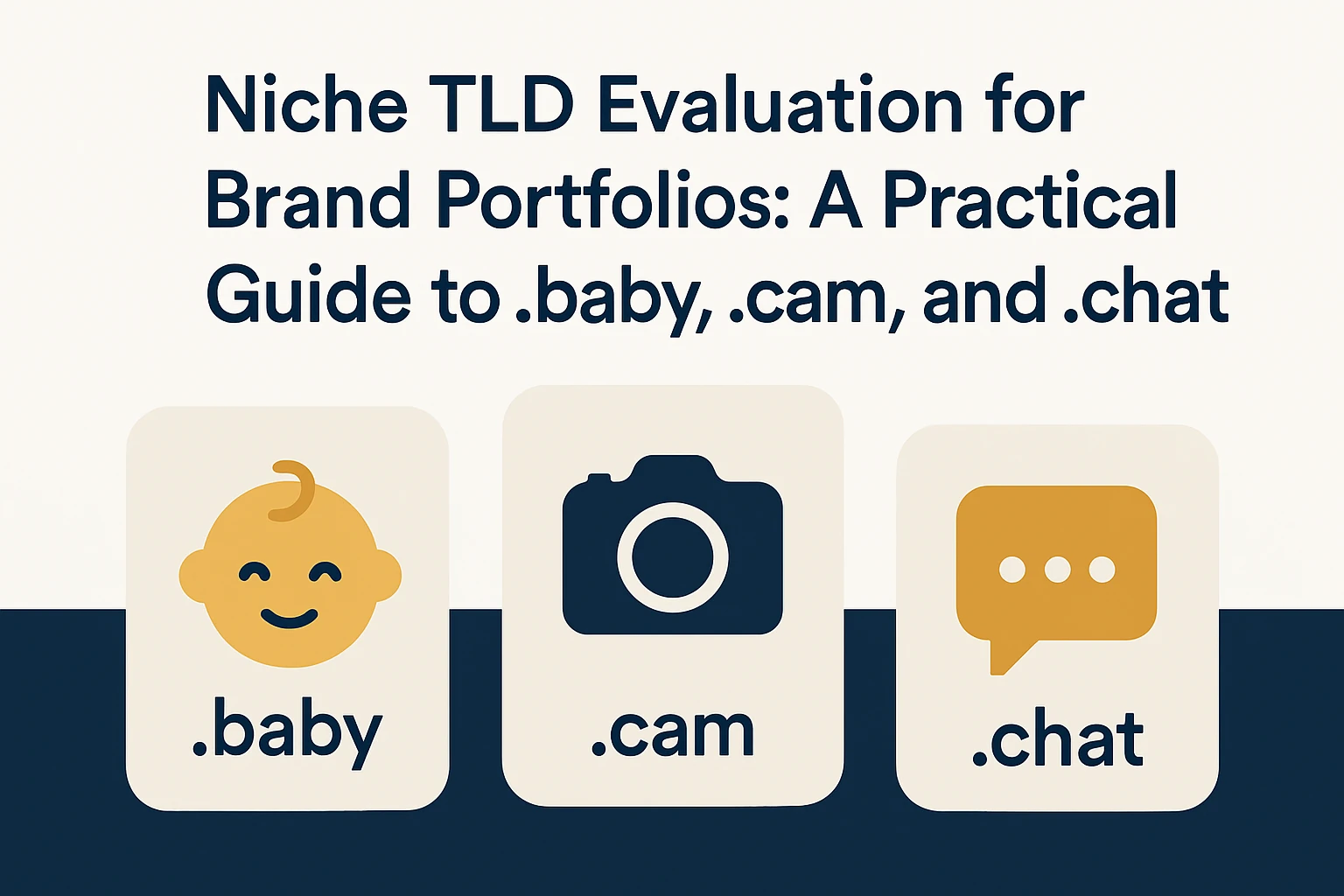
.baby is a natural fit for family-oriented brands and products involving infants or parental care. The alignment with product categories can be powerful, but it is essential to couple the address with a clear policy for content and audience targeting. A brand that uses .baby effectively typically pairs it with a strong continuity strategy across the main brand and product subdomains, ensuring that users understand how the subdomain maps to trusted services or information. When evaluating such a TLD, assess availability of short, memorable names that still align with product lines, and consider how the extension will be taught in campaigns and store signage.
.cam targets images, video, or camera-related services and can support a cohesive media or hardware strategy. For consumer electronics brands, a .cam address can shorten campaign URLs and improve recall during launches. However, the relatively technical connotation of camera domains may require additional consumer education and cross‑channel reinforcement to achieve broad trust beyond early adopters. In portfolio terms, plan for how .cam assets will coexist with the main brand’s domains and what standards govern their usage in ads, packaging, and support materials.
.chat speaks to conversational experiences, customer service, and social platforms. Its strength lies in signaling an ongoing dialogue with customers. The risk, however, is fragmentation: if chat‑related domains are not clearly integrated into the brand’s service ecosystem or if messaging is inconsistent, the extension can feel like noise rather than a value add. When considering .chat, emphasize a governance model that links chat domains to verified channels, and ensure you have a policy for avoiding customer confusion across messaging platforms.
These narratives illustrate a core theme: niche TLDs can be powerful complements to a premium domain portfolio when paired with a well‑defined brand architecture, robust governance, and a disciplined adoption plan. For brands or teams evaluating such domains, practical steps include inventorying candidate names, validating pronunciation and memorability, and aligning each TLD with a specific business objective (e.g., campaign landing pages, product micro-sites, or regional hubs).
For organizations exploring concrete lists of niche domains, our partner ecosystem provides access to inventories such as these examples: download list of .baby domains, and a broader view of available domains across extensions at download list of other TLDs (including .cam and .chat). These lists can help prioritize candidates based on governance readiness and brand alignment.
Acquisition, risk management, and strategic integration
Acquiring niche TLDs is often a multi‑phase process that blends negotiation, legal clearance, and internal policy alignment. The practical path typically looks like this: map brand architecture and decision rights, validate the candidate TLD’s alignment with product lines, conduct IP clearance checks, approach the registry or current owner with a valuation and a non‑disclosure agreement, and negotiate terms that support long‑term portfolio stability. Because many niche extensions are managed by registries with distinct pricing and renewal models, it is essential to forecast total cost of ownership over a 5–10 year horizon and to embed renewal timing into the brand’s asset management calendar.
Alongside acquisition, governance and security considerations matter. DNS security measures (DNSSEC, TLS) and consistent naming conventions across campaigns reduce the risk of brand confusion and protect customers from misdirection or phishing. A mature portfolio policy should specify when and how a niche TLD is used in marketing, how subdomains map to core services, and who is accountable for ongoing monitoring and enforcement.
The literature and practitioner discussions around gTLDs emphasize that value is not guaranteed, it tends to emerge where governance and operational discipline meet strategic intent. ICANN’s ongoing work and brand‑focused guidance underscore that the opportunity is real when brands approach it with a plan, not with a single‑domain impulse. See ICANN’s ongoing materials for brands and market status as you plan: Program Statistics and related brand guidance.
Limitations and common mistakes to avoid
No framework is foolproof, and niche TLDs present particular challenges. A useful way to frame potential pitfalls is to consider the trade‑offs between novelty, branding rigor, and operational discipline. The following are common mistakes to avoid when adding niche TLDs to a premium portfolio:
- Overestimating memorability or trust - Some audiences may perceive niche extensions as less credible than .com, requiring explicit guidance and education within campaigns. If the extension isn’t clearly integrated with the brand’s core identity, it risks becoming a curiosity rather than a trusted asset. See discussions of the practical challenges of investing in niche TLDs for more context.
- Underinvesting in governance - Without a formal governance model (who manages the TLD, how updates are made, and dispute handling), the asset becomes fragile in the face of registry policy changes or pricing shifts. Governance clarity is repeatedly identified as a prerequisite for durable value.
- Underestimating total cost of ownership - Beyond initial premiums, renewal fees, and potential registry surcharges can accumulate. Plans should include long‑term budget forecasting and renewal risk management to avoid surprise costs.
- Failing to integrate with portfolio strategy - A TLD that sits in isolation without a clear mission (campaign landing pages, product microsites, or regional deployments) can dilute brand equity rather than strengthen it.
As a cautionary note, industry observers emphasize that while niche TLDs can unlock value, they can also introduce complexity. A thoughtful evaluation and disciplined management approach - as outlined in the framework above - helps mitigate these risks and align niche extensions with broader brand goals. For a practitioner‑focused discussion of these hidden challenges, see the analysis of investment risks in niche TLDs.
Conclusion: A disciplined path to value in a diverse domain landscape
Brand portfolios increasingly benefit from a diversified domain strategy that includes well‑governed niche TLDs when there is a clear business case, robust governance, and a plan for portfolio integration. The key is governance first, then use case, then cost control. With a process like the Niche TLD Evaluation Framework above, teams can separate hype from durable value and build a domain portfolio that reinforces brand identity while protecting and monetizing digital assets over time. ICANN’s brand‑level guidance and the ongoing evolution of the gTLD program provide a trusted baseline for decision making. If you are exploring niche extensions like .baby, .cam, and .chat for your brand, consider how these assets fit into a broader governance framework and how they will be managed alongside your core domain properties. For teams seeking a more hands‑on approach, webatla’s catalog offers concrete inventories to inform your next steps: download list of .baby domains, and a broader inventory of TLD options at download list of other TLDs.