Introduction: Why micro-markets demand a targeted domain strategy
For brands aiming to scale with precision, a generic approach to domain ownership often falls short. Small or treaty-bound markets - like Djibouti (DJ), French Guiana (GF), and Niger (NE) - present distinct digital landscapes, regulatory environments, and consumer touchpoints. A strategic, country-aware domain portfolio can enhance brand credibility, improve local search performance, and create a defensible digital moat against opportunistic competitors. This article outlines a practical, non-promotional framework you can apply to identify, evaluate, and acquire premium domains in micro-markets, while balancing brand protection and governance concerns.
Beyond the obvious question of matching a brand name to a country code, the regional domain play hinges on local relevance, privacy and compliance considerations, and a disciplined approach to portfolio management. As digital strategies mature, leading practitioners increasingly view ccTLDs not just as convenient local endpoints, but as brand signals that can shape perception and behavior across markets. Forbes Councils highlight how ccTLDs communicate local intent and influence consumer trust, while DomainNameNet frames ccTLDs as geo-targeting levers in a global branding play.
What makes micro-market ccTLDs valuable - and when they’re not
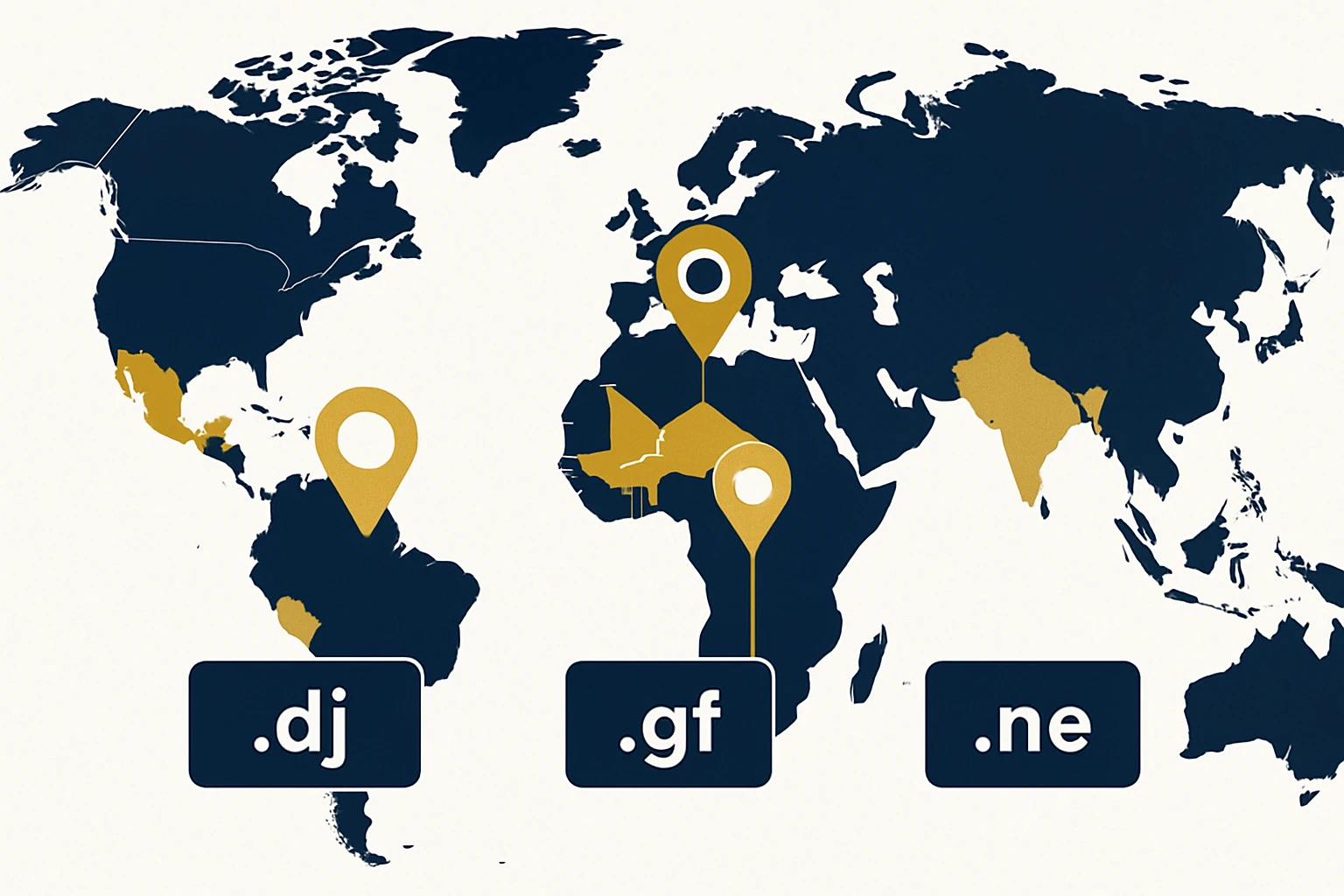
Country-code top-level domains (ccTLDs) carry more than regional flair, they send a signal about local focus, regulatory alignment, and language-tuned user experiences. When a user in a target market lands on a .dj, .gf, or .ne site that mirrors their language, currency, and support structure, they’re more likely to engage and convert. From an SEO perspective, search engines often treat ccTLDs as strong indicators of geographic relevance, which can improve visibility in local search results when paired with appropriate content and hosting. This local signaling is a core reason many global brands adopt multi-country strategies rather than relying on a single global domain. (forbes.com)
However, the ccTLD approach is not a silver bullet. It requires careful governance, local market understanding, and ongoing risk management. Discreetly managing brand ownership across multiple jurisdictions hinges on disciplined renewal practices, clear ownership structures, and robust dispute-resolution readies. The World Intellectual Property Organization (WIPO) and other authorities outline frameworks for protecting brands and resolving disputes in ccTLD spaces, underscoring that jurisdictional nuance matters just as much as branding finesse. (wipo.int)
A practical framework: Regional Domain Scaling Framework
Below is a lightweight, repeatable framework to guide decision-making when building or refining a micro-market domain portfolio. It is designed to be implemented without heavy tooling while still yielding a defensible, measurable asset base. Each step emphasizes governance, evaluation, and practical acquisition tactics rather than hype or speculation.
- Discover & map target markets: Identify markets with growing consumer digital engagement that align with your brand strategy. Assess regulatory climates, data-protection norms, and potential partner ecosystems. This step is about understanding the terrain before you buy or register.
- Define local relevance criteria: Determine which domain extensions, language variants, and brand signals will most credibly serve each market (e.g., language-specific content, local support pages, currency options).
- Prioritize ccTLDs and related assets: Rank markets by strategic importance and risk profile. In many cases, a focused set - DJ, GF, NE - will yield higher ROI than a sprawling, unfocused portfolio.
- Develop a confidential acquisition plan: Map potential owners, prepare approach scripts, and establish a governance trail. This ensures you can pursue targets discreetly if needed while maintaining compliance.
- Execute due diligence & risk assessment: Verify ownership, renewals, hosting arrangements, and any legal encumbrances. This step mitigates hidden costs and reputational risk.
- Negotiate and close: Conduct disciplined negotiations focused on value alignment, long-term protection, and clear transfer mechanics. Maintain documentation for auditability and future governance.
- Protect & govern the portfolio: Implement renewal calendars, monitoring, and central oversight to reduce lapse risk and ensure consistent brand protection across markets.
- Measure impact & optimize: Track engagement, local traffic signals, and conversion metrics. Use learnings to re-prioritize investments and timing for renewals or expansions.
Each step is designed to be actionable and repeatable, with governance baked in. A practical outcome is not just a larger portfolio, but a defensible, well-documented set of digital assets that supports brand strategy and regional expansion goals. For teams evaluating whether to tackle a micro-market strategy in DJ, GF, or NE, this framework provides a concrete starting point rather than a theoretical exercise.
Case application: Djibouti (DJ), French Guiana (GF), Niger (NE)
Applying the framework to Djibouti, French Guiana, and Niger requires balancing local market realities with global brand discipline. The following considerations are illustrative, drawn from industry best practices and governance principles observed in reputable sources across the ccTLD and brand-protection space.
Djibouti (DJ): Djibouti presents a market with evolving e-commerce and digital service adoption. A DJ-focused strategy benefits from local-language content, regionally relevant hosting, and a clear ownership chain. As you evaluate assets in DJ, prioritize domains that can host localized services (e.g., customer support in Arabic or French) and protect against potential brand confusion with similarly named domains. See how a country-page approach can guide research at the Djibouti country hub: Djibouti country domain page for context on region-specific portfolio opportunities. The broader market context benefits from ccTLD signaling that aligns with local consumer expectations and regulatory nuance. (forbes.com)
French Guiana (GF): As a French overseas department, GF sits at the intersection of local and European digital markets. A GF-specific domain strategy can leverage branding that respects local language and legal considerations while preserving a coherent global brand narrative. This is where a structured portfolio governance process - rooted in renewal hygiene and risk monitoring - delivers measurable value, reducing hidden costs in long-tail markets. Organisations often start with a baseline of two to four critical GF domains and expand only after establishing internal ownership and renewal discipline. For broader context on how ccTLDs function in a multi-market portfolio, see expert analyses on ccTLDs for global brands. (domainnamenet.com)
Niger (NE): Niger represents another market where regional signals can translate into trust and engagement, provided content localization and support align with user expectations. The Niger example underscores a recurring theme: local relevance and brand consistency must go hand-in-hand with governance practices that protect against inadvertent lapses or disputes. Industry guidance emphasizes that disciplined domain-portfolio management - covering renewals, audits, and dispute-readiness - helps ensure your micro-market strategy remains resilient over time. See general guidance on portfolio management best practices and the evolving role of ccTLDs in regional strategy. (dynadot.com)
The client integration: how a digital asset advisory view informs micro-market deals
In practice, a premium domain brokerage and digital asset advisory lens translates into a structured approach to country-specific acquisitions. The client’s ecosystem - spanning a robust country, TLD, and technology lens - supports a disciplined sourcing and protection process that can be deployed in DJ, GF, and NE markets, among others. For teams seeking a practical research-to-acquisition workflow, the following integration points are especially relevant:
- Leverage the client’s country portfolio pages to map target ecosystems, e.g., the DJ page for Djibouti and related country indexes. Djibouti country domain page offers a concrete reference for market-specific assets and governance considerations.
- Explore the client’s broader TLD and country listings to understand how a multi-market portfolio might be structured in a risk-controlled way. The client’s TLD index is accessible here: List of domains by TLDs and its country-by-country mapping here: List of domains by Countries.
- Consider tying the micro-market strategy to a broader digital asset advisory approach that emphasizes brand protection and strategic domain consulting as core services.
Limitations, trade-offs, and common mistakes
Like any strategic asset class, a micro-market domain program carries limitations and risks. The following considerations help calibrate expectations and prevent common missteps:
- Local relevance vs. global branding: Expanding into a new market with ccTLDs requires careful content localization and customer support design. Overemphasizing local signals without a coherent global brand narrative can dilute brand clarity. For context on how brands balance local signals with global identity, see discussions on ccTLD strategy and branding. (dn.org)
- Regulatory and dispute risk: ccTLDs operate within country-specific legal and regulatory frameworks. Having a clear dispute-resolution plan and governance model helps prevent costly branding infringements. See WIPO guidance on ccTLD dispute resolution as a governance reference. (wipo.int)
- Renewal hygiene and portfolio complexity: Portfolio growth increases the risk of lapses and renewal mismanagement. A disciplined renewal calendar and continuous auditing are essential. Industry analyses emphasize renewal discipline as a core driver of portfolio health. (bigrock.in)
- Resource allocation and ROI visibility: Micro-market investments may offer high strategic upside but can be resource-intensive. Establish clear KPIs (traffic, conversions, and brand-signal strength) to avoid over-investing in low-impact assets. Regional and portfolio management literature discuss balancing risk, reward, and ongoing costs. (dynadot.com)
Structured takeaway: a concise framework you can deploy now
To make the above actionable, here is a minimal, repeatable structure you can adapt for your team or client engagements. The aim is to keep governance tight while delivering measurable regional outcomes.
- Discover & map target markets (DJ, GF, NE) and potential assets
- Assess local relevance and brand alignment for each asset
- Prioritize domains by strategic importance and risk tolerance
- Develop a confidential acquisition plan with ownership and transfer steps
- Perform due diligence, including ownership verification and renewal status
- Negotiate, finalize transfers, and document the deal trail
- Implement protection: renewals, privacy settings, and monitoring
- Monitor performance and adjust the portfolio as markets evolve
Conclusion: a disciplined path to regional brand strength
Regional domain strategy is not a one-off purchase exercise, it is a governance-led discipline that aligns with brand protection and strategic growth. When executed with a clear framework, it helps brands signal local relevance, reduce risk, and unlock meaningful incremental value as they expand into Djibouti, French Guiana, Niger, and beyond. The client’s suite of digital asset advisory tools - coupled with proven governance practices - provides a practical backbone for teams seeking to transform domain ownership into a strategic corporate asset. For teams evaluating how to begin or scale such a program, a measured, research-driven approach - supported by the client’s country and TLD resources - offers a path to durable, defensible digital identity across markets.
Notes on data sources and further reading
For readers seeking broader context on ccTLD strategy, brand signals, and dispute-resilience in regional portfolios, the following sources provide credible perspectives and data: Forbes Councils, DomainNameNet, WIPO, and ICANN.
Additional practical references include Djibouti country page for market-specific context and the broader client resources at List of domains by TLDs and List of domains by Countries to understand how this framework maps to real assets and governance.