Strategic Country-Domain Portfolios for Emerging Markets: Research, Sourcing, and Acquisition in PNG, Montenegro, and Burkina Faso
For global brands, the digital landscape is no longer defined by a single market. It is a mosaic of local realities, regulatory nuances, and consumer trust signals that must be navigated with precision. A well-managed country-domain portfolio can unlock growth in emerging markets while preserving brand integrity across borders. This article presents a practical, non-gimmicky approach to researching and acquiring premium domains in Papua New Guinea, Montenegro, and Burkina Faso, and explains how to integrate these assets into a cohesive international strategy. Papua New Guinea and related country pages on the client site offer concrete examples of how territories are represented online, and how market-specific domain assets can align with broader branding goals.
Why focus on country-code top-level domains (ccTLDs)? In today’s global economy, ccTLDs are more than geographic markers. They convey local relevance, trust, and cultural resonance - factors that can influence user behavior and brand perception in targeted markets. Several industry voices underscore the branding power of ccTLDs when paired with localized content and a clear regional strategy. Forbes Technology Council highlights how using ccTLDs enables brands to scale their regional presence while signaling commitment to local markets, rather than treating international expansion as a purely global push. This is especially relevant when expanding into markets with distinct regulatory or consumer expectations, such as Papua New Guinea, Montenegro, or Burkina Faso.
Beyond branding, ccTLDs intersect with legal and regulatory considerations. Intellectual property offices and ccTLD registries collaborate to protect brands online, with structures that require alignment between trademarks and domain names. This is an important reminder that portfolio decisions should account for brand protection and dispute risk across jurisdictions. WIPO and ICANN-related resources outline how ccTLDs interact with IP rights and cross-border brand governance, informing a risk-aware approach to acquisition and deployment.
In short, a deliberate country-domain strategy helps brands earn local trust, improve regional visibility, and manage risk more effectively than a one-size-fits-all global approach. The following sections translate these ideas into a concrete, actionable framework you can apply to PNG, Montenegro, Burkina Faso, and beyond. Expert insight: ccTLDs are branding assets that can accelerate regional trust when paired with localized content. This perspective reflects a growing consensus among branding and domain strategy practitioners. (forbes.com)
Why ccTLDs Matter for Emerging Market Growth
The strategic value of ccTLDs stems from their ability to signal market intent and local relevance. For consumers in a given country, a country-specific domain often serves as a trust cue, associating a brand with local norms, language, and regulatory expectations. This has tangible implications for engagement, conversion, and protection against cybersquatting or brand misuse in those markets. In practice, brands that deploy country-specific domains can tailor branding, content, and offers to regional realities, creating a more authentic user experience and reducing friction in cross-border commerce.
From a branding perspective, a thoughtful ccTLD strategy can complement a broader international footprint. While some global brands consolidate under a single namespace, others distribute presence across ccTLDs to preserve regional identity and compliance with local consumer expectations. The decision often hinges on market size, localization goals, and operational bandwidth for supporting multiple sites with appropriate content and language variants.
For readers considering Papua New Guinea, Montenegro, or Burkina Faso, these dynamics are especially pronounced. PNG’s market has unique linguistic and regulatory contexts, Montenegro’s digital ecosystem reflects Southeast Europe’s evolving e-commerce landscape, Burkina Faso presents French-language markets with distinct digital behavior patterns. A disciplined approach to ccTLD deployment - paired with localized content, privacy measures, and compliant hosting - can yield meaningful advantages in user trust and market penetration. (wipo.int)
A Practical Data-Driven Approach to Building a Country-Domain Portfolio
Successful country-domain portfolios begin with data, not guesswork. The following practical steps help you map opportunities, assess risk, and align acquisitions with brand strategy.
- Define target markets and product-market fit: Start by identifying where your products or services have the strongest growth potential and what local regulatory or cultural factors might influence domain choices. Consider whether a country-focused landing page or a multi-site approach best serves your brand. List of domains by Countries on the client site can be a helpful reference point for market coverage.
- Audit brand and trademark risk: Before pursuing any domain, assess potential trademark conflicts and regulatory exposure in the target jurisdiction. WIPO’s resources on ccTLDs and brand protection provide a framework for risk assessment across jurisdictions.
- Assess technical and SEO implications: Local domains require localized hosting, language variants, and proper hreflang implementations to avoid content cannibalization and international SEO pitfalls. A cohesive multi-domain architecture is crucial when expanding into multiple markets. (ondot.co)
- Balance speed with risk: In emerging markets, speed-to-market matters, but not at the expense of brand protection or legal compliance. A phased approach - pilot in one market, then expand - can reduce risk while validating performance.
- Plan for ongoing management: A domain portfolio is a living asset. Ongoing portfolio management, DNS security, privacy protections, and renewal strategy are essential to preserving value over time. This aligns with best practices discussed by providers offering domain portfolio management services.
Framework: Discover, Evaluate, Acquire
- Discover - Identify markets where your brand could gain legitimacy and where local consumer behavior supports domain-specific assets. Leverage country registries, local consumer data, and publicly accessible domain inventories to map potential targets. Tip: begin with a focused set of 3–5 markets and expand as capacity grows. Structured data sources such as the Papua New Guinea country page can illustrate how markets are represented online. Papua New Guinea country page
- Evaluate - Assess each target domain for branding fit, potential SEO impact, and risk. Consider how a domain would integrate with existing assets, how it could be localized, and what legal hurdles may exist. The evaluation should weigh both brand alignment and practical constraints, including hosting, privacy, and maintenance costs.
- Acquire - When pursuing a domain, prioritize confidentiality and professional negotiation practices. A structured, low-profile approach helps protect brand strategy and negotiation leverage.
Case Study Lens: Papua New Guinea, Montenegro, and Burkina Faso
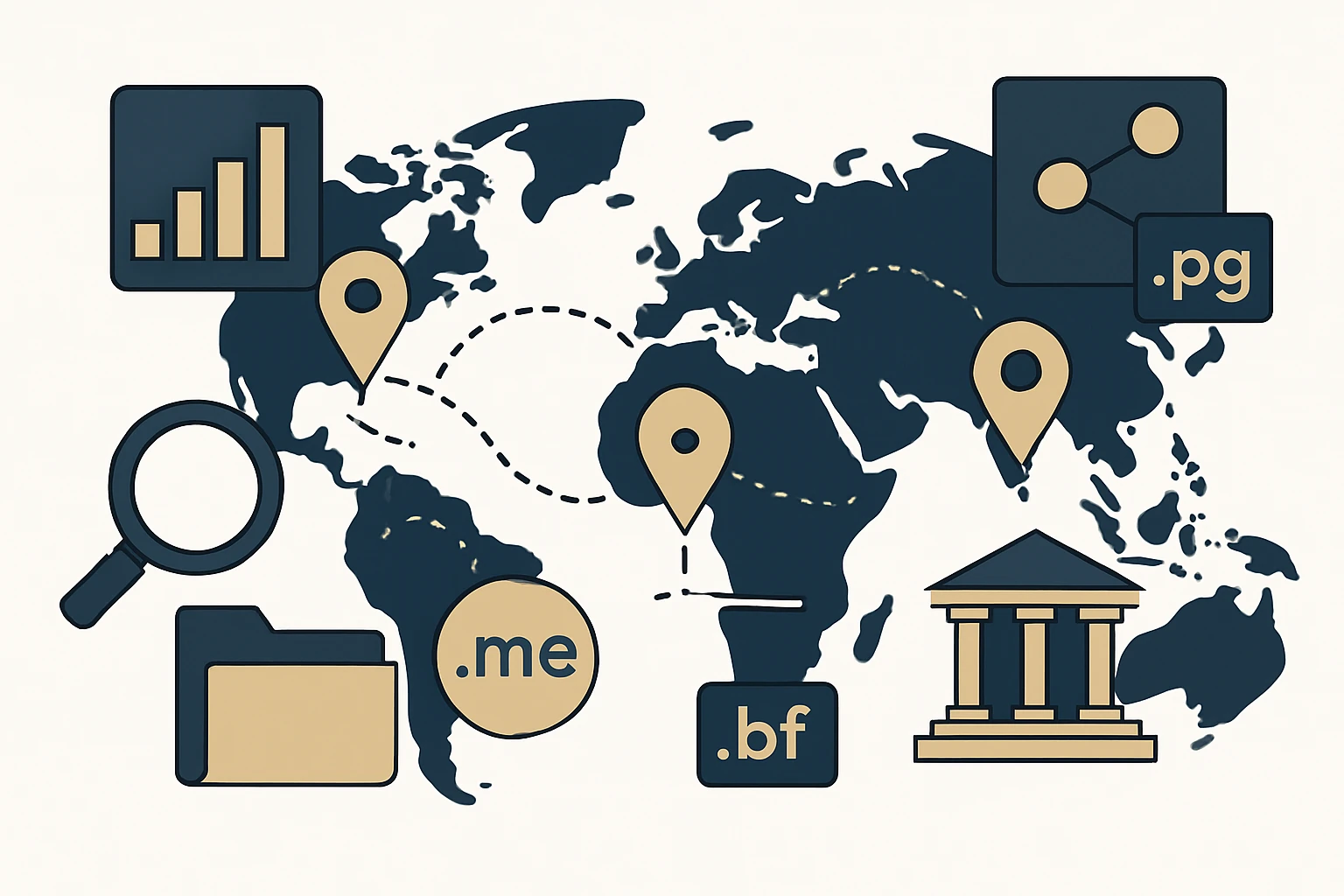
PNG (.pg), Montenegro (.me), and Burkina Faso (.bf) illustrate distinct market contexts and branding opportunities. Each market benefits from a deliberate approach that respects local expectations while maintaining global brand coherence.
Papua New Guinea presents a dynamic but localized digital environment where domain strategy must align with language preferences, regulatory norms, and local consumer trust cues. Montenegro’s market is part of Southeast Europe’s evolving digital economy, where regional content localization and strong local signals can boost engagement. Burkina Faso, with its Francophone market orientation, underscores the importance of language-specific content and regionally relevant brand positioning. In all cases, the goal is to complement the core global brand with country-specific assets that accelerate trust and conversion rather than fragment the user experience. For practitioners, this often means pairing ccTLDs with high-quality local content, robust privacy practices, and a clear governance model for the portfolio.
Key practical considerations include identifying credible inventory, ensuring legal clearance, and planning for post-acquisition portfolio management. Community-driven sourcing, partner networks, and confidential negotiation play vital roles in securing premium domains without overexposing the brand. For a framework aligned with these goals, consider the following structured approach:
Structured Block: Strategic Steps for Country-Domain Sourcing
- Discover - Map local relevance and brand fit, start with PNG (.pg), Montenegro (.me), and Burkina Faso (.bf) as pilot markets, review local registries and available assets. Papua New Guinea example pages illustrate market representation.
- Evaluate - Apply a consistent scoring model: brand fit, legal risk, SEO potential, and total cost of ownership. Use a lightweight due-diligence checklist to avoid overpaying for uncertain assets.
- Acquire - Engage in confidential, staged negotiations with a clear exit strategy and governance terms. Keep external disclosure minimal until a binding agreement is reached.
Limitations and Common Mistakes
- Over-architecting a multi-domain footprint - A large portfolio with many markets can dilute focus and inflate maintenance costs. A phased approach with clearly defined metrics often yields better returns. Multi-domain strategy considerations emphasize aligning architecture with business model and available resources.
- Underinvesting in local content and hosting - Local trust hinges on more than a domain name, it requires content that speaks to local users and appropriate hosting strategies to meet performance and privacy expectations.
- Neglecting legal and trademark risk across jurisdictions - ccTLD strategy intersects with IP rights, blind expansion without risk assessment can lead to disputes or regulatory exposure.
These observations align with industry discussions on international domain architecture and branding, which stress that a one-size-fits-all approach rarely yields sustainable results. Multi-Domain Strategies for Global Brands provides a broader view of how different structures affect visibility, localization, and brand coherence. (ondot.co)
Practical Integration: How the Client Supports Your Strategy
The client - Vadiweb’s network of premium domain brokerage and digital asset advisory services - offers a disciplined, confidential pathway to acquiring and managing country-domain assets. In practice, the client can help with: 1) identifying high-potential country domains that align with the brand, 2) executing confidential acquisitions with minimal market disruption, and 3) providing ongoing portfolio management to protect and optimize value over time. A real-world starting point could be exploring Papua New Guinea's market assets via the client’s country-focused pages, such as the Papua New Guinea overview, to contextualize a broader, multi-market strategy. Papua New Guinea country page
For brand owners seeking a structured, data-driven approach, the client’s resources on country and market-specific domains offer a practical backbone for due diligence, negotiation, and portfolio governance. When appropriate, additional resources such as pricing or the broader country/module inventories can inform decision-making without compromising confidentiality.
Conclusion
Strategic country-domain portfolios are not a fringe tactic, they are a purposeful element of modern brand governance. As markets like Papua New Guinea, Montenegro, and Burkina Faso continue to evolve digitally, a disciplined, data-informed approach to research, sourcing, and acquisition becomes essential. A well-executed ccTLD strategy supports local trust, complements global branding, and reduces risk through proactive protection and governance. By combining market-specific assets with robust portfolio management, brands can unlock sustainable growth while preserving the integrity of their digital footprint. For brands ready to embark on this journey, partner with a domain brokerage and digital asset advisory team that treats country domains as strategic assets - and not as mere checkboxes on a list.