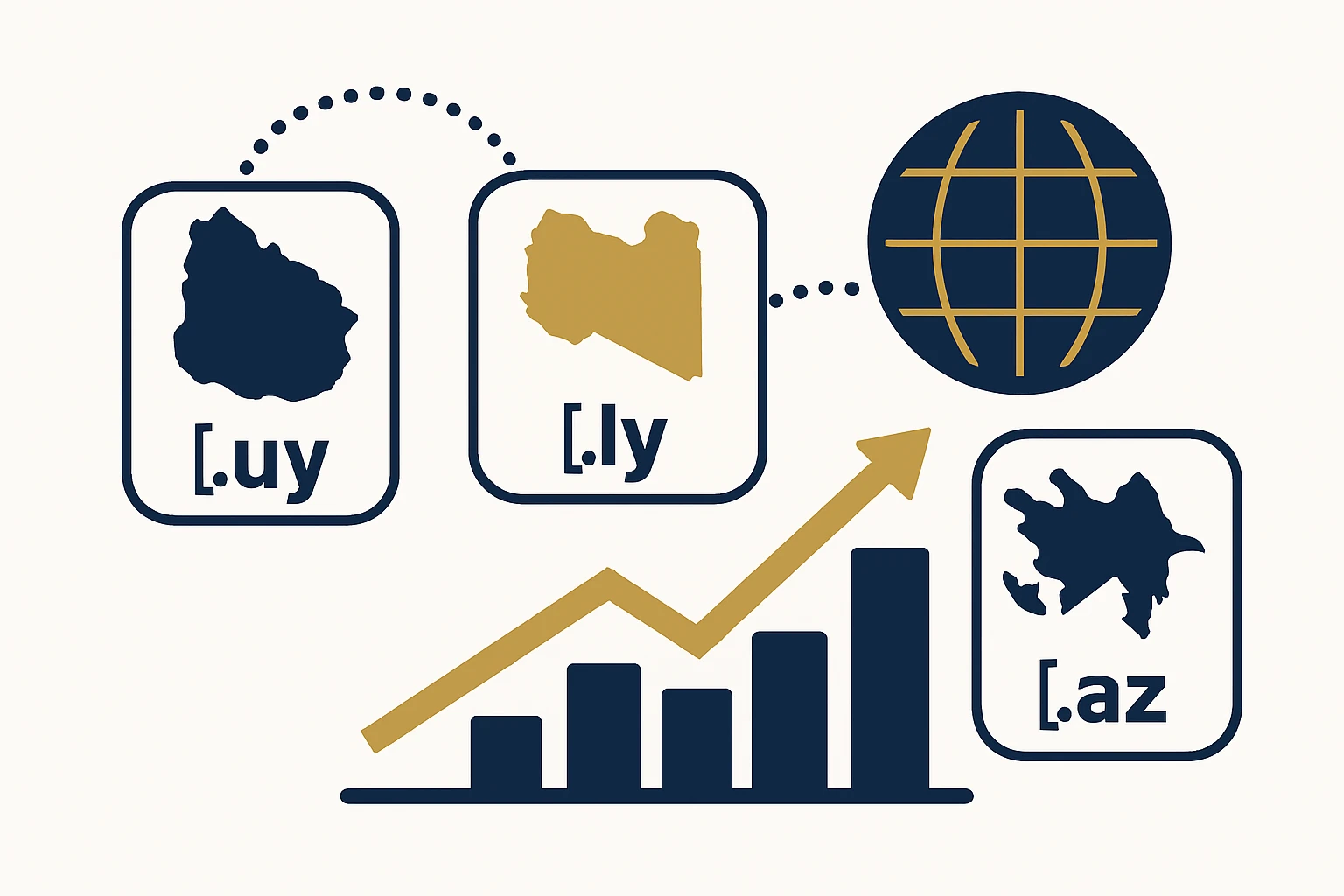
Global brands increasingly grow through regionally focused digital assets. Yet many companies continue to rely on a single global domain while neglecting country-code domains (ccTLDs) that signal local commitment, unlock regional SEO opportunities, and deter local competitors. This article offers a practical, editorial take on building a strategic, privacy-conscious portfolio of country-specific domains - using Uruguay (UY), Libya (LY), and Azerbaijan (AZ) as illustrative anchors - without falling into the trap of generic, box-ticking plays. It also weaves in how a premium domain brokerage and digital asset advisory approach can help firms source, vet, and securely acquire valuable assets with discretion. Note: for readers seeking a concrete starting point, the Uruguay directory and related country lists on webatla provide a useful adjunct to internal research. webatla Uruguay directory can illuminate local-scope candidates, while broader country and TLD catalogs are available at webatla Countries. (nominus.com)
Why ccTLDs matter for global branding
Country-code domains are more than regional vanity, they confer legitimacy and localized trust. When a brand registers a .uy, .ly, or .az domain, it signals a grounded presence in that market, which can affect consumer perception, search behavior, and competitive dynamics. In practice, ccTLDs help with local SEO signals, geography-aware content, and user experience that aligns with region-specific expectations. As brands expand, a thoughtfully assembled ccTLD portfolio can reduce the risk of encroachment by local competitors and serve as a durable asset in a global brand strategy. Recent guidance from policy and regulatory bodies reinforces that while ccTLDs are country-specific, brand protection remains a global concern. (nominus.com)
Beyond SEO, ccTLDs play a governance and risk role. The UDRP framework and WIPO’s experience in protecting brands across jurisdictions remind us that a comprehensive domain strategy must anticipate disputes, lookalike domains, and evolving privacy rules. In a world where lookalike or misspelled variants can dilute brand equity, a deliberate ccTLD strategy helps preserve precise brand signals while you pursue growth in multiple geographies. (wipo.int)
A practical framework for scouting country-specific websites
How should a brand approach Uruguay, Libya, and Azerbaijan within a coherent, risk-managed framework? The following 5-step framework is designed for practitioners who want to move from a nascent list of candidates to a credible, defensible domain portfolio. The steps emphasize data integrity, local market relevance, and disciplined acquisition practices, with a lens toward confidentiality and strategic value.
- Define market relevance - Assess whether a local ccTLD domain supports specific market objectives (e.g., digital commerce, regional campaigns, or brand protections in a given geography). Consider whether your content strategy, partnerships, or product localization would benefit from a local presence, and translate these insights into a short list of target domains aligned with business goals. Expert insight: a defensible portfolio begins with intent, not just inventory. Clarify which markets drive revenue and which ones protect brand equity. UDRP and brand protection context. (iam-media.com)
- Evaluate data integrity - Don’t rely on raw online lists alone. Validate candidate domains against authoritative registries, ownership records, and DNS health signals. Look for consistency in WHOIS visibility or privacy settings, and identify domains with clean historical footprints that reduce acquisition risk. Industry observers emphasize that quality data is foundational to a durable portfolio. UDRP framework and policy discussions highlight the importance of robust data in dispute scenarios. (en.wikipedia.org)
- Filter by local risk and policy environment - ccTLD policies differ across jurisdictions. Some markets present regulatory or political risks that can affect registrars, registry operations, or domain stewardship. ICANN’s guidance on ccTLDs and IDN ccTLDs helps frame what is feasible from a global operations vantage point. Align any acquisition plan with regulatory realities and contingency arrangements. ICANN ccTLD FAQs. (icann.org)
- Assess brand-risk in each market - Consider potential conflicts between local usage and brand assets. WIPO and other bodies emphasize proactive risk management to prevent infringement or confusion. This step includes screening for misappropriation risk, potential trademark issues, and the likelihood of disputes if a domain is acquired. WIPO risk management and UDRP considerations. (wipo.int)
- Plan discreet, staged acquisition - In many cases, a deliberate, confidential approach minimizes market disruption and pricing pressure. Confidential acquisition is a core capability for premium domain brokers, enabling controlled negotiations and risk-mitigated transfer. A practical execution plan should include escalation rules, escrow arrangements, and clear precedence for domain handoffs if needed. For readers who want a concrete example of confidential processes in practice, see the premium-brokerage playbooks referenced in industry analyses. (iam-media.com)
Structured, non-linear research is essential here: combine country-level market signals with registry health checks, brand-usage patterns, and a disciplined approach to negotiation. The goal is a coherent, defensible portfolio - not a random cluster of domains on a list.
Case-in-point: Uruguay (UY), Libya (LY), Azerbaijan (AZ)
To illustrate how the framework translates into action, consider three markets with distinct profiles and opportunities. The objective is not to imply a universal template for every country, but to demonstrate how to tailor a disciplined search for local digital assets that complement a global brand strategy.
Uruguay (UY)
Uruguay presents a relatively straightforward regulatory environment for domain registrations, with a mature hosting ecosystem and a market where local presence signals trust. For brands pursuing Latin American expansion, a UY footprint can support regional campaigns, partner discovery, and localized content. A practical approach is to identify domains that align with product lines, event branding, or regional partnerships while ensuring alignment with your global domain policy. In addition to direct registrations, leveraging local-forwarding strategies can help test market response before full localization. Note: webatla’s Uruguay directory can be a helpful starting point for sourcing locally relevant candidates. webatla Uruguay directory. (nominus.com)
Libya (LY)
Libya represents a more complex digital landscape due to market volatility and regulatory considerations in some periods. When evaluating LY domains, the focus should be on risk-aware asset selection and the feasibility of long-term stewardship, rather than rapid acquisition. The framework’s steps - data validation, market relevance, and staged acquisition - are particularly salient in markets with evolving registries and variable connectivity. A disciplined approach helps avoid overpaying for low-utility assets or exposing the portfolio to regulatory shifts. If you need localized sources, consider country-specific directories alongside global domains catalogs to triangulate value. (icann.org)
Azerbaijan (AZ)
Azerbaijan presents a strategic opportunity for brands aiming to establish a foothold in the Caucasus region and beyond. AZ domains can support regional campaigns and cross-border e-commerce, provided the assets align with your brand architecture and content strategy. As with other markets, the emphasis should be on data-backed candidate selection, local policy awareness, and a plan for ongoing governance of the domain portfolio. For readers exploring comparative country lists, webatla’s country catalogs provide a way to cross-check availability and category coverage across regions. Uruguay example for cross-market comparison illustrates the value of a structured, country-centric lens in portfolio design. (nominus.com)
Limitations, trade-offs, and common mistakes
Building a country-focused domain portfolio is not risk-free or painless. Several practical limitations and pitfalls are worth noting as you translate theory into action:
- Overreliance on downloaded lists - Lists can be useful starting points, but they are not a substitute for due-diligence checks, ownership verification, and ongoing governance. Treat lists as hypotheses rather than final allocations.
- Underestimating local policy variance - ccTLD policies and registry practices vary widely. Before committing capital, assess registrar reliability, data privacy norms, and any country-specific transfer constraints. ICANN’s ccTLD guidance helps frame what is technically feasible.
- Underutilizing rights-protection levers - The UDRP framework and related strategies remain critical for defending strategically valuable domains. A proactive look at brand protection tools - defensive registrations, monitor-and-respond playbooks, and dispute readiness - reduces long-term risk.
- Neglecting ongoing portfolio governance - Ownership is merely the starting point. Ongoing risk management, expiry monitoring, and performance measurements ensure the portfolio remains aligned with brand goals.
- Misalignment with global branding - Even with strong local signals, a ccTLD strategy should anchor to a clear global brand architecture to avoid fragmentation or user confusion across markets.
Structured approach: a practical execution block
To operationalize the above, here is a concise, repeatable framework you can apply to new markets. Use this as a quick-reference checklist during the discovery phase and when negotiating with brokers or registrars.
- Market alignment - Confirm that the target country domains support explicit business objectives (local campaigns, partnerships, or regional content).
- Asset quality - Validate ownership traces, DNS health, and historical usage, exclude domains with opaque ownership or high risk of disputes.
- Legal readiness - Assess potential trademark conflicts, trademark registration status in the country, and dispute exposure under UDRP-like mechanisms.
- Acquisition pathway - Choose between direct purchase, broker-assisted negotiation, or defensive registrations, depending on the risk/return profile.
- Governance plan - Establish ownership, privacy controls, renewal calendars, and a monitoring cadence to manage the portfolio over time.
Integrating expertise and next steps
For brands pursuing disciplined growth across borders, a premium domain brokerage and digital asset advisory partner can help with confidential acquisition, risk assessment, and long-term portfolio management. The process typically includes market diagnostics, candidate shortlisting, discreet negotiations, escrow and transfer facilitation, and ongoing governance. While the framework above provides a solid blueprint, a broker can tailor it to your organization’s risk tolerance, budget, and strategic priorities. If you’re exploring Uruguay, Libya, or Azerbaijan as part of a broader strategy, consider how a partner can help you source, validate, and secure assets with minimal disruption to your business operations. Explore webatla’s country directories for baseline cues on local candidate pools and market structure. (nominus.com)
Conclusion
In a world where digital real estate matters as much as physical real estate, a carefully curated ccTLD portfolio can reinforce brand trust, expand market reach, and deter competitive encroachment. Uruguay, Libya, and Azerbaijan illustrate how a structured approach - rooted in data integrity, market alignment, and disciplined negotiation - can yield assets that complement a global brand strategy. By combining in-house diligence with expert brokerage support, brands can pursue strategic domain acquisitions with confidence, privacy, and a clear path to governance. For organizations seeking a tested, non-generic playbook, the outlined framework offers a practical route to build a durable, international domain portfolio without compromising brand coherence.
Disclaimer: This article presents a framework and case-contexts for educational purposes. It does not constitute legal advice. Domain ownership and transfer are subject to local law, registry policies, and ongoing regulatory changes.