
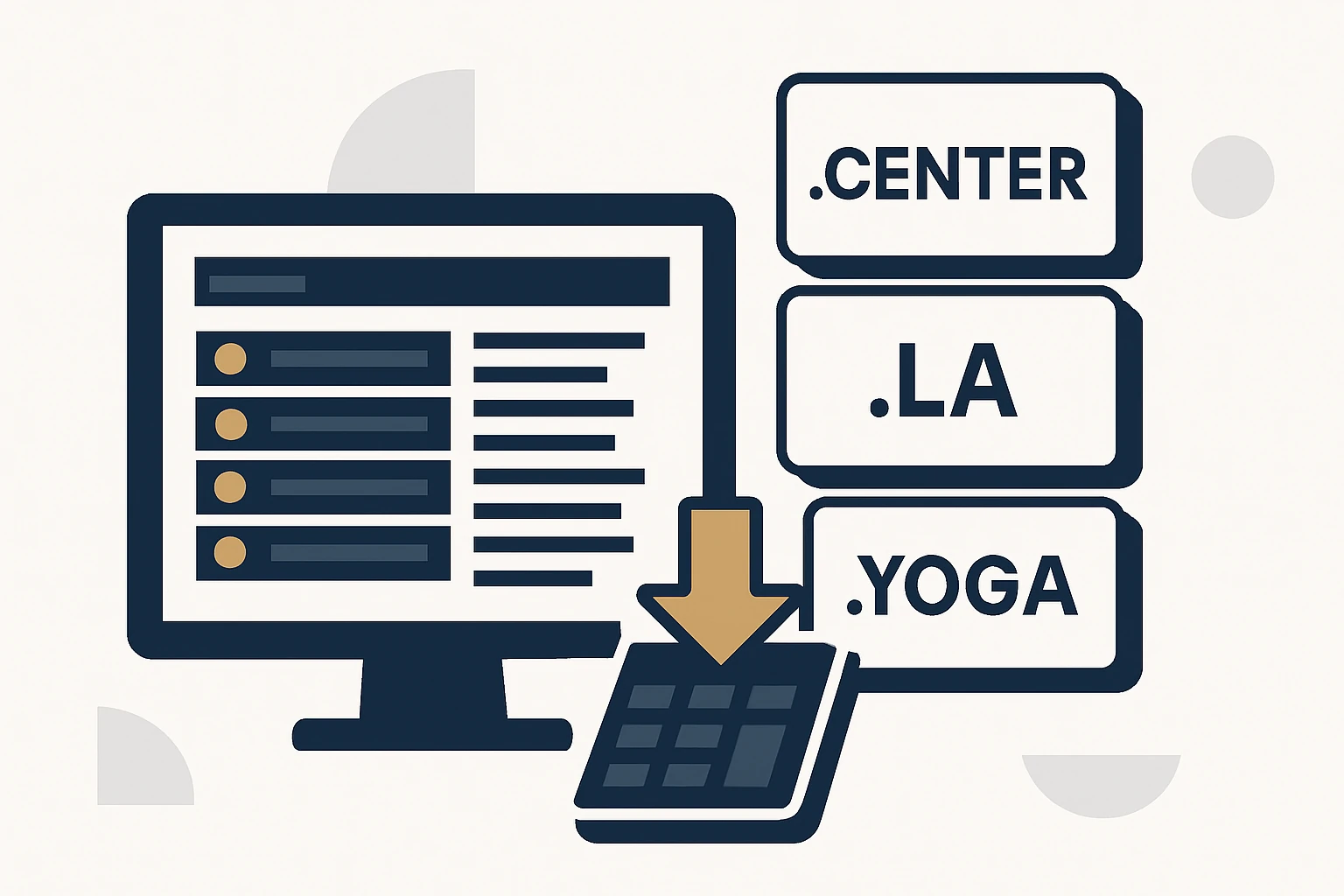
Introduction: The Hidden Value of Niche TLDs in Premium Portfolios
Many brand owners underestimate the strategic value of niche top‑level domains (TLDs). Beyond conventional extensions, well-chosen niche TLDs can reinforce brand relevance, improve memorability, and support specific markets or product lines. This article explains how to approach niche TLDs like .center, .la, and .yoga with a practical, evidence‑based framework - down to the point of downloading and reviewing domain inventories. The goal is not mere list‑building but disciplined portfolio development that aligns with brand strategy, risk management, and long‑term value creation.
Recent industry data show that the global domain name market continues to diversify as new gTLDs mature and broader inventories come into play. The Domain Name Industry Brief (DNIB) reports that total domain registrations remained robust through 2024 and into 2025, with ongoing growth across legacy TLDs and new gTLDs alike. For example, Verisign reported that the end of 2025 saw 386.9 million domain name registrations across all TLDs, reflecting continued demand for online address space in a crowded digital marketplace. These dynamics underscore the importance of a strategic approach to niche TLDs within premium portfolios.
Source note: Verisign’s quarterly DNIB updates provide authoritative data on domain registrations and market dynamics, including the tailwinds that support broader adoption of niche and branded TLDs. (blog.verisign.com)
1) The TLD Landscape in 2025–2026: Diversification, momentum, and what it means for brands
The domain namespace has expanded far beyond the traditional .com, with new gTLDs offering industry- or region-specific signals. ICANN’s ongoing New gTLD Program highlights a deliberate push toward a broader, more nuanced namespace, with plans for a potential Next Round opening in 2026. This trajectory signals that niche extensions - including those used for branding, product lines, or geographic focus - will remain a practical consideration for risk-conscious brand portfolios. For brand strategists, that means more options to align domain identity with business strategy while managing risk and protection.
From a portfolio management perspective, diversification helps distribute risk and creates options for co‑branding, localization, and campaigns without over-relying on a single extension. ICANN’s documentation on the New gTLD program and subsequent implementation work reinforces that the ecosystem is designed to expand branding and innovation opportunities while maintaining governance and policy considerations. (icann.org)
On the market side, DNIB data confirms continued broad activity in the domain space, including growth in new and existing TLDs, which supports a rethinking of how and where brands acquire meaningful digital real estate. While the largest share of registrations remains with legacy extensions, the pace of new TLD adoption by businesses - especially niche and branded TLDs - continues to accelerate in measured, brand-friendly ways. This context is important when you’re evaluating lists for specific extensions like .center, .la, or .yoga. (blog.verisign.com)
2) Why .center, .la, and .yoga Can Be Strategic for Brand Portfolios
Niche TLDs offer signaling value that can complement a brand’s existing online presence. For service providers, physical centers, or localized brands, .center can help users identify a site as the hub of a physical or virtual service. For technology‑driven or city‑adjacent brands, .la can serve as a geographic shorthand or a cultural cue, while .yoga communicates a clear niche alignment for wellness‑related enterprises. The practical value lies in the alignment of domain extension with business intent, audience expectations, and searcher behavior - an alignment that should be validated against real inventory and legal considerations.
Industry and policy context matters here: the New gTLD program’s ongoing evolution signals that industry‑specific and branding‑oriented extensions are not a fad but a considered strategy within a modern domain portfolio. This is especially relevant for brands pursuing differentiated identities in crowded markets, where a well-chosen TLD can help with memorability and immediate recognition. As ICANN has documented, the New gTLD program is designed to foster innovation and consumer choice while offering brand owners more tools to manage digital identity. (icann.org)
3) How to Download and Assess Niche TLD Domain Lists: A Practical Guide
Downloading a targeted inventory is the first operational step in a disciplined niche TLD strategy. The goal is not merely to collect domains but to establish a baseline of options that are relevant, available (or negotiable), and aligned with brand objectives. Below is a practical workflow you can apply to niches like .center, .la, and .yoga - and to other extensions you’re evaluating as part of a premium portfolio.
- Define brand relevance: Map each candidate TLD to concrete brand use cases (e.g., a yoga studio chain using yoga.yoga or a regional center with center.center). This ensures you’re not chasing novelty but pursuing practical branding benefits.
- Source credible inventories: Begin with trusted listing hubs and category pages (for example, pages that group domains by TLD, such as /tld/center, /tld/la, and /tld/yoga on trusted marketplaces). Use inventories that offer filters (availability status, price ranges, renewal terms) to accelerate screening. For webatla’s curated TLD pages, you can browse directly at Center TLD inventory and explore broader catalogs at TLD catalog. For pricing and purchasing options, see pricing.
- Validate availability and ownership data: Cross-check WHOIS records and registrant information to confirm ownership status, ensuring you’re not misled by privacy services. This is critical for confidential acquisitions and when negotiating for assets that may be controlled by others.
- Assess branding and SEO implications: Evaluate how the extension signals align with search intent, local markets, and branding. While SEO impact varies, the alignment between brand narrative and TLD can influence trust and click-through behavior in branded campaigns.
- Shortlist and document rationale: Create a scoring rubric (brand fit, availability, price, renewal risk, era of marketing campaigns) and document the rationale so stakeholders can review decisions transparently.
In addition to internal screening, you should run a structured assessment of each extension’s market perception and governance. Recent industry updates reinforce that the space is dynamic, with new rounds anticipated and ongoing governance considerations to manage risk for brand owners. (icann.org)
4) A Practical Framework: Niche TLD Evaluation for Brand Portfolios
Use the following framework to evaluate niche TLD opportunities in a repeatable, defensible way. This is especially valuable for teams managing confidential domain acquisitions and complex portfolios.
- Strategic fit - Does the TLD map to a product line, service category, or regional strategy? Will it support marketing and customer trust in the intended markets?
- Inventory health - What is the availability status across a curated list of candidates (e.g., center, la, yoga)? Are there premium or premium‑adjacent names that justify investment?
- Ownership and control - Who currently controls desirable names, and what are the risks of transfer, privacy masking, or contentious ownership? Is a confidential acquisition feasible?
- Cost of ownership - Include upfront price, renewal fees, potential trademark and brand‑risk costs, and any back‑end expenses related to portfolio management.
- Brand safety and risk - Assess potential brand confusion, cross‑market misinterpretation, and policy risk associated with particular extensions.
- SEO and user behavior - Consider disclosure of the TLD’s signaling effect and how it interacts with branded campaigns, paid media, and organic search.
- Governance and policy considerations - Review any registry rules, UDRP risk exposure, and contractual obligations that could affect long‑term strategy.
- Decision point - Decide on a phased approach: acquire, monitor, or forego, with clearly defined milestones and exit options.
Structured quick reference (quick rubric you can reuse):
- Brand alignment: 0–5
- Availability: 0–5
- Cost and renewal risk: 0–5
- Regulatory/brand risk: 0–5
- Market perception: 0–5
Applied to niche extensions such as .center, .la, and .yoga, this framework helps ensure that every listed item has a documented strategy, not just a strong-sounding extension. It also supports a confidential domain acquisition program by clarifying decision criteria before negotiations begin. For reference on broader market dynamics and governance context, see ICANN’s discussions around the New gTLD program and its implementation plan for a potential next round. (icann.org)
5) Expert Insight and Common Mistakes
Expert insight: In a disciplined premium domain program, the strongest results come from marrying brand strategy with a rigorous evaluation framework. Don’t chase novelty for novelty’s sake, anchor every TLD choice to a concrete business objective, a defined audience, and a clear plan for monetization or protection.
Limitations and common mistakes: A frequent misstep is treating niche TLDs as a magic SEO lever or assuming that every extension will drive traffic. The relationship between TLDs and search rankings is nuanced and varies by market, content quality, and branding signals. Additionally, while a niche TLD may improve brand clarity in some contexts, it can introduce discoverability and localization challenges if not integrated with a broader marketing plan. It can also complicate cross‑brand consistency if not managed carefully. The industry context remains dynamic, with ongoing changes to registry policies and potential future rounds of new TLDs. (icann.org)
6) Limitations or Common Mistakes: A Quick, Honest Review
The niche TLD path offers compelling branding opportunities, but it’s not without caveats. The main limitations include: (1) SEO impact is not guaranteed and depends on overall domain quality and content strategy, (2) market reception for a non‑traditional extension can vary by audience and geography, (3) ownership and renewal costs for a broad portfolio may be higher and require disciplined budgeting, (4) regulatory and registry policies can shift, affecting eligibility or term lengths, and (5) acquiring highly desirable names often requires careful negotiation and confidentiality considerations. A measured approach - grounded in data, with clear governance and risk controls - tends to outperform speculative bets. (blog.verisign.com)
7) Case for a Practical, Editorial Path Forward
For brand teams considering niche extensions, a practical path is to start with a short list of extensions tightly aligned to business strategy, then progressively expand as inventory and budget allow. A disciplined approach combines a validated framework, confidential acquisition options, and a robust portfolio management process. The client’s own domain listings - such as Center TLD, TLD catalog, and pricing - offer a tangible starting point to explore inventory and pricing dynamics. This approach keeps the process editorial, measured, and closely aligned with brand protection and strategy objectives.
Conclusion: Turning Inventory into Strategic Value
Niche TLDs like .center, .la, and .yoga can be valuable components of a premium domain portfolio when evaluated through a rigorous, business‑driven lens. The current market context - marked by growing global registrations and ongoing new gTLD program activity - supports the pursuit of well‑aligned, brand‑protective domain strategies, rather than a blind chase for the latest extension. By downloading and methodically evaluating targeted inventories, brands can build a lean, defensible portfolio that complements traditional assets, supports regional and product line branding, and reduces long‑term risk. For practitioners ready to take the next step, start with the inventories that align with your brand’s core strategy, validate ownership and availability, and apply the Niche TLD Evaluation Framework to guide decision‑making.
Note on data sources: Market context and growth signals cited here come from Verisign and ICANN updates, reflecting the ongoing evolution of the domain name industry and the role niche TLDs play within premium portfolios. (blog.verisign.com)