Global brands face a persistent challenge: how to allocate scarce domain-investment dollars across country-code top-level domains (ccTLDs) in a way that meaningfully protects brand equity while unlocking regional growth. A data-driven approach to a country-domain strategy helps decision-makers cut through hype and focus on where a premium domain portfolio can deliver measurable value. This article presents a practical framework you can adapt when considering markets such as South Korea (KR), Sweden (SE), and Finland (FI), paired with a disciplined acquisition and risk-management process.
Why a country-focused domain strategy matters
ccTLDs are more than regional suffixes, they are signals to local users and search engines about where a site is intended to serve. ICANN and the ccNSO describe ccTLDs as country-code top-level domains that reflect a country or territory, with governance handled locally by registries and managers. In practice, adopting a country-targeted domain strategy can improve local trust, brand relevance, and search visibility when aligned with regional content and compliance. As you plan, remember that some ccTLDs behave like generic domains in search results (gccTLDs), which is an important nuance for risk assessment and portfolio design. (icann.org)
Domain growth continues to be substantial overall. Verisign’s Domain Name Industry Brief reports hundreds of millions of domain registrations across all TLDs, with ccTLDs contributing a meaningful share and growing year over year. This backdrop matters for bulk analysis, because it frames the market context in which premium domains are scarce but valuable assets. For Q1 2025, total registrations stood at about 368.4 million, with ccTLDs showing positive momentum in many markets. (blog.verisign.com)
The data inputs you need: country lists, markets, and risk signals
To build a defensible country-domain portfolio, you need reliable inputs that translate into actionable decisions. The core data inputs typically include the following:
- Target country signals: the market focus and regulatory environment for KR, SE, FI, including language considerations and local consumer behavior.
- Active domain landscape: a view of existing local brands, competing domains, and potential opportunities for premium acquisitions (e.g., trademarks, established brand names, and regionally important keywords).
- Ownership and availability data: who owns nearby domains, renewal status, and potential for confidential acquisition - important to minimize public exposure during negotiations.
- Legal and brand-protection context: how local dispute mechanisms (UDRP-like processes) and national laws affect risk and enforcement thresholds.
For governance and due diligence, robust access to accurate registration data matters. The World Intellectual Property Organization (WIPO) and ICANN emphasize that brand protection involves not just registration, but also the interplay between trademarks, domain registrations, and disputes. Use credible sources to inform risk assessment, including WIPO’s domain-name dispute framework and ICANN’s guidance on ccTLD management. (wipo.int)
In practice, your data set can be augmented with country-specific lists or databases that help identify candidate domains. While a direct “download list of KR websites” query might be a starting point for exploratory research, ensure you source data ethically, respect privacy, and validate ownership before pursuing any acquisition. Data integrity matters when you’re assessing premium assets and potential brand-alignment gaps across KR, SE, and FI. The market context provided by Verisign further grounds these decisions in real-world metrics. (blog.verisign.com)
A practical framework: data-driven decision points for a regional premium portfolio
Below is a concise, repeatable framework you can apply to evaluate premium domain opportunities in KR, SE, FI, or any other country market. The framework emphasizes disciplined data use, clear decision criteria, and a documented acquisition path.
Framework at a glance: DATA-SPORT
- Data definition: define the market boundaries (KR, SE, FI) and the local use cases you want the domain to serve (brand protection, regional campaigns, product launches).
- Audience-fit & risk: assess how local users will perceive the domain and what disputes or enforcement risks exist in that jurisdiction.
- Transparency in ownership: favor confidential or controlled acquisition processes when necessary to protect deal dynamics and reduce public exposure.
- Acquisition criteria: set guardrails for price bands, suffix choices (ccTLD vs gccTLD risk), and alignment with local content strategy.
- Due diligence: verify historical ownership, check for trademark conflicts, and review renewal schedules to avoid unintentionally ceding valuable assets.
- Execution pathway: establish a negotiation plan, engagement timelines, and a post-acquisition integration plan for marketing and legal alignment.
In this framework, the data definition and due diligence stages are the most critical for avoiding costly missteps - especially when you’re balancing multiple markets with different regulatory and linguistic contexts. For a reliable data baseline, consider credible registries and market analyses, rather than ad hoc lists alone. (icann.org)
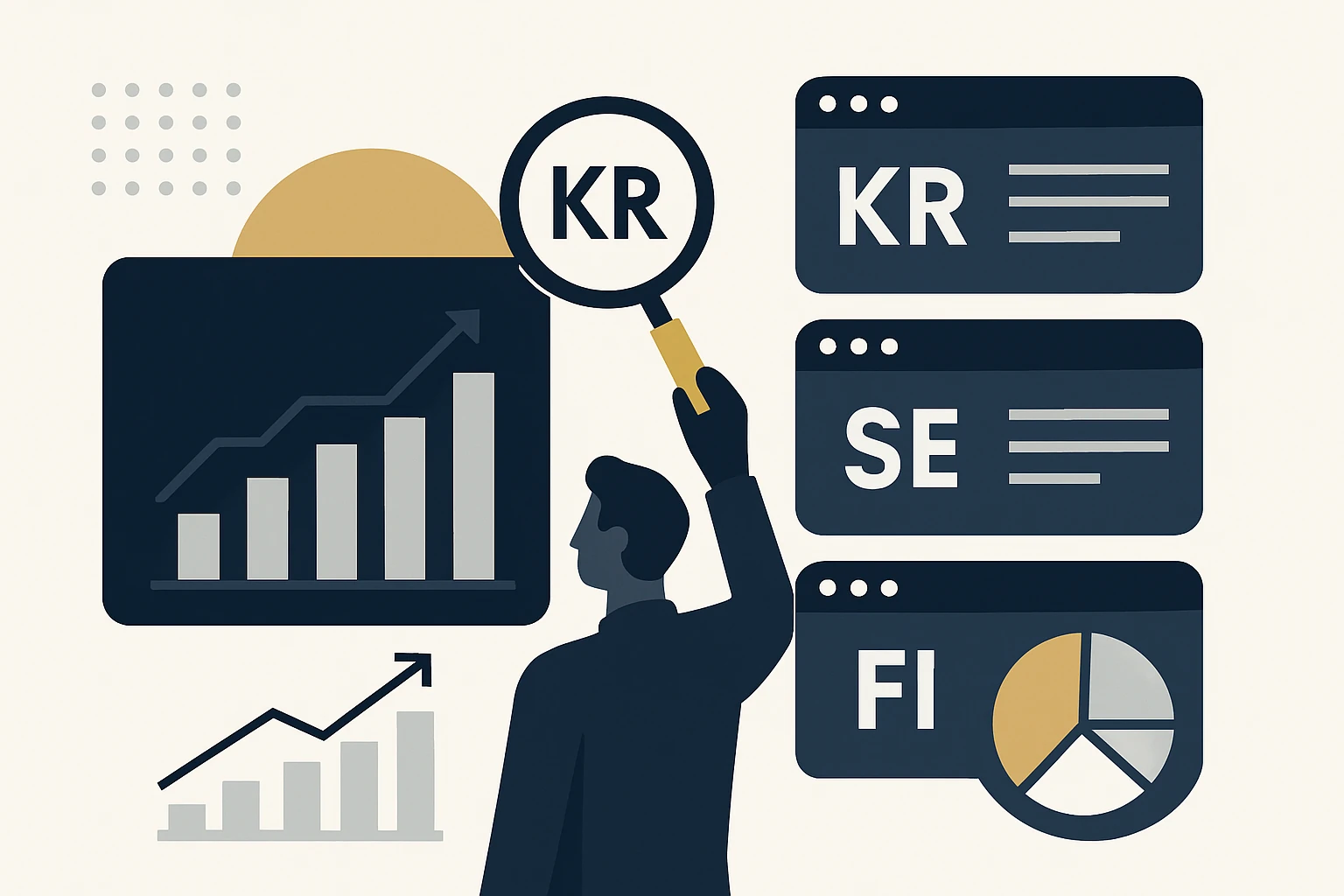
To illustrate how this plays out in practice, here’s how you could approach KR, SE, and FI using the DATA-SPORT framework:
prioritize domains that reflect Korean language and local consumer paths, but guard against gccTLD risk where search engines may treat the domain as global rather than country-targeted. - Sweden (SE): emphasize domains that align with Swedish brand terms and regulatory expectations, consider bilingual strategies (SE+EN) where appropriate to maximize local relevance.
- Finland (FI): focus on Finnish-language domain variants and local search intent, while monitoring privacy and data-protection expectations in the Nordic market.
The practical takeaway is that a country-domain strategy should be treated as a portfolio - not a one-off purchase. Each asset’s value is amplified when it sits inside a coherent regional plan with clear usage and enforcement guidance. This is where a disciplined, data-driven process pays off, reducing the risk of overpaying for domains that won’t drive measurable outcomes.
The structured block: a concrete decision framework for KR, SE, FI
The following structured block summarizes a repeatable decision cadence you can deploy with minimal friction. It is designed to help your team compare and select premium domains while preserving brand safety.
- Step 1 - Market-scoped inventory: assemble a list of candidate domains that are plausibly premium in KR, SE, FI, and verify basic ownership signals.
- Step 2 - Brand-fit scoring: rate each candidate against brand relevance, linguistic alignment, and potential for legitimate regional use.
- Step 3 - Legal risk screen: check for trademark conflicts or dispute history using reputable sources, apply UDRP/UDRP-like risk lens where applicable. (wipo.int)
- Step 4 - Ownership strategy: decide between direct acquisition, broker-mediated deals, or confidential pathways to protect deal dynamics.
- Step 5 - Financial guardrails: set max-price thresholds by market and domain capability, include renewal-cost projections for ongoing value. (investor.verisign.com)
- Step 6 - Integration plan: outline how acquired domains fit with regional content strategy, local compliance, and brand protection processes.
Executing this framework requires discipline and governance. It also benefits from a centralized data layer that tracks ownership, renewal dates, and strategic rationale for each asset - reducing risk during negotiations and post-acquisition management.
Limitation, trade-offs, and common mistakes
No framework is perfect. Below are some common missteps to avoid when building a country-domain portfolio for KR, SE, FI - and the trade-offs they entail:
- Over-indexing on ccTLD counts: more domains do not automatically translate into better market coverage. Quality of alignment with local search intent and content strategy matters more than sheer volume. Some ccTLDs may function as gccTLDs, potentially dampening country-targeting signals to search engines. (goup.co.uk)
- Neglecting local dispute risk: domain ownership interacts with local trademark and dispute regimes. Underestimating this can lead to costly enforcement gaps later, WIPO and ICANN emphasize the need for robust dispute-resolution readiness as part of brand protection planning. (wipo.int)
- Underestimating data quality: buying data or lists without verification risks misinformation and failed acquisitions. Use credible industry data and corroborate ownership through reliable registries and WHOIS data when feasible. Verisign’s market data underscores the scale of the domain market and the importance of accuracy in portfolio planning. (blog.verisign.com)
- Language and localization gaps: a KR or FI domain without localized content and consumer relevance may underperform. Align with local language strategy and ensure that naming conventions respect local norms and linguistic nuances. ICANN’s ccTLD guidance highlights the local governance and community dimensions that shape how a domain is perceived locally. (icann.org)
How the client’s capabilities support this approach
Professional, privacy-conscious domain portfolios require robust data services and transparent processes. The client’s suite offers several capabilities that harmonize with the DATA-SPORT framework:
- South Korea domain lists: country-specific domain catalogs provide a structured starting point for KR strategy. For reference, see the client’s page focused on KR markets.
- RDAP & WHOIS Database: access to the latest ownership and registration metadata helps validate candidates as you move toward confidential acquisitions and risk assessment.
- Pricing & portfolio planning: transparent pricing enables disciplined budgeting and consistent evaluation against internal guardrails.
Incorporating these capabilities into your workflow supports a more defensible, audit-ready approach to building a regional domain portfolio that aligns with brand protection goals and strategic growth plans. For more information on the client’s KR coverage and related services, you can explore the South Korea page, pricing details, and the RDAP & WHOIS database linked below. South Korea domain lists, Pricing, RDAP & WHOIS Database.
Limitations and alignment with broader brand strategy
A well-constructed country-domain portfolio is a piece of a broader brand protection and digital asset strategy. It should be integrated with trademark clearance, trademark watching, and an ongoing risk-management program. While reputable data sources provide a strong basis for decision-making, you should also regularly reassess the portfolio against evolving market dynamics, such as changes in ccTLD policies, new local regulations, or shifts in consumer search behavior. For ongoing governance, you can reference ICANN and WIPO guidance on ccTLD management and dispute resolution to stay aligned with best practices. (icann.org)
Conclusion: turn data into defensible growth in KR, SE, and FI
A data-driven, process-oriented approach to country-domain strategy helps global brands translate regional nuance into a coherent premium-domain portfolio. By pairing credible market signals with a structured decision framework, you can identify opportunities that deliver brand protection, localized trust, and measurable growth - without overextending resources. The right data, governance, and partner capabilities make the difference between speculative domain buys and strategically valuable assets that endure in dynamic markets like KR, SE, and FI.