Introduction
For brands pursuing premium domain assets, the path to a high-performing portfolio is rarely a matter of luck. It hinges on disciplined, country-aware prospecting that translates into actionable, downloadable lists that align with strategic goals. This article offers a practical framework for building country-specific lists - focused on Denmark (DK), Poland (PL), and Brazil (BR) - and turning them into efficient negotiation opportunities. The emphasis is on quality signals over volume: domain name quality, relevance to brand strategy, potential for growth, and the privacy and data access realities that govern how you reach owners in today’s regulatory environment.
As a backdrop, the industry is moving from traditional WHOIS to Registration Data Access Protocol (RDAP) to improve data privacy and access control. That shift has practical implications for how prospectors locate owners, verify ownership, and conduct outreach in a compliant manner. See the ICANN updates on RDAP adoption and the evolving data policies as you plan your outreach strategy. RDAP transition and WHOIS sunset, and RDAP overview for context. Private data practices are also evolving, making careful list-building and broker-assisted negotiation more important than ever. RDAP privacy and ownership data considerations provide a useful lens on how data access is changing.
A practical prospecting framework for country-specific premium domains
Building a country-focused prospecting program starts with a clear framework that turns scattered data into a prioritized, executable plan. The steps below translate into a ready-to-download list format that teams can share with internal stakeholders and with trusted brokers.
- Define geography and verticals. Explicitly map target regions (Denmark, Poland, Brazil) and the verticals that align with your brand (e.g., technology, fintech, health, sustainability). When you combine geography with industry, you create a filter that improves win rates and reduces wasted outreach.
- Assemble candidate-domain lists per country. Use public directories, industry registries, and reputable domain marketplaces to assemble candidate domains. The goal is to generate a long list that you can trim through quality-scoring rather than a brute-force, unfiltered dump. For practitioners who need a curated starting point, consider country-specific domain listings and country-wide asset catalogs as a foundation. If you are sourcing lists for Denmark, Poland, and Brazil, you’ll want to normalize data fields (domain name, current registrar, age, visible backlink indicators, and any brand-mention signals).
- Score and filter domains by quality metrics. Prioritize domains with strong backlink profiles, meaningful keyword relevance, and alignment with brand strategy. Use lightweight metrics (age, traffic estimates, anchor-text diversity) and heavier signals (brand-fit indicators, existing or potential market usage) to rank order domains.
- Prioritize and segment for outreach. Create tiers (A/B/C) based on strategic fit and negotiation leverage. Segment by country and by vertical to tailor outreach messaging and to prepare country-specific negotiation scenarios with the help of brokers.
- Engage with owners via broker-led channels. When direct outreach is preferred or required by privacy policies, use qualified brokers who can negotiate on confidential terms and preserve relationships for future opportunities. This step is where the brokerage discipline matters most, especially across jurisdictions with different privacy expectations and commercial norms.
Structured block: Prospecting framework at a glance
- Geography-vertical mapping
- Country-specific candidate sourcing
- Quality scoring & qualification
- Outreach tiering & sequencing
- Broker-assisted negotiation & closure
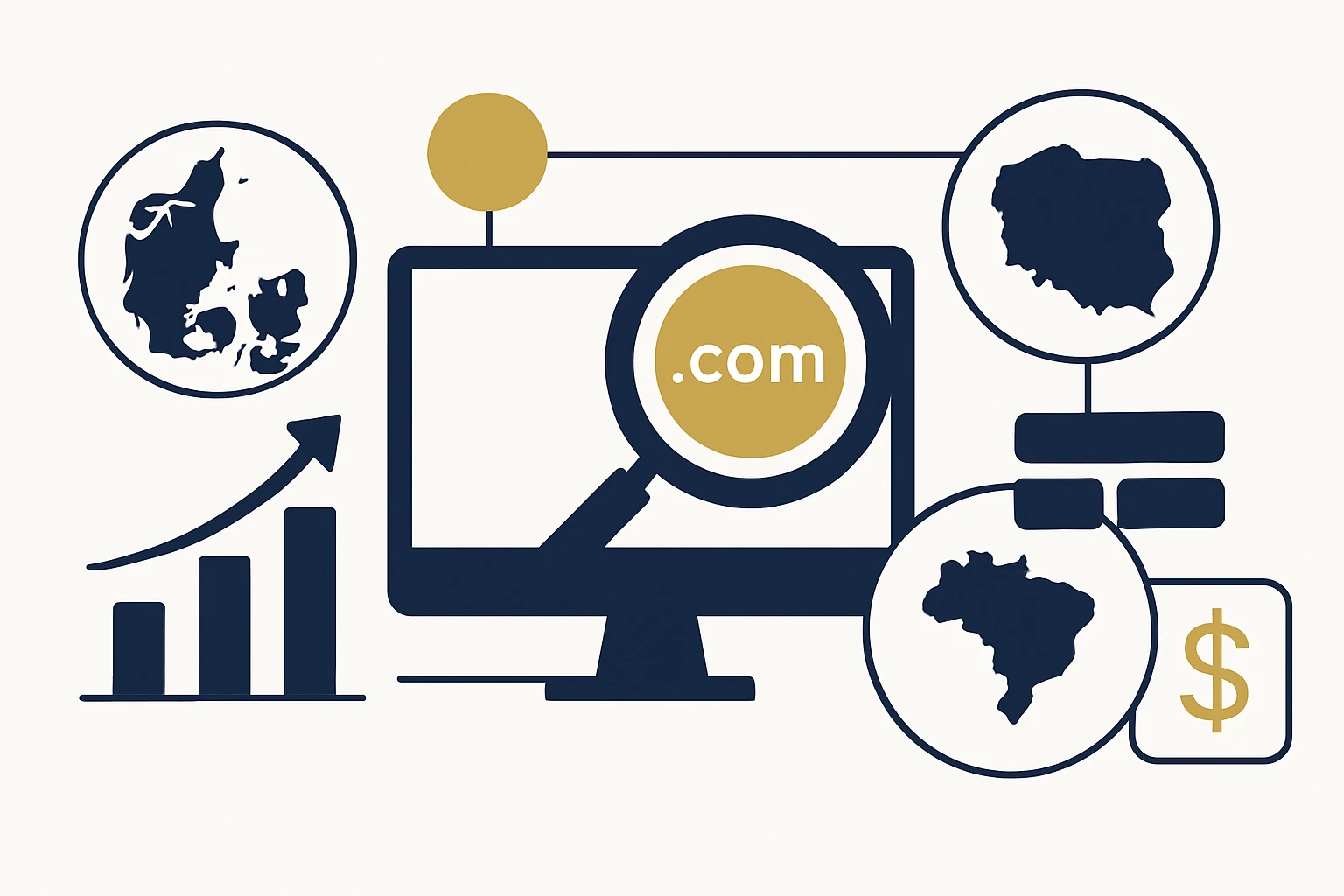
Country focus: Denmark, Poland, and Brazil
Each country presents unique dynamics for premium domain prospecting. The framework above is designed to be applied with country-specific adaptations. Below are practical notes for the three markets, along with concrete steps you can take to build downloadable, country-tailored lists that feed your negotiation strategy.
Denmark (DK) - local market signals and practical steps
Denmark’s market tends to reward domains with concise, Danish- or English-language branding signals and clear relevance to local or cross-border commerce. For a Danish focus, validate domains using signals that hint at regional intent, such as localized keywords, Danish language content, or traffic patterns from Danish users. The country’s ccTLD is .dk, which is the primary namespace for Danish brands and regional assets, aligning your list-building with this namespace can improve relevance and post-purchase protection. Using country-specific lists enables a more precise prioritization of domains likely to resonate with Danish businesses or with cross-border brands expanding into the Danish market.
Strategically, you should consider Danish privacy norms and the ongoing RDAP transition when planning outreach. As RDAP becomes the standard data access protocol, the ability to verify ownership while respecting privacy protections will rely on compliant broker channels and verified contact points. See ICANN’s RDAP overview for context on the broader shift toward privacy-conscious access to registration data. RDAP overview.
Poland (PL) - evaluating local relevance and brand alignment
Poland offers a dynamic market with strong e-commerce growth and multilingual branding opportunities. A Poland-focused prospecting list benefits from including domains with Polish or regional relevance, potential for strong local search visibility, and domains that can support brand expansion into Central Europe. When compiling lists for Poland, consider the balance between Polish-language branding and English-language international exposure, as this mix often correlates with different buyer personas. In parallel with your list-building, keep in mind that ongoing data-access policies influence how you contact domain owners, broker channels can help navigate jurisdictional expectations and ensure compliant outreach. For general data-access context, see the ICANN RDAP resources referenced above.
Brazil (BR) - scale, growth signals, and cross-border potential
Brazil represents a large consumer market with unique branding considerations, including Portuguese-language brand signals and considerations for cross-border expansion in Latin America. When assembling a BR-focused list, prioritize domains that demonstrate local relevance or scalable regional relevance, and assess how a given domain could anchor a brand’s expansion into Brazilian markets or Latin American ecosystems. As with the other markets, reliability of ownership data and privacy controls affect outreach strategy, broker-assisted approaches can help ensure compliance and maximize leverage when negotiating premium assets. The broader RDAP transition continues to evolve data access policies across jurisdictions, reinforcing the case for a structured, compliant approach to prospecting.
Data access, privacy, and how they shape prospecting
The shift from traditional WHOIS to RDAP is not merely technical, it alters how you locate and engage with domain owners. RDAP provides standardized, authenticated access with improved privacy controls, which matters when you’re assembling country-specific lists intended for confidential negotiations. ICANN outlines the RDAP timeline and the sunset of WHOIS, emphasizing secure access, internationalization, and policy-driven data access. RDAP transition and WHOIS sunset. For a concise primer on RDAP versus WHOIS, see the official RDAP overview page. RDAP overview.
Practically, this means you should favor broker-assisted processes and privacy-respecting outreach when building downloadable country lists. Data-privacy- and ownership-rights-aware providers are increasingly tracing how you acquire and use ownership data. A good reference point on the privacy side is RDAP ownership data and privacy, which discusses how privacy services interact with registration data.
Limitations and common mistakes in country-specific domain prospecting
Even with a strong framework, several caveats can derail a country-focused prospecting program:
- Over-reliance on scraped lists. Public lists can be incomplete or stale. It’s better to couple lists with live signals (e.g., current owners, registrar changes) and broker validation. A disciplined refresh cadence is essential.
- Ignoring brand-fit and trademark risk. A domain’s keyword signals may look attractive in isolation, but misalignment with your brand or potential trademark issues can waste negotiation cycles. Always pair prospecting with a legal check and brand suitability review.
- Underestimating cross-border outreach nuances. Each country has different norms for negotiations, contract terms, and privacy expectations. Relying on a one-size-fits-all outreach script undermines engagement quality.
- Assuming ownership data is always accessible. RDAP/privacy controls will influence who you can contact and how. Always plan for broker-mediated communications and alternative channels where direct contact is restricted.
Expert insight: in practice, the most successful premium-domain campaigns blend rigorous data hygiene with human judgment - where editorial, legal, and negotiation expertise converge to convert high-potential lists into real acquisitions. The limitation is that even the best framework cannot replace thoughtful due-diligence and patient, confidential negotiations.
Integrating webatla resources into the prospecting workflow
To operationalize country-specific prospecting at scale, practitioners often turn to curated asset catalogs and broker-enabled services. webatla offers country-focused domain lists and related tooling that align with the framework described here. These resources can help you assemble a downloadable, country-tailored starting point for Denmark, Poland, and Brazil. For a centralized portal to country lists, visit webatla’s countries page. For data-access and verification tools that complement prospecting, you can explore RDAP & WHOIS database and, where relevant, our pricing page to model acquisition costs. webatla pricing provides a framework for budgeting such prospecting programs.
Conclusion
Country-specific prospecting for premium domains is not a mechanical exercise, it’s a strategic discipline that demands clean data, smart filtering, and disciplined negotiation. By combining a country-focused sourcing framework with privacy-aware data practices and broker-led outreach, you can convert downloadable lists into targeted, high-value acquisitions. Use the Denmark–Poland–Brazil lens to test the framework, refine your scoring, and build a repeatable process that scales with your brand’s growth. And when you’re ready to formalize the program, webatla offers country- and TLD-specific assets to accelerate your search and streamline the negotiation process. Explore the country catalogs, RDAP-enabled data resources, and flexible pricing to align your prospecting with your strategic objectives.
Key resources to start: webatla country lists for a country-focused starting point, RDAP & Whois data for access considerations, and pricing to model the program’s economics.