For modern brands, protecting and growing value isn’t limited to product lines or traditional advertising. A thoughtfully constructed portfolio of country-code top-level domains (ccTLDs) can shield a brand from impersonation, unlock regional SEO opportunities, and create defensible digital real estate in markets that matter most. In this article, we explore a practical framework to evaluate ccTLD assets - specifically Aruba (.aw), Guadeloupe (.gp), and Greenland (.gl) - as part of a holistic brand and domain strategy. The discussion draws on established governance and risk-management principles for ccTLDs, as described by leading governance and advisory sources, to help brand leaders decide when and how to invest in these assets. Note: ccTLDs are regulated by country-specific registries and dispute mechanisms, consult official resources for the latest policies. WIPO: ccTLD Domain Dispute Resolution and IANA: .gl root information provide foundational context for governance and operations.
Why a ccTLD portfolio matters for brand protection and growth
Beyond the traditional .com, a strategic ccTLD portfolio helps brands mitigate risk in regional markets, capture local search visibility, and prevent opportunistic registrations that could confuse customers or undermine trust. While many marketers chase global reach, local extensions can serve as a protective layer that complements a global domain strategy. Governance bodies and major firms highlight the importance of disciplined ccTLD management as part of a broader domain strategy, including risk assessment, lifecycle planning, and a tiered approach to investments. WIPO notes that ccTLD operations include registration rules, dispute resolution, and policy considerations that brands should navigate with care. In parallel, the technical Internet governance community emphasizes that every ccTLD is tied to a registry with its own policies, cost structures, and renewal realities, which informs price and risk planning. IANA provides registry-level details for Greenland’s .gl, underscoring the importance of verifying local requirements before purchase.
From a strategic perspective, a ccTLD approach aligns with a disciplined portfolio management mindset: it is not only about owning domains but about managing risk, renewal, and potential conversion into regional digital assets. An expert framework for maximizing domain investments emphasizes tiered, risk-adjusted decision-making - balancing long-term brand protection with near-term budget realities. CSC Global: Maximizing Domain offers a structured lens for evaluating domain investments, including ccTLD considerations and controls for governance, lifecycle, and risk.
A practical framework for evaluating ccTLD opportunities
Use the following framework to assess ccTLD assets as part of a broader brand and digital asset strategy. The framework is designed to be actionable for enterprise teams, in-house brand protection leads, and premium domain brokers alike. It emphasizes a balance between strategic value, operational risk, and cost-of-maintenance over time.
| Step | Focus | Guidance Example |
|---|---|---|
| Market alignment | Evaluate whether a ccTLD aligns with target regions, partner networks, or distribution channels | Map regional brand touchpoints and verify that a ccTLD covers key customer segments or strategic partners |
| Registry openness | Understand registration policies, ownership requirements, and presence rules | Assess whether the registry requires local presence or specific business qualifications, verify renewal mechanics |
| SEO and content strategy | Determine impact on local search visibility and international SEO | Plan content localization, hreflang mappings, and cross-domain canonical strategies |
| Cost and renewal risk | Estimate initial costs, renewal fees, and long-term financial exposure | Forecast total cost of ownership (TCO) over 5–10 years, including renewal escalators |
| Legal risk | Assess trademark conflicts, disputes, and enforcement options | Run a quick trademark clearance and factor in WIPO dispute resolution options if needed |
| Governance model | Define ownership, policy, and lifecycle governance for the ccTLD assets | Assign a domain governance owner, define renewal cadences, and establish a-litigation-prepared playbook |
Structured frameworks like this help teams compare ccTLD opportunities on an apples-to-apples basis, rather than evaluating each extension in isolation. For reference, industry guidance emphasizes a tiered, risk-aware approach to domain investments as part of a broader digital asset strategy. CSC Global: Maximizing Domain offers a similar methodology for governance, lifecycle management, and risk controls that can be applied to ccTLDs as well as gTLDs.
Applying the framework: Aruba, Guadeloupe, and Greenland
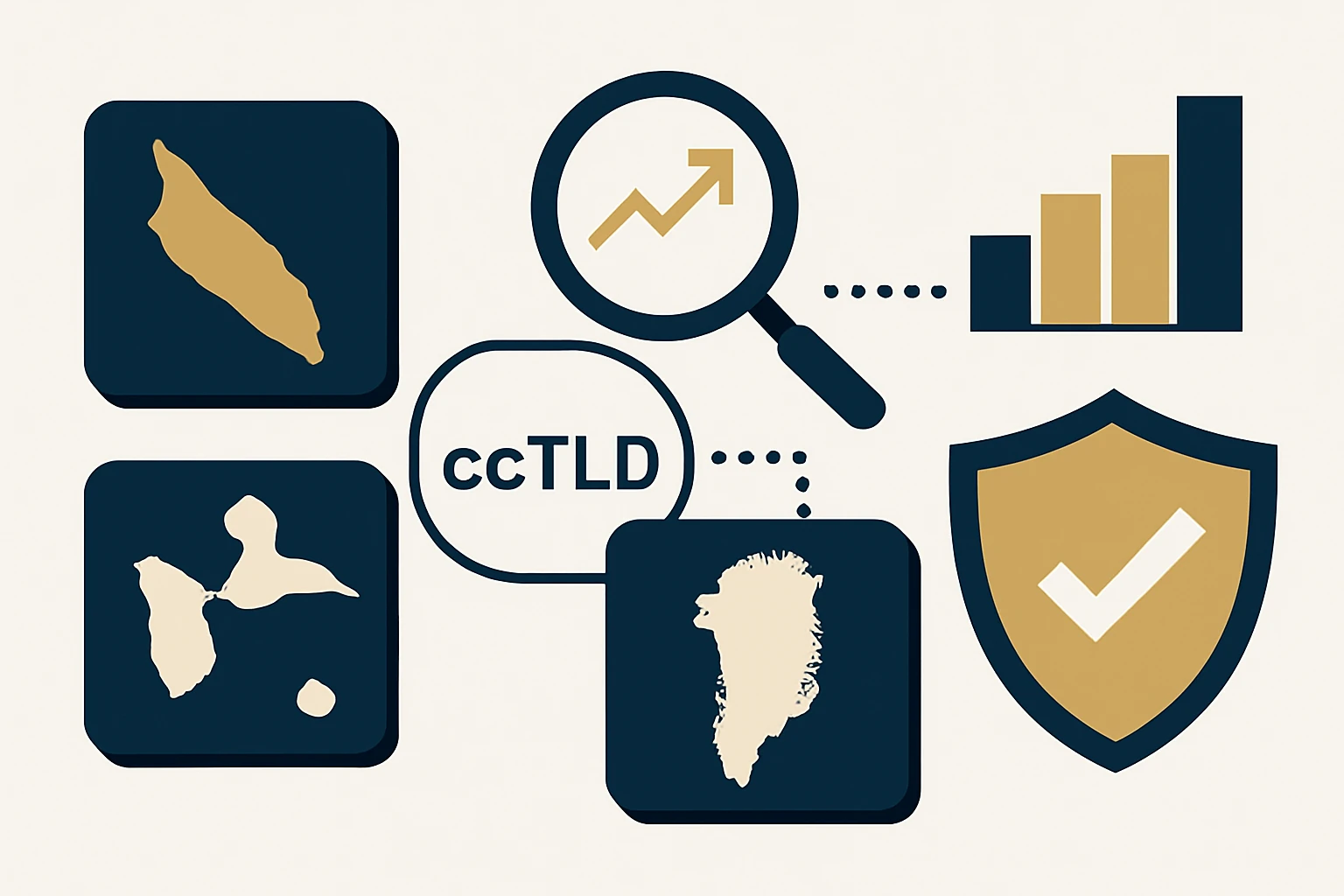
When considering Aruba (.aw), Guadeloupe (.gp), and Greenland (.gl) as part of a strategic asset mix, approach each extension with a clear use-case and governance plan rather than treating them as generic add-ons. The common path is to start with a regional risk assessment, then map ownership and renewal strategies, and finally connect the assets to a broader brand narrative and regional marketing objectives.
- Aruba (.aw) often attracts attention from brands with Caribbean reach or travel-related ambitions in the Dutch Caribbean. A disciplined approach starts with identifying potential intra-regional domains that could protect brand names or campaign names, followed by a policy for renewal and a contingency plan if the extension’s policies change. Governance and dispute-ready playbooks are essential here to prevent costly escalation.
- Guadeloupe (.gp) is a geographically focused extension with ties to the French Caribbean. For brands pursuing regional recognition, a GP presence may offer local relevance and regional search signals. As with other ccTLDs, verify registration requirements and ensure alignment with regional marketing assets and content localization strategies. This is where a structured framework helps separate the signals from the noise.
- Greenland (.gl) presents a unique opportunity for brands that want to test highly localized or linguistically diverse campaigns, and it has potential as a domain-hack option in certain contexts. The governance and availability of .gl are shaped by its registry operator, with policies that may differ from larger, more generalized extensions. In practice, a disciplined evaluation helps avoid overhang costs and ensures alignment with broader digital asset strategy. IANA: .gl registry information provides the registry-level context you should consult before committing.
Editorially, the best practice is to treat these assets as complements to a global domain strategy rather than replacements for core brand domains. A well-structured CCtLD program can enable localized presence while preserving a cohesive, defensible brand footprint across markets. For an illustration of how to navigate policy and portfolio decisions in practice, see the framework above and consult governance guidance on ccTLDs as part of your due diligence process.
For a practical starting point on cataloging and evaluating ccTLDs, many teams rely on trusted asset directories and advisory services. webatla’s TLD Directory can help you inventory available extensions and compare them against your internal scoring rubric, while webatla pricing provides a sense of the financial considerations involved. For broader domain intelligence, the RDAP & WHOIS Database can be a useful resource as part of ongoing asset governance.
Expert insight and practical trade-offs
One of the core takeaways from industry best practices is that ccTLD investments should be governed with the same rigor as gTLD portfolios. A tiered approach - prioritizing higher-risk, higher-reward extensions while maintaining a baseline set of policy-compliant assets - helps balance budget with protection. This aligns with a widely cited framework for domain governance, lifecycle management, and risk controls that emphasizes disciplined decision-making and governance mechanisms rather than ad hoc registrations. CSC Global: Maximizing Domain highlights the importance of structured policy, ownership, and renewal strategies that can be applied to ccTLDs as well as other domain classes.
Expert insight: ccTLD portfolios work best when they are integrated into a broader digital asset strategy, with clear ownership, documented renewal timelines, and a plan for escalation in the event of policy changes at the registry level. The governance lens helps prevent a misallocation of capital and ensures that every extension serves a concrete business objective rather than existing in isolation.
Limitations, trade-offs, and common mistakes
- SEO over-rotation: Believing a ccTLD will automatically boost regional search rankings without a proportional content and localization plan often yields limited ROI. Local SEO requires more than just registering a domain, it requires localized content, accurate business listings, and proper hreflang signals.
- Regulatory surprises: Registry policies can change, and some ccTLDs require local presence or other conditions. Build a governance plan that anticipates policy changes and includes contingency routes for portfolio adjustments. See general ccTLD governance discussions for context.
- Cost drift: Renewal fees and premium pricing for restricted extensions can escalate over time. A total cost of ownership model helps avoid overpaying for assets with uncertain strategic value.
- Dispute risk miscalculation: Even with a strong brand, a ccTLD can become a source of dispute, WIPO’s dispute resolution framework provides a structured path for addressing potential conflicts.
Key takeaway: ccTLD investments require disciplined governance, explicit business cases, and ongoing performance monitoring. A thoughtful approach reduces the risk that a portfolio becomes an expensive vanity project.
Conclusion: a pragmatic, defensible approach to ccTLDs
A well-constructed ccTLD portfolio - backed by a clear use-case, governance, and financial discipline - can enhance regional protection, improve local discovery, and complement a global brand strategy. Aruba, Guadeloupe, and Greenland each illustrate how the same framework can yield different value propositions depending on regional dynamics and registry policies. By applying a structured evaluation, brands can separate opportunity from risk, align investments with strategic priorities, and advance a defensible digital asset program that scales with business needs. For teams seeking a practical starting point, the combination of a formal evaluation framework, governance playbooks, and a connection to trusted asset directories can accelerate decision-making while maintaining discipline across the portfolio.