Introduction
For global brands, the ability to protect and monetize a domain portfolio across markets is not optional - it's a strategic differentiator. When expanding into smaller or underpenetrated markets, a chaotic approach to domain acquisitions risks brand confusion, regulatory missteps, and costly disputes. A disciplined method for assembling geo-specific domain prospect lists - especially for country-code top-level domains (ccTLDs) such as Micronesia (.fm), Congo (.cg), and Solomon Islands (.sb) - can meaningfully improve both risk management and market readiness. The goal is not merely to buy domains, but to build a verifiable, privacy-conscious inventory that informs risk-aware decisions and accelerates brand protection and portfolio strategy. For teams exploring country-by-country opportunities, robust data foundations - drawn from up-to-date RDAP/WHOIS sources and governance best practices - are essential. RDAP is increasingly the standard for registration data, replacing legacy WHOIS in many contexts, and should anchor any due-diligence workflow.
Why geo-specific domain lists matter for brand protection
Country-specific domains are more than digital real estate, they are signals of local presence, trust, and regulatory alignment. A thoughtful ccTLD strategy helps prevent brand fragmentation, supports local search performance, and reinforces protective rights across a brand’s global footprint. As brands extend into new geographies, the ability to download, validate, and conditionally acquire a curated list of relevant domains becomes a core capability for defensive portfolio management. This approach aligns with established guidance on brand protection and global domain strategy, which emphasizes proactive scoping, risk assessment, and governance discipline. Growing your Brand from WIPO outlines the importance of country-level considerations for brand protection and local-market strategy.
A practical framework for geo-domain prospecting
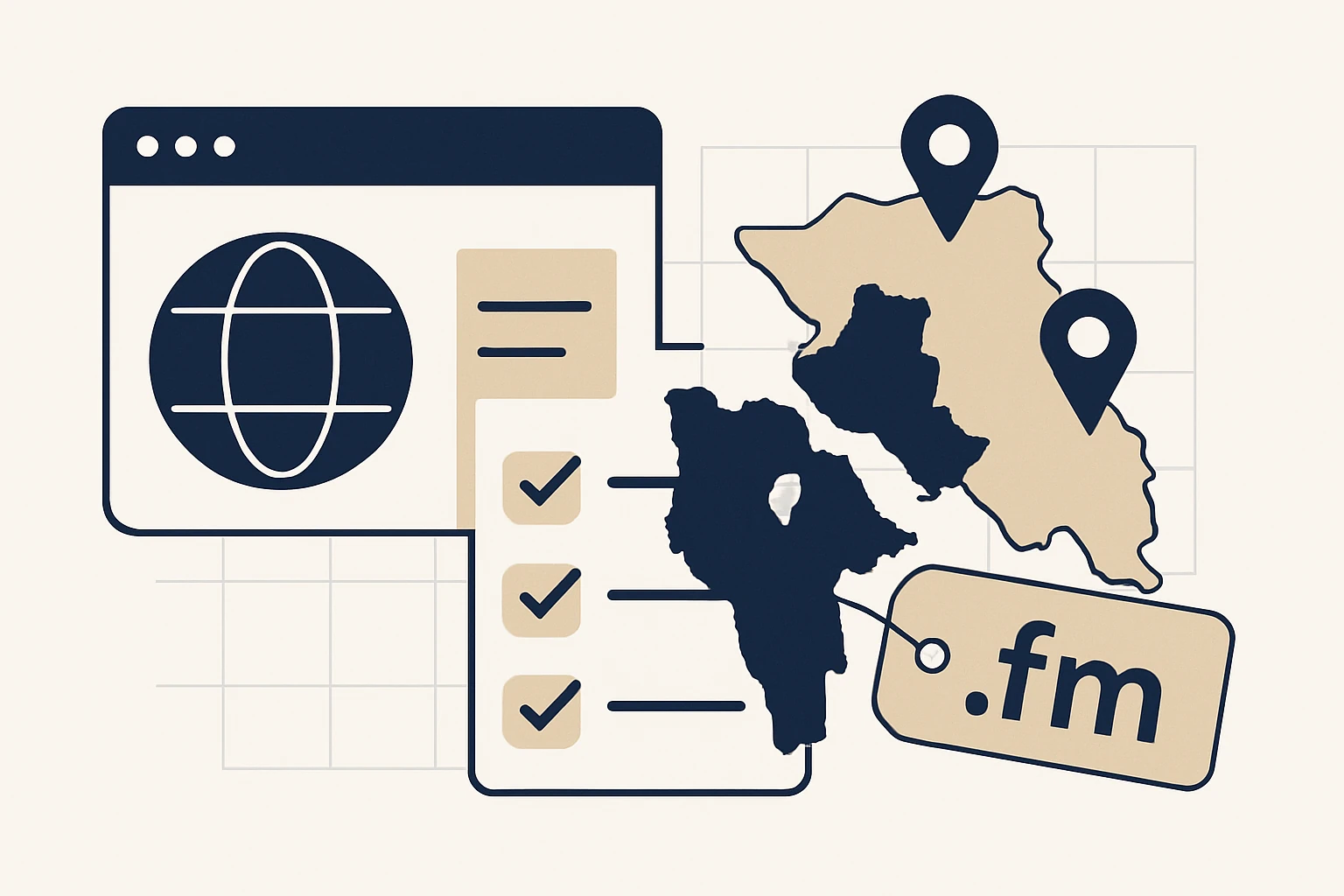
Below is a concise, repeatable framework designed to help brand and portfolio teams build confidential, geo-specific domain prospect lists for Micronesia, Congo, and Solomon Islands. The framework emphasizes verifiable data, practical triage, and a disciplined acquisition plan. It also recognizes that data quality matters as much as the data itself.
Framework for geo-domain prospecting
- 1) Define objectives and risk tolerance for each country (brand protection height, potential for domain monetization, and regulatory considerations).
- 2) Source candidate lists for target ccTLDs: Micronesia (.fm), Congo (.cg), and Solomon Islands (.sb). Consider combining public registries with reputable data sources to assemble a starter list.
- 3) Validate data using Registration Data Access Protocol (RDAP) as the primary source of registration data, complemented by WHOIS where RDAP data is incomplete. RDAP provides structured, machine-readable data essential for scalable due diligence. RDAP overview.
- 4) Enrich and verify each candidate: confirm registrant identity where permissible, DNS health, potential trademark conflicts, and alignment with brand protection goals. Consider privacy controls and local data regulations in each jurisdiction.
- 5) Prioritize targets and frame a confidential acquisition plan: flag high-value, defensible domains and develop strategies for outreach, negotiation, and transfer, while documenting governance and consent requirements.
In practice, this framework is designed to be implemented with a data foundation. For organizations that need a robust data backbone, webatla offers a RDAP & WHOIS database and country-focused domain lists, which can serve as a starting point for the workflow described above. You can also explore a broader view of domains by country with List of domains by Countries.
Data quality, governance, and the RDAP transition
One of the critical decisions in geo-domain prospecting is how you source and verify registration data. RDAP represents the modern, standardized approach to registration data, delivering consistent, machine-readable JSON responses that facilitate automation and scalable due diligence. This contrasts with legacy WHOIS data, which can be inconsistent across registries. For teams aiming to build repeatable processes, RDAP offers the foundation for reliable enrichment pipelines and governance workflows. ICANN's RDAP overview explains how RDAP replaces traditional WHOIS in many contexts and how registries implement it.
Beyond data formats, governance matters. Leading frameworks for corporate domain portfolios advocate a balanced approach to growth, risk, and compliance, emphasizing the importance of structural controls and lifecycle management. A practical synthesis of seven best practices for corporate domain portfolios can guide teams as they translate country-level insights into action. Authentic Web: Seven Best Practices.
Practical considerations for Micronesia, Congo, and Solomon Islands
Three geographies illustrate the kinds of nuance involved in geo-domain prospecting. Micronesia, with its .fm domain, has a reputation often linked to media and technology sectors, but local regulatory nuances can influence availability and enforcement. The Congo's .cg ccTLD presents a distinct regulatory environment and market dynamics that require careful due diligence around ownership, privacy, and local compliance. The Solomon Islands .sb domain similarly requires attention to local laws, potential trademark conflicts, and the specifics of local registrars. In each case, the goal is not only to identify candidate domains but to assess defensibility, ownership clarity, and alignment with broader brand strategy. This is precisely where a structured data-driven approach - supported by RDAP, governance frameworks, and careful risk assessment - adds value.
Limitations, trade-offs, and common mistakes
- Over-reliance on a single data source: Even with RDAP, registries can have gaps or delays. Cross-checking with multiple reputable data sources reduces risk.
- Ignoring privacy and local regulations: Some jurisdictions impose strict data-sharing or privacy constraints that can affect how you collect or act on ownership information.
- Assuming ownership certainty: Domain ownership data can be opaque or withheld, plan for uncertainty and include escalation paths in your process.
- Neglecting long-term governance: A geo-domain prospect list without a clear ownership, renewal, and disposition plan tends to become a liability rather than an asset.
A structured data block: turning insight into action
- Candidate identification: Start with country-specific extension cohorts (.fm, .cg, .sb) and filter by brand relevance, language, and market potential.
- Data validation: Run data through RDAP lookups, verify DNS health, and flag domains with ambiguous ownership or conflicting TMs.
- Risk scoring: Assign a defensibility score based on ownership clarity, registrar stability, and local trademark risk.
- Acquisition planning: For high-defensibility domains, draft confidential outreach and negotiation strategies with appropriate approvals.
Editorial takeaway: a disciplined approach yields better outcomes
A robust geo-domain prospecting program enables brand teams to align domain acquisition activity with corporate risk appetite, local-market strategy, and long-term value creation. The approach outlined here integrates credible data standards, governance considerations, and practical steps that can be implemented by in-house teams or with external partners. As with any asset that touches a brand’s identity, transparency, control, and a clear business rationale are essential for sustainable success.
Integration with webatla and practical next steps
For practitioners seeking a strong data foundation to support geo-domain prospecting, webatla provides a RDAP & WHOIS database and a List of domains by Countries resource. These tools can help operationalize the framework outlined above, enabling teams to download, validate, and enrich domain lists for Micronesia, Congo, and Solomon Islands at scale. In tandem, consider pairing these data capabilities with a strategic advisory approach that frames decisions around brand protection and portfolio governance.
Further reading and context on data quality and governance can be explored in authoritative sources that discuss RDAP’s role in modern domain data and the importance of brand protection in ccTLD strategies. RDAP overview and Growing your Brand provide foundational context for teams building such programs.
Conclusion
Building geo-specific domain prospect lists is a practical, repeatable discipline that underpins stronger brand protection and smarter domain portfolio management. By combining a clear strategic objective with a robust data foundation (RDAP-based verification, privacy-aware enrichment, and governance controls) and a disciplined acquisition plan, brands can confidently engage Micronesia, Congo, and Solomon Islands domains as part of a coherent global strategy. The result is a more defensible, value-driven portfolio that supports local-market presence while protecting the brand for the long term. For teams seeking a scalable data backbone to support this work, webatla’s RDAP & WHOIS database and country-focused domain lists offer concrete starting points.