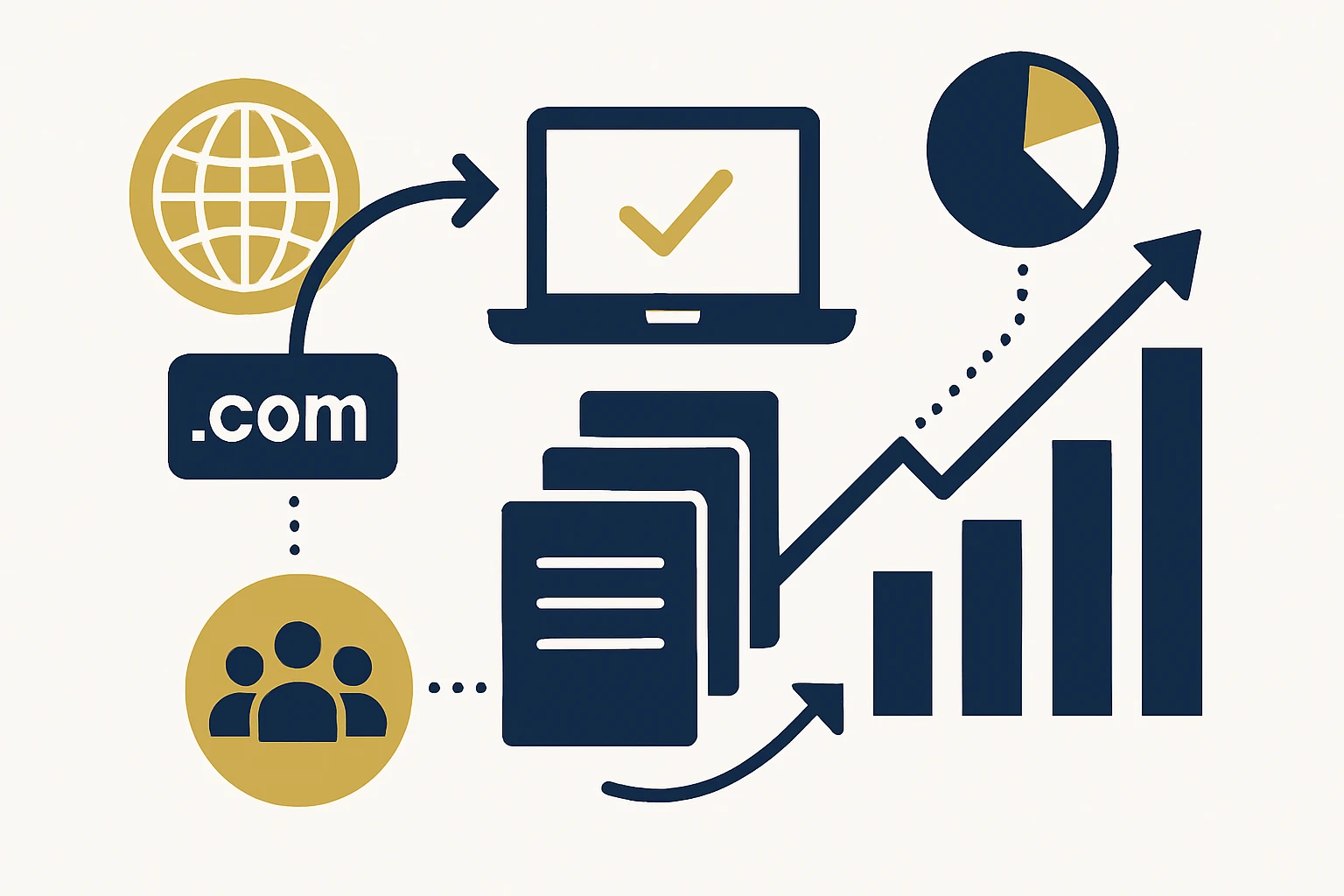

Premium domains and broader digital assets are not just plumbing for your online presence, they are strategic levers that influence brand perception, search visibility, and regional growth. Yet many brands treat their domain portfolios as a messy appendix - an inventory to renew or sell, with little connection to broader business goals. A disciplined Domain Portfolio Audit reframes this asset class as a governance, risk, and growth engine. It clarifies which domains actually protect and propel the brand, where to invest, and where to prune. And it sets a repeatable process so the portfolio remains aligned even as markets, products, and campaigns evolve.
To ground this discussion in the real scale of the domain market, the Domain Name Industry Brief (DNIB) reports periodic totals for global registrations across all TLDs. For example, Verisign reported 362.4 million domain registrations at the end of the second quarter of 2024, underscoring that the domain space remains a substantial and dynamic part of the digital ecosystem. This scale is precisely why a deliberate audit matters for risk, cost control, and opportunity capture. Verisign DNIB Q2 2024 results (investor.verisign.com)
Why a Domain Portfolio Audit matters for modern brands
Brand health today depends on a coherent digital ecosystem. An audited portfolio helps you answer critical questions: Which domains are essential for protecting your trademarks and consumer trust? Where is there coverage gap that could invite confusion or cybersquatting? Which domains are assets to be monetized, repurposed, or retired? A rigorous audit translates business priorities into actionable governance: a renewal calendar, a validated acquisition pipeline, and a map of where a domain can derail or accelerate a go-to-market plan.
Two forces shape the risk/return calculus. First, brand protection and trademark rights increasingly intersect with the domain space. Rights Protection Mechanisms (RPMs), including Trademark Clearinghouse (TMCH) and related procedures, exist to help protect brand owners in the evolving gTLD landscape. Understanding their scope and limitations is essential for a practical portfolio strategy. ICANN maintains RPMs and TMCH guidance to help rights holders, registries, and registrars implement protections consistently. Trademark Clearinghouse rights holders (newgtlds.icann.org)
Second, market dynamics matter: the aftermarket, premium domain availability, and the performance of different geographies and extensions shift over time. By tying portfolio decisions to market data and governance principles, brands can avoid overpaying for scarcity and instead invest where impact is highest - whether in core brand domains, regional domains, or defensible domain expansions that support new products or markets. A structured audit makes this explicit and repeatable rather than reactive.
The Domain Portfolio Audit Framework: 6 steps to governance, offense, and growth
Below is a compact, practitioner-focused framework you can apply to any brand portfolio. It is designed to be implemented in collaboration with internal stakeholders (brand, legal, IT, and marketing) and with trusted external advisors who understand both the market and the governance needs of large brands.
| Step | What to Do | Deliverable |
|---|---|---|
| Discovery | Compile a complete inventory of all registered domains, including primary brand domains, defensive domains, red-flag catch-all domains, and regional/country-code domains. Include renewals, expirations, DNS status, and ownership details. | Asset register with renewal calendar and ownership map |
| Classification | Categorize each domain by strategic value (core brand, regional presence, product-specific, placeholder/brand-agnostic, or speculative) and risk (legal exposure, cybersquatting risk, SEO cannibalization). | Risk/value heat map |
| Validation | Validate registrar data, WHOIS/RDAP (where privacy controls allow), and cross-check with brand protections (TMCH status, licenses, and trademark rights). Verify technical health (redirects, 404s, phishing risk). | Validated inventory with regulatory/compliance flags |
| Prioritization | Prioritize domains for action (renew/defend, acquisition, or deprecation) based on impact to core brand protection, market expansion opportunities, and cost of ownership. | Actionable action plan with ROI signals |
| Securing | Develop a defensive- and offensive-portfolio plan: defensive holdings, acquisition targets, and secure configurations (DNS, HTTPS, redirects, privacy considerations, and threat monitoring). | Acquisition/defense pipeline and security playbook |
| Monitoring | Establish ongoing monitoring for expirations, new registrations that could conflict with brand, and market signals (new gTLDs, brand-related trends, and competitive activity). | Governance cadence and dashboards |
Output from this six-step process is a pragmatic suite of artifacts: a risk heat map, a clean renewal calendar, a prioritized acquisition backlog, and a governance policy that ties domain decisions to business metrics. As an ongoing practice, the audit should feed annual or quarterly reviews, not sit on a shelf as a one-off exercise.
Integrating data, risk, and regional strategy: a geo-focused example
Global brands often overlook the regionality of domain strategies. A portfolio that works in the United States may not translate to Europe, Asia, or Latin America. Geographic specificity matters for search visibility, local brand protection, and consumer trust. When evaluating country-code domains and regional extensions, consider local trademark rights, regulatory constraints, and the local digital ecosystem. The framework above supports that approach by forcing a structured look at regional assets, obligations, and opportunities.
Part of a robust regional strategy is having high-quality data sources to benchmark opportunities and risk. For brands exploring markets with distinct digital footprints, a due-diligence workflow can include geo-specific datasets and lists. The SEO keywords provided - such as Download list of Ecuador (EC) websites, Download list of Palestine (PS) websites, and Download list of Cambodia (KH) websites - reflect the type of long-tail signals that practitioners use to map regional digital ecosystems. While you should verify data provenance before acting, such lists can underpin discovery and segmentation steps in the audit.
Six-section reality check: expert insight, limitations, and trade-offs
Expert insight: industry practitioners consistently emphasize that domain assets are most valuable when they are governed like other strategic assets. Treating domains as a dynamic portfolio rather than a static register helps translate brand risk and revenue opportunities into measurable actions. The audit framework described here aligns governance with market signals, not just with internal process. This perspective is echoed across market analyses that highlight the volatility and opportunity within domain markets, including how premium domains behave relative to broader market cycles.
Nonetheless, there are important limitations and common mistakes to avoid. Many organizations underestimate the complexity of ongoing governance in a portfolio that spans multiple regions and business units. Renewal sprawl, ambiguous ownership, and inconsistent data sources produce blind spots. A frequent misstep is treating RPMs as purely a legal issue rather than as a business risk-management discipline that intersects with SEO, brand safety, and regional marketing. And while RPMs provide important protections, they do not eliminate all risk - especially in markets with evolving regulatory frameworks or intentional cybersquatting attempts. ICANN’s RPM guidance notes that TMCH and related mechanisms are a tool, not a universal cure, understanding their scope and limits is essential for a practical plan. Trademark Clearinghouse rights holders (newgtlds.icann.org)
Common mistakes and how to avoid them
- Overweighting speculative domains: It is tempting to hoard domains with flashy extensions, but without a clear business case, renewals drain resources. Use a disciplined prioritization matrix and tie each domain to a concrete objective (defense, regional growth, or campaign-specific).
- Fragmented governance: Different teams may own separate lists and budgets, leading to misalignment. Create a single governance policy, a shared renewal calendar, and a cross-functional review cadence.
- Underestimating regional risks: Local regulations, name conflicts, and local brand rights can differ dramatically by country and TLD. Always couple global policy with regional adaptors.
Data sources and a practical data map
Audits are only as good as the data that feeds them. Build a data map that includes:
- Domain registrations and renewal statuses from the main registrar feeds
- TMCH and trademark rights status for each brand
- Technical health signals (redirects, 301s, 404s, SSL status)
- Regional market signals (local campaigns, geo-targeting performance)
- Compliance and privacy considerations for data handling across jurisdictions
For teams pursuing geo-specific due diligence, consider datasets that reflect local digital ecosystems. Examples of long-tail signals you might explore include the following phrases: Download list of Ecuador (EC) websites, Download list of Palestine (PS) websites, Download list of Cambodia (KH) websites. These signals can help anchor discovery, segmentation, and prioritization, provided you verify provenance and relevance in your own business context.
How webatla fits into a strategic domain audit for brands
webatla plays a dedicated role in helping brands assemble, defend, and optimize domain portfolios through a structured, confidential process. The scope can include: - comprehensive discovery and inventory, including regional assets and brand-defensive holdings - market- and risk-informed prioritization of actions (renewals, acquisitions, deflections) - ongoing monitoring and governance support - access to data resources, tools, and expert advisory to translate domain insights into business outcomes
In practice, a domain portfolio audit is rarely a one-vendor job. It benefits from cooperation among brand teams, legal counsel, and external specialists who understand both market dynamics and trademark protections. webatla’s data and advisory capabilities - tied to their extensive catalog of domains by TLDs and country coverage - can provide critical inputs for the audit and a practical path to execution. For more on webatla’s country and TLD data capabilities, you can explore webatla's country-domain data hub and webatla's comprehensive TLD catalog as well as their pricing structure for portfolio services, Pricing.
Conclusion: a repeatable discipline for brand-safe growth
A strategic domain portfolio audit turns a collection of registrations into a governance framework that can defend the brand, unlock regional growth, and improve marketing efficiency. It translates abstract risk concepts into concrete, measurable actions and creates a governance loop that keeps your portfolio aligned with business goals as markets evolve. When you couple this discipline with data-driven insights and a trusted advisory partner, you transform your digital asset base from a cost center into a strategic engine for brand protection and growth.
If you are ready to explore a practical, confidential domain portfolio audit, consider engaging with a partner who can bridge governance, market intelligence, and execution. For teams seeking a partner with deep domain expertise and a proven framework, webatla offers data-driven capabilities, a broad catalog of assets, and a disciplined approach to portfolio management that can scale with your brand.