Introduction: The value and challenge of a country-code portfolio
As brands scale internationally, the country-code top-level domains (ccTLDs) in each market become more than local web addresses - they are strategic assets. A thoughtfully designed ccTLD portfolio can signal local relevance, improve regional search visibility, and help defend a brand against opportunistic registrations. At the same time, the governance, policy variation, and risk of disputes around country domains require disciplined management. For global brands, a structured approach to country-code domains - combining market intelligence, disciplined acquisition, and ongoing protection - is essential. This article offers a practical framework for building a ccTLD portfolio with Paraguay (PY), Jordan (JO), and Tanzania (TZ) in mind, while illustrating how premium domain brokerage and digital asset advisory services can augment in-house capabilities. Note: when researching markets and lists of local websites, rely on authorized registries and public registries rather than unverified download sources.
Why ccTLDs matter for global brands
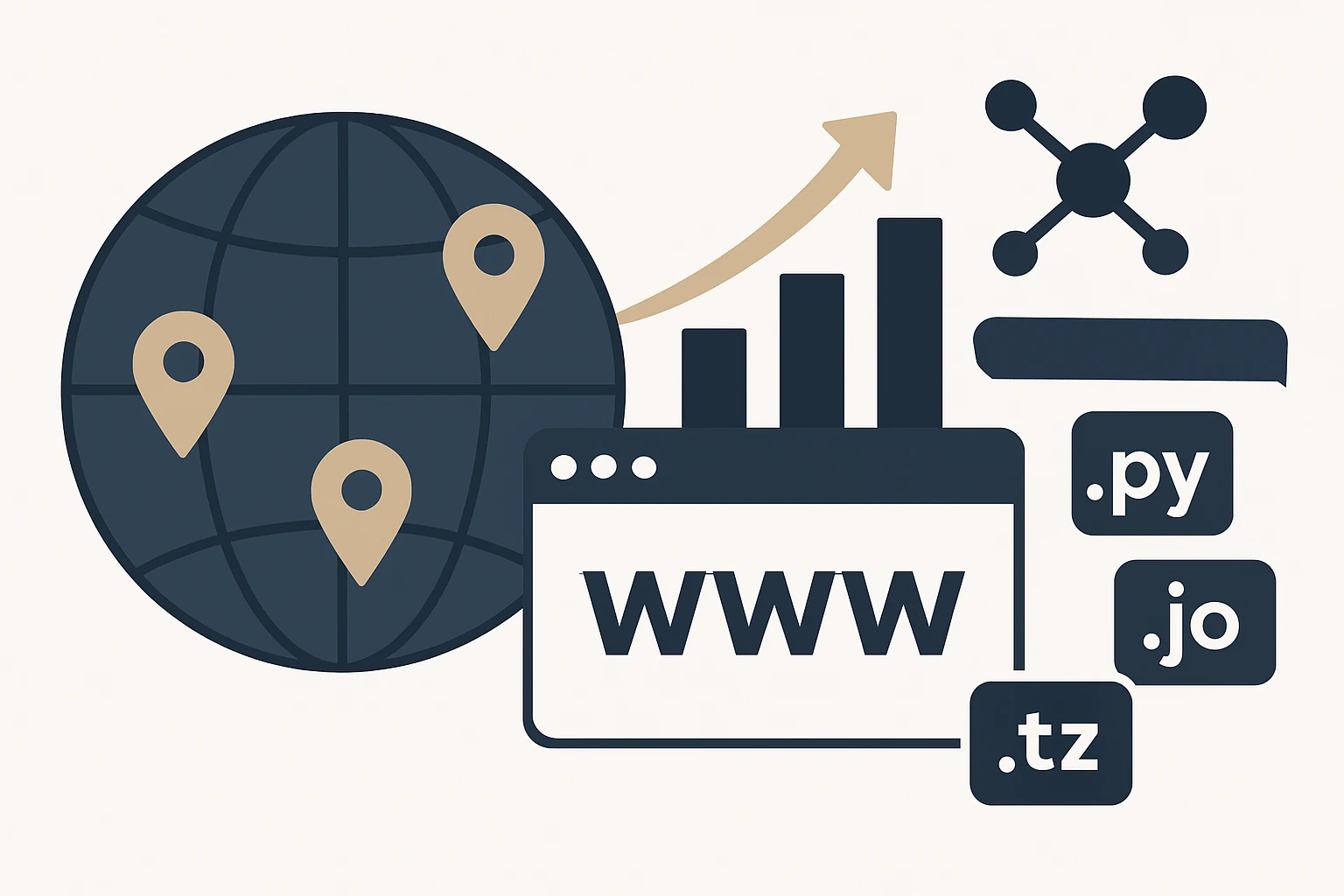
Country-code domains embody a brand localization strategy that goes beyond language and currency. They signal geographic intent, support local user trust, and help search engines deliver region-specific results. Industry observers, regulators, and registries emphasize that ccTLDs are governed by local communities and policy frameworks, which means a brand must approach each market with careful governance and compliance in mind. This is not just about acquiring .py, .jo, or .tz domains, it is about aligning a territorial presence with brand strategy and risk management. ccNSO FAQs and ICANN guidance on ccTLD governance illustrate how local policy decisions shape domain strategy across markets. (ccnso.icann.org)
From an SEO and brand-protection perspective, ccTLDs offer localized signals while potentially complicating global consistency. Major brands increasingly balance ccTLD deployments with broader strategies (including the global .com) to maximize reach while preserving local relevance. In practice, this means pairing domain acquisitions with thoughtful hreflang implementation and a governance framework that accommodates regional teams and external partners. For context on governance and best practices, see ICANN’s ccNSO materials and related guidance. (icann.org)
A practical framework for building a ccTLD portfolio
Think of a ccTLD portfolio as three interacting layers: discovery (what matters in each market), design (which domains to own and how to structure them), and defense (protecting your investment and your brand).
- Discovery: market relevance and risk assessment
- Identify markets where your brand has real expansion potential, partner ecosystems, or regulatory relevance. The Paraguay, Jordan, and Tanzania markets illustrate diverse regulatory environments and digital ecosystems that merit tailored domain strategies.
- Map existing brand mentions and competitor presence in each market to determine which ccTLDs should be prioritized. This helps avoid over-investment in markets with limited upside while ensuring critical geographies are protected.
- Source data from reputable registries and market analyses rather than scraping large lists of sites. Public registries and official directories are preferred sources for market intelligence and risk mitigation. ICANN ccNSO – governance context (ccnso.icann.org)
- Design: strategic ownership and naming policy
- Decide which ccTLDs to acquire beyond purely local branding. A balanced portfolio often includes country codes that align with search localization, brand protection goals, and regional partner networks. This is where a premium domain brokerage and digital asset advisory can add value by identifying viable, defendable assets and negotiating discreetly.
- Adopt a naming policy that supports future expansion and simplifies regional content strategy. For example, owning your brand in PY, JO, and TZ can prevent confusion and reduce misdirected traffic in key markets.
- Plan hreflang and canonicalization to avoid content duplication and SEO cannibalization when serving multiple country domains. The governance and technical choices around ccTLDs are not just legal or branding concerns, they affect long-term search performance and user experience. See ICANN and related policy guidance for context. (ccnso.icann.org)
- Defense: protection, risk, and governance
- Implement brand-protection measures across the portfolio, including defensive registrations that preempt brand confusion and misappropriation. This is a core capability of premium domain brokerage services, which provide confidential acquisition options and risk-aware sourcing strategies.
- Establish dispute-readiness and governance processes guided by WIPO best practices for ccTLDs to prevent and resolve potential disputes quickly and with minimal business disruption. WIPO ccTLD Best Practices (wipo.int)
- Maintain ongoing monitoring and renewal discipline to protect value over time. Portfolio rotation and lifecycle management help ensure that the portfolio remains aligned with evolving business priorities. See industry discussions on portfolio management for context. (ait.com)
Market-driven considerations: Paraguay, Jordan, and Tanzania as use cases
Choosing to include markets like Paraguay, Jordan, and Tanzania in a ccTLD strategy can reflect a deliberate stance on regional growth, regulatory alignment, and local-market responsiveness. Each country presents a different digital maturity and brand-building path, which informs portfolio design:
- Paraguay (PY): A growing digital economy with distinct local audiences and services ecosystems. A PY-focused strategy may prioritize defensible brand domains that map to local services while ensuring name stability in Latin American markets. Consider how PY registrations interact with regional SEO signals and content localization.
- Jordan (JO): A market with strong logistics, tech adoption, and cross-border trade in the Middle East. A JO focus can support regional partnerships and bilingual or multilingual content strategies, requiring careful domain naming that respects local language and policy norms.
- Tanzania (TZ): East Africa’s expanding digital footprint and mobile-first user base create opportunities for localized brands. TZ registrations can support regional outreach and local-language content while complementing broader African-market strategies.
In practice, these markets illustrate a key principle: country-code domains should be chosen not merely because they exist, but because they enable a coherent, scalable branding and growth plan. The governance and policy environment for ccTLDs varies by country, so partner organizations that understand local rules - such as registries, regulators, and local counsel - are essential to a smooth rollout. ICANN and ccNSO materials offer a framework for understanding how policy decisions in each market shape strategy. (icann.org)
Acquisition, risk management, and the role of a premium brokerage
Acquiring premium domains across multiple ccTLDs requires more than price negotiation, it demands confidentiality, strategic fit, and risk management. A robust approach includes:
- Confidential acquisition processes: To avoid signaling intent, it is often advantageous to work with a broker who can source assets discreetly and propose offers that align with your brand strategy rather than public market dynamics. This is a core value proposition of premium domain brokerage services.
- Portfolio risk assessment: Evaluate the legal, regulatory, and reputational risks associated with each domain, including potential disputes and conflicting trademarks. This is where collaboration with a digital asset advisor helps quantify total cost of ownership and long-term ROI.
- Dispute-preparedness and domain governance: Establish internal guidelines for renewal windows, defensive registrations, and escalation pathways should a dispute arise. WIPO guidance and ICANN policy context inform best practices in this area. WIPO Best Practices (wipo.int)
In practice, a client like webatla can help with:
- Identifying viable premium domains that align with brand strategy in PY, JO, TZ and beyond.
- Negotiating confidential terms to minimize public exposure and protect strategic interests.
- Developing a digital asset governance plan that covers brand protection domains, portfolio rotation, and ongoing risk assessment.
For readers who are mapping regional opportunities, a practical tip is to extend your market intelligence beyond traditional lists. While some sources offer downloadable lists of country-specific websites, it is prudent to corroborate with official registries, governmental portals, and industry analyses to avoid stale or inaccurate data. Responsible sourcing protects your brand and improves the reliability of your outreach and acquisition program. See industry discussions on governance and data-quality considerations in ccTLD portfolios. (ccnso.icann.org)
Framework at a glance: three-step approach
- Discovery – market relevance, brand signals, and risk profile.
- Design – asset selection, naming conventions, and governance policy.
- Defense – brand protection measures, dispute readiness, and renewal discipline.
To operationalize this framework, consider a structured workflow that aligns with your internal teams and external partners. The following structured block summarizes a practical start point for many brands exploring ccTLD diversification:
- Step 1: Market mapping - Identify key markets with growth potential and local ecosystem signals (partners, suppliers, regulatory readiness).
- Step 2: Portfolio design - Decide which ccTLDs to own and which domain variations to defensively register to preserve brand integrity.
- Step 3: Acquisition and governance - Use confidential brokerage to source assets and implement governance policies that scale with the brand.
Common mistakes and limitations to watch for
- Over-portfolioing or under-portfolioing: Acquiring too many ccTLDs can dilute focus and inflate costs, too few can leave gaps in brand protection and local relevance.
- Misalignment with core brand strategy: ccTLDs should complement, not replace, the global brand strategy. Without alignment, regional domains may fail to contribute to revenue or user trust.
- Inadequate governance: Without documented ownership rules, renewal calendars, and dispute-prevention measures, the portfolio becomes vulnerable to lapse or mismanagement.
- SEO missteps: Without proper hreflang and canonical strategies, multiple country domains can create content duplication issues or confuse search engines about regional intent.
Expert insight: Industry practitioners emphasize that a ccTLD portfolio is a strategic asset, not a miscellaneous hedge. A well-structured portfolio can act as a moat around a brand, protecting it from fragmentation while enabling precise regional adaptation. This requires disciplined processes, cross-functional governance, and ongoing portfolio review.
Limitations, trade-offs, and practical considerations
While ccTLD portfolios offer clear benefits, they come with trade-offs. Local policy nuances mean a one-size-fits-all approach rarely works. Balancing speed, cost, and risk is essential, and timelines should reflect local regulatory cycles as well as internal brand milestones. Data-driven decision-making, regular portfolio health checks, and clear escalation paths for disputes are key to sustaining value over time. For a deeper governance perspective, refer to ICANN’s ccTLD policy overview and related governance resources. (ccnso.icann.org)
Conclusion: a practical path to a resilient, global brand
Building a strategic ccTLD portfolio is a multidimensional endeavor that blends market intelligence, careful acquisition, and proactive protection. Paraguay, Jordan, and Tanzania illustrate how different regional dynamics shape domain strategy, while the underlying principles remain consistent: identify markets with real potential, design a defensible and scalable domain set, and defend the portfolio through disciplined governance and risk management. By integrating premium domain brokerage, digital asset advisory, and a structured protection plan, brands can navigate the ccTLD landscape with confidence and precision. If you’re ready to translate these principles into action, a partner like webatla can help you pursue confidential acquisitions, strategic consultations, and ongoing portfolio management that align with your brand ambitions. For more on Paraguay-specific market dynamics, visit Paraguay market insights, or explore broader domain strategies at the list of domains by TLDs and RDAP & WHOIS database.