Introduction: why country-focused domain assets matter
Global brands face a persistent tension: scale quickly across markets while protecting a coherent identity. A disciplined country-domain portfolio - carefully selected ccTLDs and regionally relevant assets - can help brands localize trust, improve regional search visibility, and defend against impersonation. Yet many firms approach this like a generic software purchase, treating domains as a compliance checkbox rather than a strategic asset. The result is overpaying for underutilized names, missed opportunities in high-potential markets, or gaps in brand protection that invite risk. The path forward is a structured framework that connects market intent with asset discovery, due diligence, and ongoing governance. Verisign’s Domain Name Industry Brief (Q2 2025) confirms that ccTLDs remain a substantial portion of the global domain footprint, underscoring the strategic value of country-code assets in a multinational portfolio.
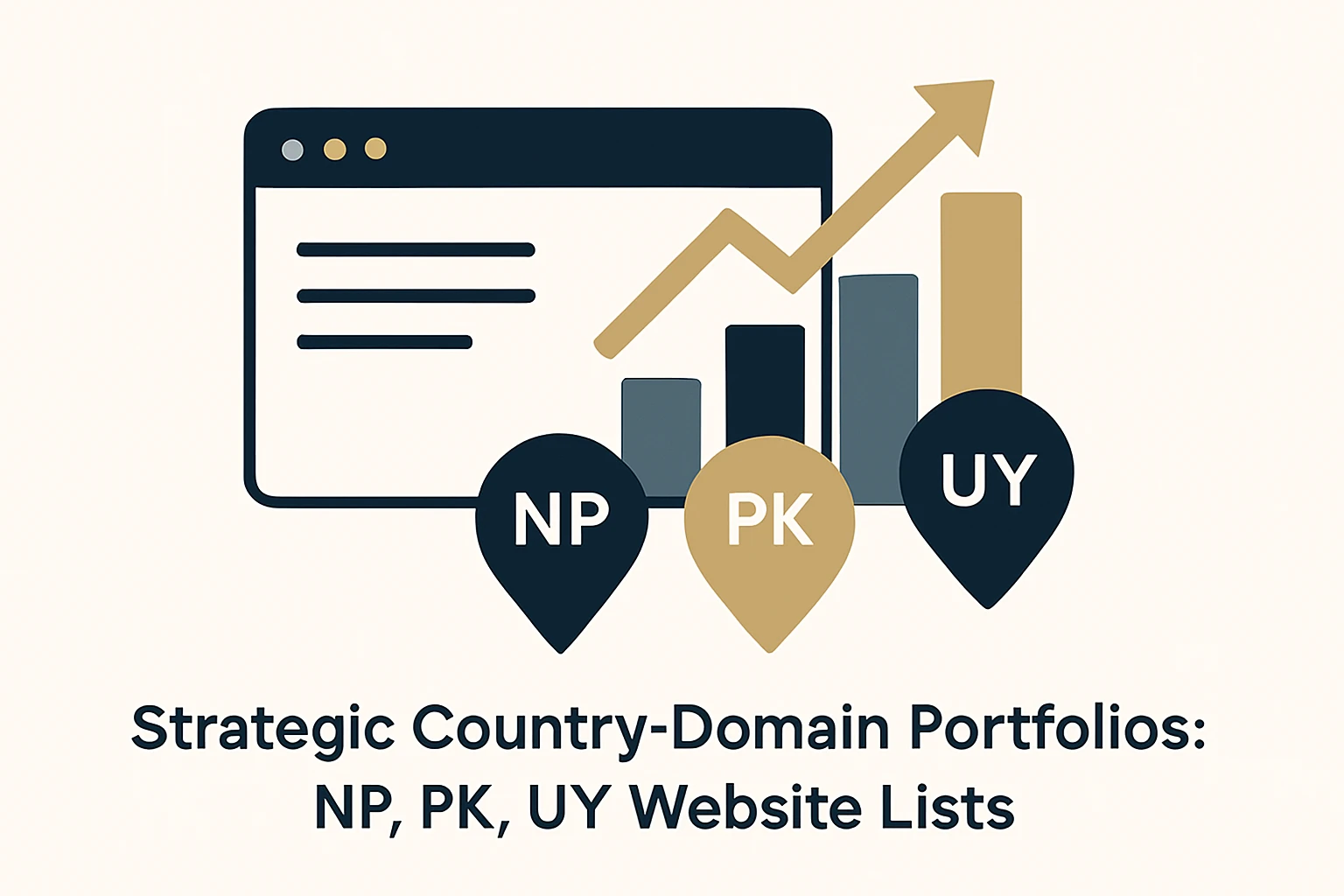
To translate that insight into action, this article outlines a practical workflow for sourcing downloadable NP (Nepal), PK (Pakistan), and UY (Uruguay) website lists, evaluating them for brand relevance, and integrating them into a resilient protective and growth program. The approach balances editorial rigor with real-world trade-offs, including data quality, regulatory considerations, and the tempo of market entry. ICANN ccTLD overview and policy guidance provides the governance backdrop for these decisions, while Verisign DNIB offers the empirical context on ccTLD volumes and dynamics.
Defining the scope: why Nepal, Pakistan, and Uruguay matter
Choosing NP, PK, and UY as focal points is not arbitrary. Each market presents distinct branding, regulatory, and consumer behavior profiles that can meaningfully influence domain strategy. In South Asia, Nepal’s developing e-commerce and tourism sectors create opportunities for localized campaigns that require credible local domains. In South Asia’s broader economy, Pakistan presents a large, youthful online audience and rising digital adoption, where local domains can bolster trust and SEO presence. In the Latin American corridor, Uruguay offers a smaller but highly digital-savvy market with a propensity for English and Spanish-language digital experiences. When combined with a robust portfolio framework, these markets illustrate how country-specific assets can slot into a global brand strategy without diluting central brand identity.
Data-driven due diligence matters here. The right NP, PK, or UY domains should meet not only branding criteria but also technical and legal criteria - ownership history, current registration status, and potential trademark conflicts. In practice, this means combining public-domain lists with verification steps such as RDAP and WHOIS checks. For organizations seeking a data-backed pathway, webatla offers country-specific domain landscapes and verification tools. See the Nepal-specific resource at webatla’s Nepal page for a concrete example of how a country view can feed into portfolio decisions, and explore their RDAP & WHOIS database for robust verification workflows.
Understanding the country-domain landscape: what actually matters
The field of country-code domains is not only about two-letter codes. It blends governance, market dynamics, and security considerations into a practical decision matrix. Here is how to think about it in a structured way.
Why ccTLDs influence local trust, branding, and search visibility
ccTLDs often convey local relevance more effectively than a generic gTLD. This can translate into higher local click-through rates and improved consumer perception, particularly in markets with strong regional preferences. In terms of scale, Verisign’s latest data show that ccTLD registrations worldwide remain sizable, reflecting ongoing local investment in digital presence.
From a governance standpoint, ccTLDs are managed by national registries under ICANN policy guidance, with a dedicated policy body (the ccNSO) playing a key role in harmonizing global standards while respecting local regulations. This dual dynamic - global governance and local administration - means that a country-domain strategy must be adaptable to both external policy shifts and internal brand goals. ICANN ccTLD overview describes the policy framework that shapes ccTLD operations, while ICANN’s IDN progress highlights illustrate how internationalized ccTLDs are evolving in multilingual markets.
Policy and governance: how rules shape risk and opportunity
ccTLDs sit at the intersection of local regulation and global Internet governance. The ccNSO and national registries set rules that can affect eligibility, renewal practices, and sunset policies for specific domains. For brand owners, this means monitoring policy developments that could affect future protection strategies or expansion timelines. A practical takeaway is to integrate governance awareness into the portfolio review cadence, so you don’t misread a registry change as a temporary market dip. The policy landscape is not static, but it tends to move with documented governance processes and stakeholder engagement. For governance context, see ICANN’s ccTLD policy materials and related guidance cited above.
Source lists and how to obtain NP, PK, UY website lists: a practical workflow
One of the core questions in a country-focused strategy is data quality: which NP, PK, and UY site lists are reliable for portfolio planning, due diligence, and risk assessment? A practical workflow combines credible public data with verification steps and brand risk screening. Below is a workflow you can adapt for a structured, repeatable process.
- Define the objective - Clarify whether the goal is brand protection, regional SEO intensity, or market-entry acceleration. This determines the depth of the list, the filters you apply (industry, site type, audience), and the cadence of updates.
- Source candidate lists - Start with credible country-level inventories and registries, plus third-party data providers that offer downloadable lists for NP, PK, and UY. While the exact sources vary, the aim is to assemble a comprehensive candidate set that you can screen for relevance and risk. Remember to respect data usage policies and privacy considerations when handling any bulk data.
- Verify with registration data - Use RDAP and WHOIS checks to confirm current ownership, DNS status, and registration timelines. This helps separate dormant domains from actively used ones and flags potential impersonation risk. webatla’s RDAP/WHOIS database is one example of a tool that supports this verification step. RDAP & WHOIS database
- Screen for brand and trademark risk - Run quick trademark clearance and brand-identity checks to identify conflicts. The risk-screen should be an automated or semi-automated step in your framework to avoid costly post-purchase disputes.
- Assess market relevance - Evaluate candidate sites against market indicators: local consumer behavior, language prevalence, and digital penetration. For example, Nepal’s growing e-commerce and touristic traffic suggests prioritizing local NP domains that support trust signals and local navigation.
- Prioritize and procure - Based on the risk, relevance, and cost, create a tiered purchase plan. Reserve a portion of budget for urgent acquisitions in hot markets while leaving room for ongoing protection of key assets.
- Monitor and govern - Establish a governance cadence that includes renewal monitoring, security checks (DNSSEC, HTTPS deployment), and a quarterly portfolio review. This helps sustain value over time and reduces the risk of accidental lapses in protection.
For practitioners who need a concrete country lens, webatla’s Nepal profile demonstrates how a country-centric view can be packaged for decision-makers. See webatla’s Nepal page for a local example and explore their broader data products like the RDAP & WHOIS database for verification workflows that can feed into your NP, PK, and UY lists.
A practical framework you can implement today
To operationalize the workflow above, consider the following framework, which is designed to be repeatable and auditable. This framework emphasizes governance, risk management, and a disciplined acquisition approach, rather than merely collecting domain names.
Framework: The G-DDDE model for country-domain discovery and evaluation
- Gather - Assemble candidate NP, PK, and UY domains from credible country inventories and data providers. Maintain a metadata catalog that captures ownership status, DNS records, renewal windows, and any observed brand risk signals.
- Diagnose - Filter for market relevance and risk. Prioritize domains that align with brand attributes, language coverage, and consumer behavior patterns in target markets. Use automated checks for common risk flags, such as look-alike spellings and impersonation risk identified during initial screening.
- Decide - Establish a decision rubric that weights strategic value (local presence, SEO potential) against risk (trademark conflicts, privacy concerns, regulatory constraints). Create a decision log to document rationales for acquisitions or declines.
- Deploy - Implement a provisional registration plan, monitor DNS health, and enforce security best practices (DNSSEC, HTTPS, two-factor access to registrars). Tie this to a governance calendar with renewal and risk review milestones.
- Evaluate - Periodically reassess the portfolio against business goals. Update the metadata, retire assets that no longer serve strategy, and reallocate budget to high-potential domains.
In practice, this framework helps prevent the most common mistakes in country-domain management (described in the next section) and keeps the portfolio aligned with evolving business priorities.
Limitations, trade-offs, and common mistakes
Anyone implementing a country-domain strategy will encounter constraints and potential missteps. Being explicit about these limitations helps teams set realistic expectations and avoid costly errors.
- Data quality risk - Not all downloadable NP PK UY lists are created equal. Some sources may have outdated ownership or DNS data. Always verify with live RDAP/WHOIS checks and choose data partners that offer ongoing updates and audit trails.
- Policy drift - ccTLD rules can shift as registries adjust terms or respond to regulatory changes. Maintain a governance cadence to detect policy shifts early and adjust acquisition strategies accordingly. For context on governance, see ICANN’s ccTLD policy materials.
- Cost versus value - A large portfolio may seem impressive, but many domains offer little incremental brand value. A tiered approach - protecting core assets while opportunistically monitoring others - often yields better risk-adjusted returns.
- Overfitting to a single market - Focusing exclusively on NP, PK, or UY can result in missed opportunities in adjacent markets or regional language variants. Use the framework to balance depth in a few core markets with breadth across a broader geographic footprint.
- Security and privacy pitfalls - Poor credential hygiene, weak registrar controls, or lack of DNSSEC can expose domains to hijacking or compromise. Align protection strategies with industry best practices and periodic security reviews.
Expert insight: governance and policy alignment with local market needs is a cornerstone of durable ccTLD strategy. Leading governance bodies emphasize ongoing stakeholder engagement and policy collaboration to ensure ccTLDs serve local digital ecosystems while maintaining global interoperability. See ICANN’s ccTLD governance materials for more detail.
Practical takeaway: a disciplined approach that couples credible data with rigorous verification and governance will outperform ad hoc acquisitions. The more your process foregrounds policy awareness and risk screening, the less exposed your brand will be to regulatory or reputational shocks.
Putting it into practice: linking the client data, the publisher’s platform, and your team
For teams or agencies pursuing a global brand strategy, a disciplined process must be codified into your workflow. The use of country-focused lists (NP, PK, UY) should be paired with a verification step and a governance plan that aligns with broader brand protection and digital asset advisory objectives. In this regard, webatla’s country pages and data resources illustrate a practical, market-aware approach to mapping digital assets by geography. For example, the Nepal page demonstrates how a country-centric view guides decision-making, while its RDAP/WHOIS database supports the verification workflow that keeps the portfolio authentic and auditable. Nepal country page
If you need a centralized verification tool, the RDAP & WHOIS database is a logical place to start: RDAP & WHOIS database. For broader country coverage and a sense of how NP, PK, and UY assets fit into a larger global landscape, explore the country lists at webatla Countries.
Conclusion: a disciplined, data-driven path to durable brand presence
Building a strategic country-domain portfolio is less about amassing names and more about aligning digital real estate with brand strategy, risk management, and governance. By combining credible data sources, rigorous verification, and a clear framework for decision-making, organizations can create a resilient digital asset portfolio that supports local engagement without sacrificing global coherence. The NP, PK, and UY markets illustrate how country-domain assets can be integral to regional growth while playing a supporting role in the overall brand architecture. For practitioners seeking to operationalize this approach, a combination of governance-driven processes, expert data resources, and careful supplier partnerships will yield durable value that extends beyond mere ownership of domain names.
As governance and data integrity continue to evolve in the ccTLD space, the best practice is to maintain a living framework - one that tracks policy developments, market indicators, and the performance of individual assets. That is the core of brand protection domains and digital asset advisory in a modern, global context. If you are looking for practical tools to support this, consider pairing your internal process with targeted country data feeds and verification workflows like the ones webatla and similar data providers offer.