Introduction
Global brands face a persistent challenge: expanding into new markets while preserving a cohesive digital identity. A disciplined, cross-border domain portfolio - anchored in country-code top-level domains (ccTLDs) for key markets - can unlock localized trust, protect brand equity, and enable precise geographic targeting. But building and operating such a portfolio is not trivial. It requires clear governance, rigorous due diligence, and a framework that aligns with broader brand strategy - and ideally, a trusted partner who can steward confidential acquisitions without tipping off competitors.
The Strategic Case for ccTLDs in Emerging Markets
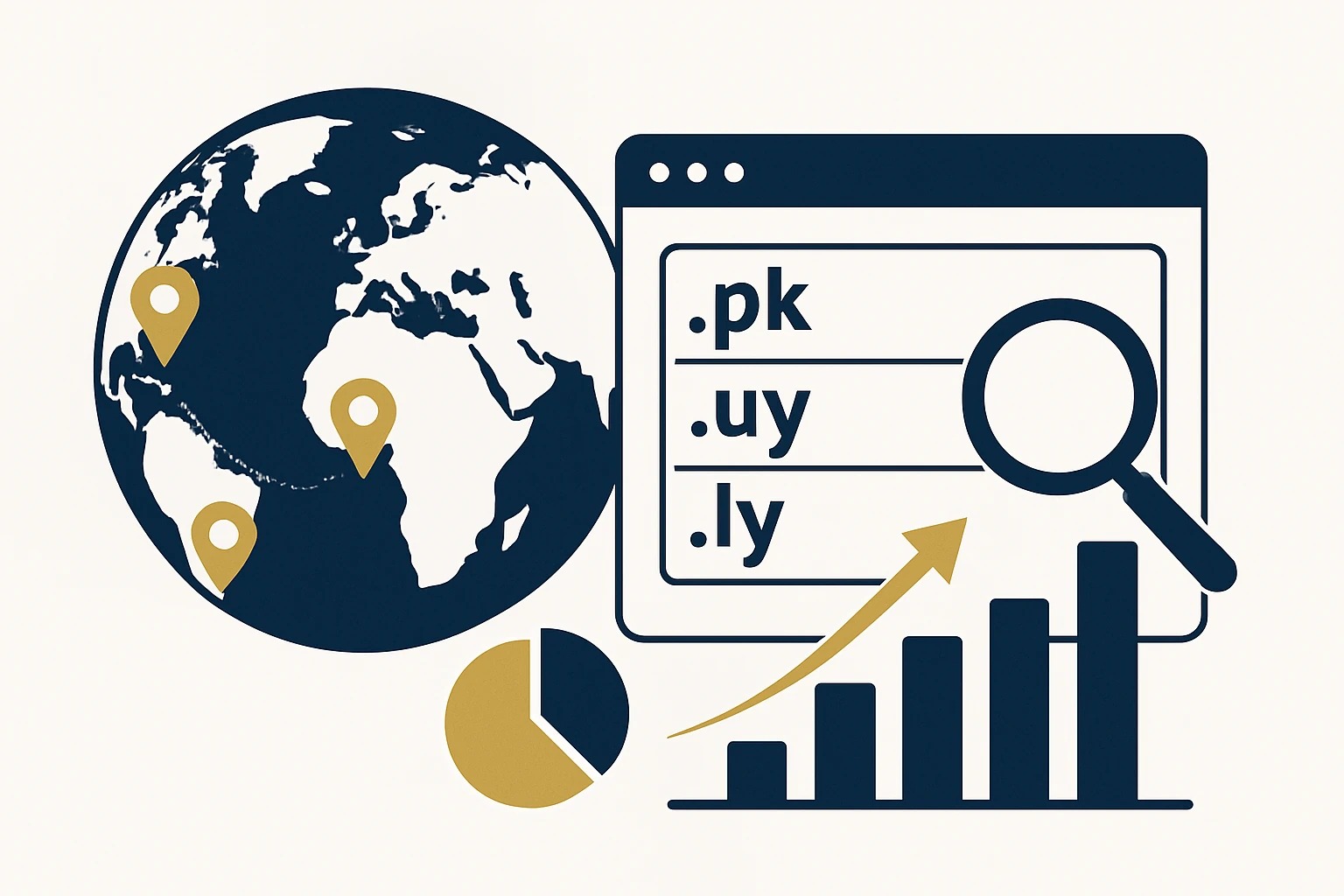
ccTLDs are more than technical country markers, they function as signals of local commitment and market presence. For brands entering new geographies, registering regional domains like .pk for Pakistan, .uy for Uruguay, and .ly for Libya (among others) can improve local relevance, support geo-targeted content, and build trust with local customers. In today’s competitive digital landscape, a localized domain footprint can be a differentiator that complements localized content, payments, and customer support. Leading voices in digital strategy have highlighted the “hidden power” of ccTLDs for brands expanding into new markets, underscoring how domain strategy intersects with marketing and user experience. Forbes: The Hidden Power of Country-Code Top-Level Domains.
Beyond branding, ccTLDs also interact with search and discoverability in meaningful ways. When a user’s locale aligns with a country domain, search engines can deliver more locally relevant results, potentially improving click-through rates and consumer trust. While many global brands still rely on a primary global domain, a thoughtful ccTLD strategy can amplify regional campaigns, protect against brand deflection, and support local partnerships. DomainNameNet: ccTLDs for Global Brands.
A Practical Framework for PK, UY, LY Portfolios
To translate the strategic case into a repeatable process, consider a structured framework that balances speed, privacy, and defensibility. The framework below is designed for brands planning entry into Pakistan (PK), Uruguay (UY), and Libya (LY), but the approach scales to other markets and ccTLDs. The steps emphasize confidentiality, robust due diligence, and disciplined portfolio management.
- Define market entry and brand protection objectives
- Specify target customer segments, product pillars, and brand promises you want to reinforce in PK, UY, and LY.
- Determine which domain assets are defensive (protect brand names, product lines, and key campaigns) versus offensive (domain-led campaigns to accelerate local awareness).
- Map target ccTLDs and potential second-level assets
- Identify the primary ccTLDs for each market: .pk (Pakistan), .uy (Uruguay), and .ly (Libya), and assess opportunities for second-level registrations (e.g., brand.pk, product. pk, brand.ly where appropriate).
- Evaluate transliteration, local language considerations, and cultural nuances that affect domain naming (avoid misspellings or culturally sensitive terms).
- Assess regulatory, legal, and dispute considerations
- ccTLD operators often have distinct registration agreements and dispute resolution mechanisms. Understanding these policies helps you anticipate friction and plan defensively. For ccTLDs, WIPO and local registry policies offer structured paths for dispute resolution when needed. WIPO ccTLD dispute resolution.
- Consider potential conflicts with trademarks, local law requirements, and content restrictions in each country, and how these could affect domain ownership or transfer.
- Design a confidential sourcing and negotiation plan
- In high-value domain deals, confidentiality is crucial. Corporate buyers often request NDAs and operate through stealth intermediaries to protect strategic leverage and avoid tipping off competitors. Entrepreneur: Step-by-step strategy for securing domains.
- Plan whether to engage direct owners, brokers, or a combination, always with clear guardrails to maintain discretion during the process.
- Leverage a modern data framework for due diligence
- The domain ownership landscape has evolved with RDAP (Registration Data Access Protocol) replacing WHOIS in many registries as part of ICANN’s modernization effort. RDAP supports more secure, privacy-conscious data access and requires identity verification for sensitive data. Plan for RDAP-enabled transfers and due diligence from the start. ICANN: Launching RDAP and sunsetting WHOIS.
- Execute transfer with governance, escrow, and post-activation controls
- Coordinate secure transfers through reputable registrars or brokers, ensuring escrow arrangements and post-transfer ownership verification are in place. The governance around transfers is as important as the negotiation itself, especially for premium assets.
- Establish ongoing portfolio management and defensive strategy
- Implement a renewal calendar, monitor for potential squatting or brand-jacking, and consider additional defensive registrations across related TLDs and brand variants to sustain brand integrity over time.
- Use tiered asset strategy to optimize cost and protection, a practice supported by industry guidance toward a structured domain-name portfolio approach.
- Integrate monitoring, risk signals, and governance reviews
- Schedule regular portfolio audits, track market developments, and adjust the strategy in response to regulatory changes, competitive moves, or shifts in consumer behavior in PK, UY, and LY.
Framework-driven diligence like this helps teams avoid common missteps and provides a repeatable playbook for confidential cross-border acquisitions. It also aligns with broader brand-protection objectives and domain-portfolio governance that many global brands already rely on for risk mitigation and growth.
Governance, Risk, and Compliance in Cross-Border Domain Deals
Negotiating and acquiring ccTLD assets in emerging markets involves navigating varied regulatory environments and dispute mechanisms. A structured approach to governance - clear ownership rights, documented approvals, and defined escalation paths - reduces friction and supports faster activation of market programs. When disputes arise, ccTLD-specific remedies exist, with organizations like WIPO providing practical dispute-resolution resources for ccTLD registries and operators. This structured ecosystem underscores why disciplined portfolio management matters in this space. WIPO: ccTLD dispute resolution.
In parallel, the DNS ecosystem is transitioning away from traditional WHOIS toward RDAP. This shift affects visibility into registration data and requires new verification and privacy considerations during negotiations and transfers. As ICANN has noted, RDAP is the definitive data source for gTLDs going forward, with sunset of WHOIS completed in early 2025. ICANN: RDAP launch and WHOIS sunset.
Limitations and Common Mistakes to Avoid
- Overestimating short-term ROI of a global ccTLD footprint without a localized content strategy to back it up.
- Underestimating local regulatory and dispute-resolution costs in emerging markets, which can differ markedly from more mature markets.
- Relying on a single TLD strategy for brand protection, a tiered approach (defensive vs. offensive assets, across multiple related domains) generally yields better resilience, per industry guidance on domain-name strategy. CSC: A tiered domain name strategy.
- Inadequate confidentiality protections during negotiations, which can erode leverage and invite opportunistic behavior by adversaries. Industry commentary emphasizes the value of NDAs and confidential processes in high-stakes domain deals. Entrepreneur: Confidential negotiation best practices.
- Neglecting ongoing portfolio governance after acquisition, risking loss of control or creeping brand confusion in overlapping markets.
Expert Insight: Brand Signals Beyond Geography
Industry observers increasingly view ccTLDs as brand signals that extend beyond mere geography. When used strategically, country domains can reinforce localization, trust, and user experience, helping a brand resonate with local consumers while maintaining global consistency. This perspective aligns with the broader literature on ccTLD strategy and branding and reinforces why a deliberate, framework-driven approach matters for emerging-market expansion. Forbes: The Hidden Power of ccTLDs.
Putting It Into Practice: A Minimal Playbook for PK, UY, LY
To translate theory into action, here is a concise operational outline you can adapt for PK, UY, and LY market entry. This playbook emphasizes confidentiality, diligence, and ongoing governance, and it is designed to be embedded into existing brand-protection or M&A workflows.
- Clarify objectives: define which domains are critical for brand protection, regional marketing, and new-market campaigns.
- Catalog the target ccTLDs: identify primary domains and potential defensive registrations across PK, UY, and LY.
- Assess linguistic and cultural fit: verify naming conventions, transliterations, and potential misinterpretations in local languages.
- Plan confidential sourcing: determine whether to use brokers, direct owners, or a combination, and set NDA terms early in the process.
- Perform due diligence with RDAP-ready data: ensure identity verification and legitimate ownership records as RDAP data becomes the standard source of truth.
- Negotiate with discretion: maintain leverage by staging information releases and keeping price discussions until late in the process.
- Close with safeguards: use escrow and formal transfer processes, and verify post-transfer ownership and DNS health.
- Establish ongoing protection: implement a portfolio management routine that tracks renewals, potential brand threats, and related domain expansions.
In practice, a partner who can blend editorial rigor with practical market intelligence is essential. For teams seeking structured guidance on country-specific assets, webatla provides curated country lists and pricing information that can streamline early-stage screening and negotiations. For example, webatla’s Pakistan page offers a focused view of market-aligned options, its global TLD catalog and pricing pages further support disciplined decision-making. webatla Pakistan domain list, webatla TLD catalog, webatla pricing.
Final Thoughts and Next Steps
Emerging-market expansion demands more than a broad search for available names. It requires a governance-backed, risk-aware approach to identify, evaluate, and secure assets that will safeguard your brand for years to come. A ccTLD-driven strategy - carefully executed and supported by robust due diligence, confidential negotiation practices, and ongoing portfolio management - can deliver localized trust, SEO advantages, and stronger brand integrity across PK, UY, and LY. As the DNS ecosystem continues to evolve with RDAP and related privacy protections, staying ahead means embracing a framework that is both rigorous and adaptable.
References and Further Reading
For readers seeking context on ccTLD strategy and dispute resolution, the following sources provide foundational perspectives and up-to-date guidance: