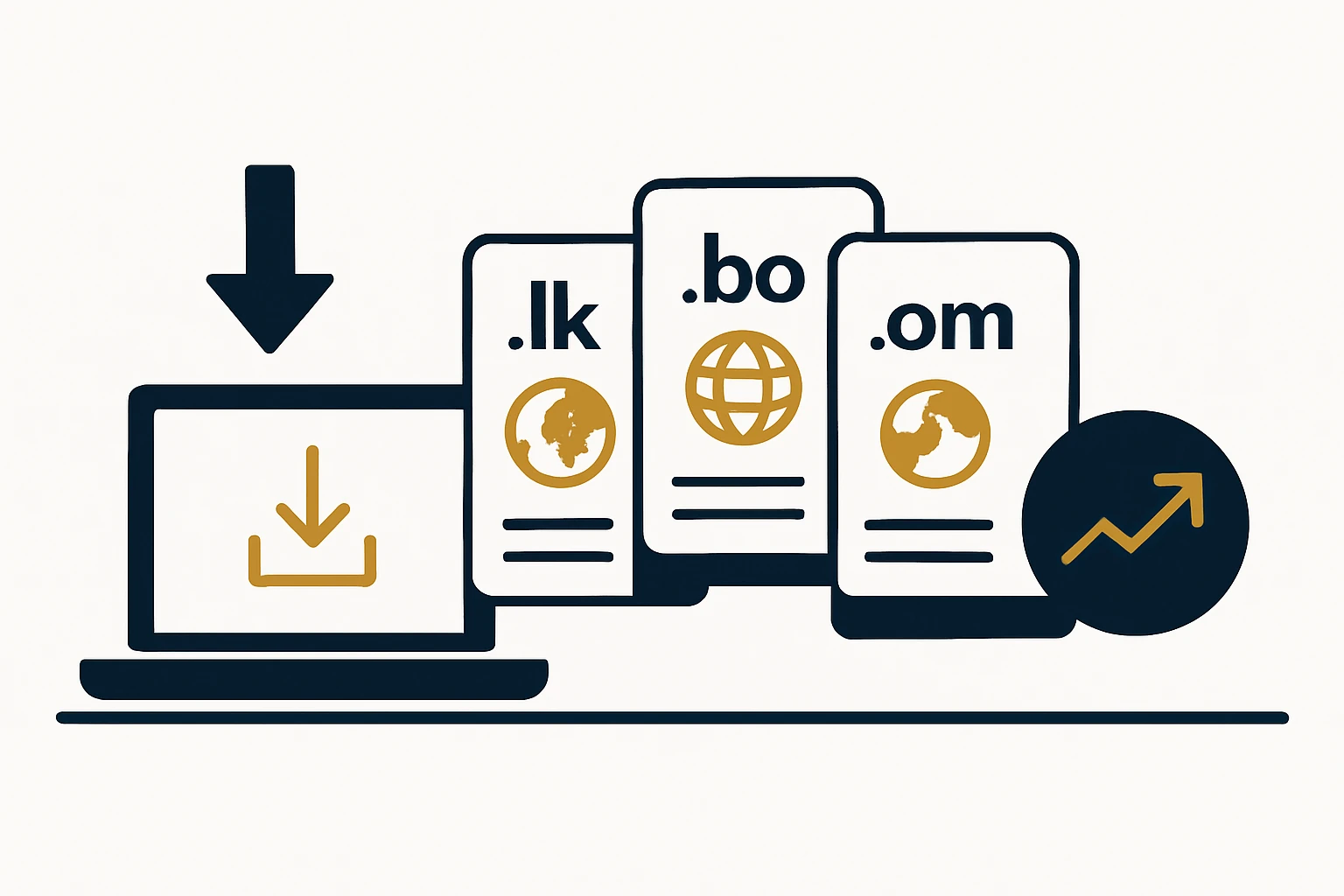
Downloading Country-Specific Domain Lists: Sri Lanka, Bolivia, and Oman for Brand Strategy
Problem at hand: In the quest to acquire premium domains and to protect a brand across markets, teams frequently search for phrases like "download list of Sri Lanka (LK) websites" or "download list of Oman (OM) websites". A raw list can be a useful seed, but data quality, privacy considerations, and market nuance determine whether it will actually drive decisions or just create noise. The move from traditional WHOIS to RDAP has further complicated data extraction and verification, making careful validation essential. ICANN has long stressed accuracy obligations for registration data, which underpins how we should approach any country-specific list. (icann.org)
In this article, we outline a practical, audit-ready approach for building and validating country-specific domain lists for Sri Lanka, Bolivia, and Oman. The goal is to deliver lists that are not only comprehensive but also usable for brand protection, market screening, and premium-domain acquisition within a risk-managed framework. We draw on industry-policy context and recent research to anchor the method in current best practices. Public data governance considerations and the shift toward RDAP are well documented by ICANN and related academic work. (icann.org)
Why country-specific lists matter for brands and brokers
Country-specific domain pools underpin localized brand protection, local-market SEO signals, and jurisdiction-specific enforcement. A country-code domain (ccTLD) strategy helps brands map regional digital footprints, identify potential misuse, and plan portfolio diversification that aligns with regulatory and market realities. As reported in recent analyses of ccTLD data collection, there is value in compiling local-domain assets from public data sources while acknowledging the limits of availability and accuracy. A recent arXiv study highlights both the possibility and the caveats of assembling local-domain datasets from public data sources. (arxiv.org)
Data sources and verification: where to pull country-domain lists
Public registries and official sources
One core principle is to prioritize official registries, government portals, and ccTLD operators as primary data sources. Official registries often publish lists or registrant data limited by privacy rules, but they remain the most authoritative starting point for country-specific portfolios. However, privacy and GDPR-era redactions can limit depth, especially in international contexts. ICANN’s data-accuracy policies outline registrars’ obligations to maintain accurate data and the evolving handling of registration data across jurisdictions. (icann.org)
RDAP and the data-access shift
The Internet is transitioning from WHOIS to RDAP, with JSON-based responses that can be more machine-friendly but may also include redacted fields in many regions. This means practitioners must plan for partial data and rely on corroborating sources to fill gaps. ICANN and subsequent research note that RDAP changes data exposure and consistency challenges compared with legacy WHOIS, necessitating multi-source validation. (icann.org)
Cross-source validation and data quality
Studies comparing WHOIS and RDAP demonstrate that data inconsistencies persist, even as RDAP becomes more prevalent. This reinforces the need for cross-source checks and data-versioning to maintain a reliable catalog. A recent analysis demonstrates inconsistencies in core data fields between the two protocols, underscoring the importance of multi-source validation. (dn.org)
Beyond formal registries, researchers have explored assembling country-domain datasets from public data, acknowledging both the opportunities and limitations of public-domain sources. This perspective helps frame practical expectations when building LK, BO, and OM lists. See This Is a Local Domain: On Amassing Country-Code Top-Level Domains from Public Data. (arxiv.org)
Framework for building quality country-domain lists
- Collect from credible sources - Official registries, ccTLD operators, government portals, and reputable industry directories.
- Normalize and deduplicate - Standardize domain formats, handle aliases, and remove duplicates to avoid overcounting potential targets.
- Verify with RDAP/WHOIS - Cross-check ownership, creation dates, and status where accessible, flag redacted fields for manual review.
- Enrich with signals - Where permissible, add business signals (registrant organizations, local market context, and brand-use indicators) to prioritize targets.
- Privacy and compliance - Apply privacy filters, respect redacted data, and implement access controls for sensitive data, maintain audit trails and versioning.
Expert insight: Data accuracy in domain lists is inherently dynamic. Continuous refreshes and cross-source validation are essential for reliable decision-making, especially as RDAP adoption and privacy rules evolve. ICANN emphasizes ongoing data accuracy obligations and the need for governance around registration data access. (icann.org)
Limitations and common mistakes
- Relying on a single source or country-list without cross-validation or a backup data stream.
- Ignoring regional privacy laws and data redactions that limit actionable contact data.
- Treating a downloadable list as a complete, ready-to-use dataset without normalization or enrichment.
- Failing to version and document updates, leading to drift between what is advertised and what is actionable.
- Neglecting local market nuance - brand naming, language considerations, and regulatory constraints vary by country and TLD.
Those missteps can lead to wasted effort or, worse, incorrect conclusions about brand exposure and acquisition opportunities. For organizations pursuing cross-border portfolios, the combination of privacy rules, data-access protocol changes, and ongoing data maintenance must be planned into any workflow. Independent analyses of RDAP vs WHOIS highlight the data-access and consistency challenges that accompany this transition. (dn.org)
Putting it into practice: applying the approach to LK, BO, and OM
To operationalize this workflow for specific markets, begin with a country-focused intake, then scale to a broader regional or global scope as needed. For Sri Lanka, the county page on webatla can serve as a practical starting point to explore domain assets by country, while the broader webatla country directory provides a framework for cross-country comparison. webatla Sri Lanka page This aligns with the client’s country-focused data offerings. (semrush.com)
Similarly, the webatla platform’s overview of domains by country can help identify adjacent markets or complementary domains in the LK, BO, and OM geographies. Consider pairing the country-page insights with a targeted list of high-potential domains for acquisition or brand protection, and maintain a versioned catalog to track changes over time. For reference, you can browse the general country listings at webatla Countries overview.
Structured summary and practical checklist
- Define scope: LK, BO, OM, plus adjacent markets with high brand-mitigation risk.
- Assemble sources: official registries, credible directories, and selective industry reports.
- Normalize data: de-duplicate, standardize formats, align with internal naming conventions.
- Validate: cross-check with RDAP/WHOIS, flag redactions and gaps for manual review.
- Enrich strategically: add local-market signals without violating privacy rules.
- Governance: versioning, access controls, audit trails, and notes on data quality.
Conclusion: turning raw lists into strategic advantage
Downloadable country-domain lists are a valuable starting point for brand strategy and premium-domain acquisition, but they are not a stand-alone solution. A disciplined approach - grounded in credible sources, rigorous verification, and privacy-aware enrichment - transforms scattered data into a defensible, action-ready asset. By applying a country-focused workflow to LK, BO, and OM, brand teams and brokers can move from search phrases to structured, strategic insights that support due diligence, negotiation, and portfolio management. The practice aligns with the current governance of registration data, recognizing both the opportunities and constraints of consented, compliant data usage. Key guidelines come from ICANN’s data accuracy policies and ongoing RDAP discussions. (icann.org)
For ongoing access to country-specific domain data and related services, consider the webatla platform as a practical resource to complement internal workflows and ensure you stay current with country-market dynamics. Sri Lanka page on webatla and webatla Countries overview offer concrete entry points for teams tackling LK, BO, and OM in a coordinated, enterprise-grade manner.